by David Steven | Apr 25, 2008 | Cooperation and coherence, Economics and development, UK
Nice to see an integrated approach to UK operations in Afghanistan…
When I asked the men of 3 Para what their first tour had achieved, they all fell silent. “It was very frustrating,” said [Major Paul] Blair. He believes that his men could have achieved something in the town of Gereshk, where they were first based, had they been given the funds and authority.
“I kept having meetings with local officials saying we were there to bring security and reconstruction. I’d say the same thing week after week, but then never deliver more than school packs. I felt I was giving them false promises,” he said.
He recalled visiting the local hospital, where the bedding was “filthy”, and coming across a washing machine donated by a US charity that was still in its plastic wrapping. It could not be plumbed in because there was no water supply.
Blair suggested sinking a well but the Department for International Development said that this could be done only by civilians. Because of the security problems, no aid agency had been in the area for years. “Fora couple of hundred bucks,” said Blair, “we could have given them something they could have used there and then – but we weren’t allowed to.”
by Daniel Korski | Apr 25, 2008 | Conflict and security, North America
Yesterday, Congress heard testimony from James Locher III – the head of the Project on National Security Reform and the organisational genius behind the 1986 Goldwater-Nichol defence reforms that put the “joint” into the Joint Chiefs of Staff and later the Cohen-Nunn Amendment, which created the U.S. Special Operations Command.
Bringing together an impressive array of experts from inside government and from both parties, PNSR is trying nothing less than to redesign the U.S national security system.
Speaking with Joseph Nye (Mr. Soft Power), and Richard Armitage, Colin Powell’s muscle-clad former deputy, Locher laid out the case for reform:
Since the beginning of the 21st Century, the United States has suffered a number of painful setbacks: the terrorist attacks of September 11, troubled stability operations in Iraq and Afghanistan, and inadequate response to Hurricane Katrina.
These setbacks are not coincidental; they are evidence of a system failure. Our national security system is not capable of handling the threats and challenges or exploiting the opportunities that confront us in today’s complex, fast-paced, information-age world.
These deficiencies are not about the lack of talent or commitment by our national security professionals in all departments and agencies. They are working incredibly hard and with unsurpassed dedication. In many cases, they are being crushed by their workload. The problem is that much of their hard work is wasted by a dysfunctional system.
What to do about it? The U.S needs “a 21st Century government for 21st Century challenges.” In Locher’s mind that means three sets of reforms. First, new presidential directives governing the operation of the national security system will be required. The second, a new national security act, replacing many provisions of the 1947 Act. And third, amendments to Senate and House rules to bring about necessary congressional reforms and the creation of Select Committees on Interagency Affairs in the Senate and House of Representatives.
Look out for Locher’s interim report produced on July 1 and his final report on September 1, as required in the National Defense Authorization Act for FY2008.
by Daniel Korski | Apr 23, 2008 | Conflict and security, Influence and networks, Middle East and North Africa
Today American Defence Secretary Robert Gates recommended that General David Petraeus be appointed head of US Central Command. Until Admiral William Fallon was sacked earlier in the year, the idea had been for General Petraeus to replace General John Craddock as Supreme Allied Commander and help fix the failing mission in Afghanistan, especially after Paddy Ashdown was nixed as UN chief by the Afghan government.
But with Fallon gone and things not altogether stable in Iraq, Afghanistan will have to wait. In Petraeus’ place will be Lt. General Ray Odierno, a mountain-like soldier who served as Petraeus’ no. 2 in Iraq until he was made Deputy Chief of the Army. The top military slot in Iraq had been rumoured to be reserved for Pete Chiarelli, Robert Gates’ Military Adviser, who was described to me as “possessing Petraeus’ intellect but none of his ego.”
In many ways, Petraeus’ move is an obvious one. Nobody knows the Iraq campaign better than Petraeus and the relationship with Odierno has worked before. Paradoxically, it may help restore the formal chain of command, which sees the Iraq commander reporting to the Centcom commander and then to the President (through the SecDef). This chain was famously disrupted because of the close link between President Bush and General Petraeus, which probably caused much of Fallon’s frustration. But will Odierno be given the freedom Petraeus himself had?
What of the persistent rumours that Petraeus will one day enter the political arena? Well, in Flordia he is closer to Washington (and the TV networks). If John McCain wins in November, he’d be a shoe-in for Chairman of the Joint Chiefs. But perhaps the sheen will come off him when he is no longer the sand-covered field commander and everyone will be pilgrimaging to Baghdad to see Odierno. The real loser would seem to be NATO’s Afghan campaign, which would have benefitted from Petraeus’ skills. As Centcom commander he will still oversee the U.S-led, CT-focused Operation Enduring Freedom mission. But the military centre of gravity in Afghanistan is the NATO mission as it’s hard to see how Petraeus can now work his magic from Tampa, Florida.
by Alex Evans | Apr 22, 2008 | Conflict and security, Middle East and North Africa, South Asia
Barney Rubin has an excellent post updating on latest developments in Pakistan’s federally administered tribal areas. Start, he says, from a clear recognition of one thing at least: the US has no plan. Here’s a graph from the US Government’s General Accountability Office which proves the point:
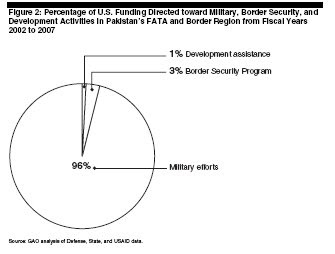
Note especially the amount being allocated to political reform, he says: 0%. Meanwhile, Khalid Aziz – the former chief secretary of NWFP – has been doing some serious strategising about what needs to happen next (in the wake of Pakistan’s elections – which as the BBC put it “saw an overwhelming vote for parties that advocate secularism, or the separation of religion from politics” in the NWFP). Aziz writes:
…the Feb 18 election has clearly indicated that the people of Pakistan voted against militarism and violence. The Taliban recognise that resort to force alone will not lead to the achievement of their main political objective which is the creation of an Islamist Caliphate.
However, while everyone waits for good sense to prevail, there may be forces amongst the non-state fighters planning another strike in the West. If that happens, one may be certain of an air war in FATA and this could lead to incalculable harm to Pakistan. This in a nutshell is the danger surrounding the process of talks. . . .
Many conservative Pakhtuns believe that the fighting in Swat, Kohat and Waziristan is a war of liberation against US occupation of Afghanistan; they fight the Pakistani state because of its alliance with the US. However, it does not make it a US war alone. Whatever may be the case at the start, this is now Pakistan’s war, since the objective of the insurgents is to change the nature of the Pakistani state. To fellow Pakistanis I would say that it is our war, whether we like it or not.
Compare that, Rubin says, to Musharraf – with whom “all negotiations with militants… had as their aim to balance the imperative of acting against al–Qaida with that of saving the Taliban as a strategic asset for Pakistan”. His conclusion:
We now have a full partner in Pakistan, elected, ironically enough, by Pakistani voters angry at what the GAO calls the “lack of a comprehensive plan,” rather than just a military approach. It is indeed time to “sit down and think through what we can collectively do” with these partners.
by Alex Evans | Mar 31, 2008 | Conflict and security, Middle East and North Africa, South Asia
Barney Rubin does know how to start a blog post:
Last week I was at a meeting in Madrid to discuss a “Political Solution” to the conflict in Afghanistan. Among the topics discussed was prospects for talking to the Taliban. I was surprised, however, at how literally some of the participants seemed to take it. One of my friends was interrupted over tea by a call from a Taliban commander in southern Afghanistan who was trying to figure out who was behind an incident in which some of his men were killed by a remote-controlled mine.
