by Charlie Edwards | May 14, 2008 | Global system, Influence and networks, UK
Tomorrow the Serious Organised Crime Agency (SOCA) will publish its annual report/ threat assessment. It will make for uncomfortable reading at the Home Office and No.10. The Agency is not living up to the great expectations officials placed upon it in 2006. In the febrile political atmosphere of Westminster you can be sure the Conservative and Lib Dems will want to scrutinize the organisation’s failings and the Government’s wider policy on organised crime (ironically called One Step Ahead). Failure to lower crime is still the political weapon of choice.
For a sense of what is to come its worth reading the transcript from Stephen Lander’s (former DG Security Service) and William (Bill) Hughes’ first visit to the Home Affairs select committee. But first the facts:
By the most conservative estimates, money laundering comprises between two and five percent of global gross domestic product (GDP).
The UNODC, roughly estimates that organised crime costs the global economy up to $1 trillion per year
In 2005, the UNODC estimated the global narcotics market at $322 billion—equivalent to a GDP ranking of roughly 30th in the world, measured against national economies, and roughly 75 percent of the total GDP of Sub-Saharan Africa
There has been a rapid expansion in the black market in counterfeit goods—now worth an estimated $400-$600 billion per year (before you stifle a yawn this includes parts for cars and areoplanes)
Preliminary research conducted by the Home Office into the economic cost of organised crime and estimated that the price could be as high as £40 billion a year – the abuse of Class A drugs estimated at £13 billion a year ‘at a highly conservative estimate’
These are serious numbers and show how big a business organised crime is. More than that it shows how organised crime acts as a cancer on society. But irrespective of how great the risk from organised crime is, the UK Government is in no position to do anything. SOCA’s budget has been frozen, resources and capabilities have been shifted elsewhere in Government to countering terorrism and enlarging the Intelligence agecnies; the MoD is focused on operational issues in Afghanistan and Iraq while the FCO recently dropped organised crime off its list of priorities. SOCA has become the orphan of Whitehall. A change of approach is needed.
by Charlie Edwards | May 13, 2008 | Climate and resource scarcity, Conflict and security
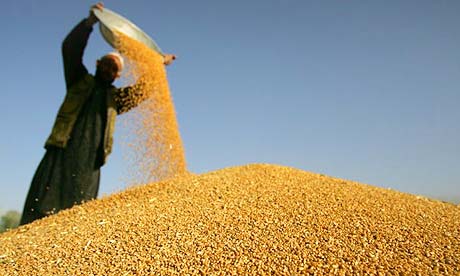
Is the global economic situation having an impact on poppy eradication in Afghanistan? Afghan farmers are capitalising on soaring food costs by growing wheat instead of poppy crops, with the fall in heroin prices further fuelling the switch. This comes at a time when the price of a tonne of wheat in Afghanistan has almost trebled this year, causing acute food shortages.
This may be the case in some regions, but Helmand may be off limits because of instability while some farmers may be put off by difficulties in getting their crops to market as roads are dangerous with bandits roaming the countryside.
by Daniel Korski | Apr 30, 2008 | Conflict and security, South Asia
Prince William, the second in line to the British throne, just finished a trip to Afghanistan, which probably happened at the same time as Taliban gunmen failed to kill Afghan President Hamid Karzai and a slew of international officials.
Despite Prince William’s safe return and President Karzai’s lucky escape, it should be clear to anyone that things are not going particularly well for NATO’s Afghan mission.
All is not lost, but it could be unless there is a change of strategy. What should such a change entail?
(more…)
by Charlie Edwards | Apr 30, 2008 | Conflict and security
Asks William Saletan over on Slate. Actually he raises a number of questions about whether suicide bombings are increasing around the world, why they might be and if so what can we do about it. The stats are revealing. According to
an article by Robin Wright of the Washington Post last week:
Suicide bombers conducted 658 attacks around the world last year … more than double the number in any of the past 25 years … More than four-fifths of the suicide bombings over that period have occurred in the past seven years, the data show. The bombings have spread to dozens of countries on five continents, killed more than 21,350 people and injured about 50,000 since 1983 … [S]ince 1983, bombers in more than 50 groups from Argentina to Algeria, Croatia to China and India to Indonesia have adapted car bombs to make explosive belts, vests, toys, motorcycles, bikes, boats, backpacks and false-pregnancy stomachs. Of 1,840 incidents in the past 25 years, more than 86 percent have occurred since 2001, and the highest annual numbers have occurred in the past four years.
(more…)
by Daniel Korski | Apr 29, 2008 | Conflict and security, Economics and development, UK
Despite having practically invented modern counter-insurgency, today Britain is woefully ill-equipped for this kind of complex, mosaic-style warfare. The Times, echoing David’s post from a few days ago, has picked up on the problems Britain has in spending money in places like Afghanistan.
As readers will know, even though the Labour government sought to overcome the problems of “departmentalism” in 1997 with the promotion of “joined-up” government and the creation of cross-departmental funding mechanisms, through the Global Conflict Pools, one of its main innovations – the creation of a stand-alone Department for International Development – militated against the kind of close civil-military cooperation necessary in post-conflict operations.
This stands in sharp contrast to the U.S, which – led by David Petraeus and his band of “neo-coins” – has revamped its approach entirely.
How to solve the problem in Britain is contentious issue, which I debated on the Guardian website a few weeks ago (see here and here).
The only way to resolve it is to rewrite the International Development Act. Yes, I know that the Act itself does not prevent DfiD from spending funds, but it creates a cultural ethos inside the department, which militates again the necessary kind of flexibility and cooperative links with the military.
(more…)
