Progressive Governance talk
Below the jump, Alex and my talk at last weekend’s Progressive Governance summit – it’s a four minute summary of our paper on multilateralism and global risks. (more…)

Below the jump, Alex and my talk at last weekend’s Progressive Governance summit – it’s a four minute summary of our paper on multilateralism and global risks. (more…)
On Saturday, Alex and I presented our paper on multilateralism and global risks to heads of state at the Progressive Governance Summit, which was chaired by Gordon Brown.
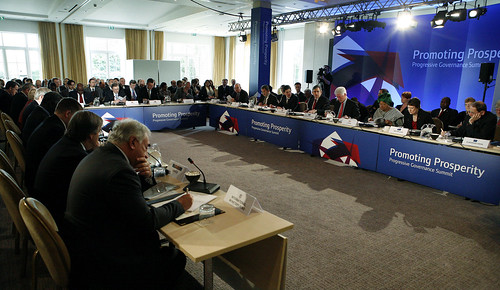
The summit was held at the Grove Hotel in Watford – which is more used to hosting the England football team and posh weddings. Locals – who were warned they would be searched before entering the hotel’s spa – seemed less than impressed at the interruption, though a few did manage to sneak in for a round of golf (though perhaps they were snipers in disguise).
And inside? We got a nice plug from Helen Clark, New Zealand’s PM, and from Africa’s first elected female head of state, Ellen Johnson-Sirleaf. Bill Clinton was also lucky enough to be collared by Global Dashboard’s Charlie Edwards on his way back from the lav, which I am sure was a highlight for both of them.
In discussion, two topics predominated. First, the global financial meltdown, with Kevin Rudd (surely the wonkiest head of state ever) fretting that ‘technology has got ahead of the regulatory environment,’ or in other words, men with computers are doing stuff with money that no-one, including the men themselves, really understands or can control.
A few leaders, Austria’s Alfred Gusenbauer among them, were calling for a World Finance Organisation to be created as an institutional big brother to the WTO (can you imagine the protests outside a WFO annual meeting?). But most were happy to settle for a revamped IMF to act as an ‘early warning system’ and for rapid action to, in the words of the head of the IMF, “disentangle the good and the bad banks”.
A global trade deal was also seen as a vital part of restoring confidence, with the WTO’s Pascal Lamy making it sound as if the conclusion of a ‘strong pro-development, pro-growth round’ was just around the corner. Peter Mandelson, who leads on trade for the Europeans, was a little less bullish, I thought.
Mandelson agreed that ‘night and day drilling’ into the detail of a proposed agreement was yielding results, but he argued that any further delay could be fatal for a deal. 2009 should be written-off, he said, due to a changing of the guard in the US in the first half of the year and in the European Commission in the second. Any agreement would have ‘turned to mush’ by 2010, he concluded.
It was a provocative point and a worrying one, given that 2009 is supposed to be the year the world does a deal on climate. How’s that going to work if everyone is too busy settling into new jobs to pay attention?
I thought the climate discussion was rather disappointing, despite Kevin Rudd’s attempt to muscle some shape into it. The climate paper was presented by Laurence Tubbiana (co-author Nick Stern had a more pressing engagement!) and she set out the same ‘seven elements for a global deal’ that Stern was promoting at Bali. It’s an unobjectionable list, but I am unconvinced by Tubbiana and Stern’s optimism that a deal will be easily struck.
Their framework, they argue, could “allow all countries to move quickly along what they see to be a responsible path”.
What is very striking here is how broadly basic understandings have already been established. Country-by-country we see targets being erected and measures being set by individual countries recognising their own responsibilities as they see international agreement being built. People seem to understand the arguments for action and collaboration on climate change much more readily than they do for international trade.
In the discussion, it was clear that leaders accepted the need for targets. After all, who doesn’t? But there seemed very little consensus on who should do what. It’s only when countries start to work out whether a global deal seems fair to them that we’ll really know whether or not it’ll be a rocky road to Copenhagen.
But climate felt like a little bit of a sideshow, with leaders keen to spend time on another scarcity problem – food. This is an area where my co-author, Alex Evans, is carrying out pioneering work (also see this summary) and it was clear how worried leaders are by rocketing prices.
But will that make any difference? In my part of our presentation (we’ll have text and perhaps some video later), I wondered whether food was going to be another ‘slow motion car crash’ like HIV/AIDS twenty years ago. Is it one of those problems that everyone can see coming, knows is going to be catastrophic, but is unable to do anything useful about? Time will tell.
As David mentioned yesterday, Downing Street’s asked us to prepare a paper on reform of international institutions and present it to various heads of state and international agencies at tomorrow’s Progressive Governance Summit outside London.
Our central argument is that the international system’s core challenge is to get better at managing global risks like climate change, financial instability or food insecurity – and at building resilience to their impacts. To achieve that, a new approach to multilateral reform is needed: one that focuses a lot more on the function of international cooperation – the outcomes we want it to deliver – and less on its form (organisations, structures and institutional paraphernalia).
We’ll be presenting to heads of state tomorrow morning and will report back here…
In a recent post on Global Dashboard, I wrote about resilience, drawing on thinking that Alex and I have been developing together for a new project we hope to launch later this year.
The post was triggered by David Miliband’s argument that one of the defining features of the era we live in is a shift in the balance of responsibilities between state and citizen. It was a mistake to assume this would lead to greater stability, I argued. The key question is whether, when faced with a distributed threat, our systems become more resilient or less so.
Lloyd Anderson, head of science at the British Council and an ecologist, pointed out to me that it is helpful to think about three levels of influence on a system: trends, stresses and shocks.
Trends are gradual shifts in a system’s composition and context. Shocks are immediate and catastrophic. Stresses sit somewhere in the middle, and tend to affect a complex system in a particular way. Under pressure, the system ‘resists’ change up to an unpredictable point. It then shifts rapidly – and usually irreversibly – to another equilibrium.
We pay plenty of attention to shocks and trends. The former sell newspapers, while the latter keep social scientists in work. But stresses are deadly, both because they fly beneath the radar, and because they have the potential to lead to deep-seated changes that undermine the basis of our way of life.
Take two examples: the 2003 heat wave in Europe and the slow-burn insurgency in the Niger delta. (more…)
Stephen Flynn, the Senior Fellow for national security studies at the Council on Foreign Relations, has an oustanding essay – America the Resilient – in the current edition of Foreign Affairs.
Right at the heart of Flynn’s argument is that resilience needs to be a bottom-up undertaking – something I’ve written about here before, as has David. His premise: “When it comes to managing the hazards of the twenty-first century, it is reckless to relegate the American public to the sidelines.” Historically, he notes, resilience has been one of America’s great natural strengths: “the quality that helped tame a raw continent and then allowed the country to cope with the extraordinary challenges that occasionally placed the American experiment in peril”.
But today, he continues, “this reservoir of self-sufficiency is being depleted”. Partly that’s a function of “an increasingly urbanised and suburbanised population [embracing] just-in-time lifestyles tethered to ATM machines and 24-hour stores that provide instant acess to cash, food and gas”. Partly it’s the result of under-investment in emergency management capacity and critical national infrastructure.
But it’s also, he continues, the result of how the government is treating the citizenry. In Climate Change: the state of the debate, David and I queried the wisdom of a dual narrative on climate change that applies apocalyptic imagery to the problem of climate change, but then plays a solution narrative that extends little further than remembering to turn the lights off and recycling a bit more. Flynn thinks the same applies to terrorism:
Since September 11, 2001, the White House has failed to draw on the legacy of American grit, volunteerism, and ingenuity in the face of adversity. Instead, it has sent a mixed message, touting terrorism as a clear and present danger while telling Americans to just go about their daily lives. Unlike during World War II, when the entire U.S. population was mobilized, much of official Washington today treats citizens as helpless targets or potential victims.
This in turn results, he continues, from a need-to-know rather than a need-to-share mentality on information management. In a point that Charlie also makes in his last Demos report on national security, Flynn says that
This discounting of the public can be traced to the culture of secrecy and paternalism that now pervades the national defense and federal law enforcement communities. After decades of combating Soviet espionage during the Cold War, the federal security establishment instinctively resists disclosing information for fear that it might end up in the wrong hands. Straight talk about the country’s vulnerabilities and how to cope in emergencies is presumed to be too frightening for public consumption.
This is madness. The overwhelming majority of Americans live in places where the occurrence of a natural disaster is a matter of not if, but when. And terrorist groups’ targets of choice are noncombatants and infrastructure. These are hazards that can be managed only by an informed, inspired, and mobilized public. Both the first preventers and the first responders are likely to be civilians.
Flynn understands the importance of narrative, too. It’s a shame, he says, that the prevailing story about 9/11 is about the attacks that succeeded, rather than the one that failed – because of self-organised action by citizens on United 93. Later, he notes that
Two tricky but potentially influential allies in the effort could be the mass media and Hollywood. To a large extent, the stories Americans see on their small and big screens have been part of the problem. A more inspirational and less dramatic reality is rarely portrayed. As the mass evacuation of Manhattan on September 11 made clear, in real crises Americans largely keep their wits about them and assist one another. During World War II, Hollywood played a helpful public-service role by supporting war-bond drives and producing training films, while providing much-needed entertainment. Media executives today could do the same by committing themselves to relating stories and communicating messages that inform and inspire individual and societal resilience.
His conclusion:
Rebuilding the resilience of U.S. society is an agenda that could reverse the debilitating politics and mounting cynicism now bedeviling the U.S. electorate. Whereas increasing security measures is an inevitable answer to a society’s fears, resilience rests on a foundation of confidence and optimism. It involves taking stock of what is truly precious and ensuring its durability in a way that would allow Americans to remain true to their ideals no matter what tempest the future may bring.
Outstanding. I’m off to buy his new book.