by Richard Gowan | Aug 25, 2011 | Conflict and security, Influence and networks, North America, Off topic
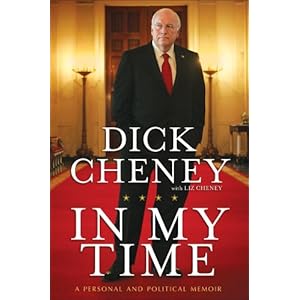 I am an exceptionally excited man. Next week brings the publishing event of 2011: the appearance of Dick Cheney’s memoirs. The NYT has seen an advance copy, and highlights the former Veep’s claim that he advised President Bush to bomb Syria in 2007. Prescient, huh? But it looks like In My Time: a Personal and Political Memoir is going to be utterly jam-packed with enjoyable nuggets:
He [writes] that George J. Tenet, the director of the Central Intelligence Agency, resigned in 2004 just “when the going got tough,” a decision he calls “unfair to the president.” He wrote that he believes that Secretary of State Colin L. Powell tried to undermine President Bush by privately expressing doubts about the Iraq war, and he confirms that he pushed to have Mr. Powell removed from the cabinet after the 2004 election. “It was as though he thought the proper way to express his views was by criticizing administration policy to people outside the government,” Mr. Cheney writes. His resignation “was for the best.”
I literally don’t know what I’m going to do with myself until I get my hands on a copy of this tome. Cheney has predicted that there “will be heads exploding all over Washington” when it comes out. The book is #3 on the Amazon best-sellers list. I only wish that the publishers had picked a more suitable cover design, like this:

by Alex Evans | Aug 25, 2011 | Economics and development, Global system, Influence and networks
[youtube]http://www.youtube.com/watch?v=qOP2V_np2c0[/youtube]
by Richard Gowan | Aug 24, 2011 | Africa, Climate and resource scarcity, Conflict and security, Cooperation and coherence, Economics and development

While I am not a regular reader of Creamer Media’s Mining Weekly, I know people who are. And they are not happy about this story from the Congo…
Congolese security forces have seized a jeep belonging to the United Nations peacekeeping operation and arrested a UN employee suspected of trying to smuggle over tonne of minerals out of the country, the government said on Monday.
The incident will embarrass the UN force, MONUSCO, which has helped prop up Democratic Republic of Congo’s weak armed forces but is also often accused of not doing enough to protect civilians and has been involved in sexual abuse scandals.
What happened?
Congolese Information Minister Lambert Mende said the incident took place on Sunday evening at the border crossing in the eastern city of Goma.
“Border police … and other security services … have seized a load consisting of 24 packages of cassiterite (tin ore) each weighing 50kg, on board a MONUSCO jeep,” he said.
A police investigation is under way and two people, including a Congolese U.N. staff member, have been arrested, Mende said.
As the lovely portrait of a lump of cassiterite at the top of this post suggests, trying to move a tonne of the stuff around by jeep might not to be the most subtle plan ever. For good discussions of how to monitor, rather than exploit, the DRC’s extractive industries, look at the papers from CIC collected here.
by Alex Evans | Aug 24, 2011 | What we're watching
[youtube]http://www.youtube.com/watch?v=NOzR3UAyXao[/youtube]
by Richard Gowan | Aug 23, 2011 | Economics and development, Europe and Central Asia, Global system, Influence and networks, Off topic

Readers of academic journal Addiction will have become rampant eurosceptics after perusing a recent article by Rebecca Gordon and Peter Anderson entitled “Science and alcohol policy: a case study of the EU Strategy on Alcohol”. I didn’t know that the EU had a strategy on booze, but the bloc has a habit of launching “strategies” with variable amounts of substance. In this case, the EU Council asked the European Commission to devise a strategy on reducing alcohol-related harm. The Commission published a Communication on the subject in 2006. Is it any good?
Although the Communication acknowledges and supports existing interventions which have high evidence for effectiveness, such as enforcing blood alcohol concentration (BAC) limits for drivers, it extensively promotes other interventions which have been shown to be ineffective; for example, recommending education and persuasion strategies as a measure across all its five priority areas.
In other words, dear readers, the Commission is boosting policies that don’t work.
Measures to influence price are mentioned only once in relation to sales in drinking venues limiting two-for-one drinks offers. Measures to control physical availability are mentioned infrequently.
It doesn’t really sound like the Commission’s heart was in it…
It also focuses its efforts more on mapping member state actions and coordinating knowledge exchange than on providing concrete recommendations for action or developing Europe-wide policy measures. This may be a compromise between the rights of Member States to develop national policy and legislation and the obligation of the European Union as a collaborative body to protect health.
So this is all about sovereignty and subsidiarity? Not quite…
Furthermore, it has been suggested that the European Union’s roots as a trading block emphasizes collaboration with industry stakeholders and this influences the ability to prioritize health over trade considerations.
Who might these powerful “industry stakeholders” be? I have a faint idea, as I once had a brush with them myself. Late last year, I co-authored a piece in the European Voice with Sushant K. Singh on the EU’s relations with India. We noted that efforts to sign off on an EU-India free trade agreement had been held up by disputes over liquor tariffs, and expressed surprise that a potentially important strategic relationship was being complicated by the price of booze. Soon afterwards, a representative of the European Spirits Organisation wrote a sniffy letter to the European Voice arguing that “that spirits are the EU’s most important agri-food export (worth €5.7 billion in 2009).”
I am told that EU-China relations are similarly complicated by the interventions of the, er, liquid lobbyists in Brussels on liquor tariff issues. I’m all for boosting agri-food exports, of course. But one would think that the EU could at least set aside “trade considerations” when it comes to stopping its citizens drinking themselves to death.
