by Alex Evans | Sep 7, 2011 | Climate and resource scarcity, Economics and development

With Obama about to attempt to get back on the front foot with a major speech on jobs to both houses of Congress on Thursday, it’s dispiriting to see the headwinds faced by the ‘green jobs’ agenda.
Back at the time of the US stimulus package, the argument was that investing in clean technology and infrastructure renewal for sustainability would deliver a big dividend in employment creation – a win/win for economy and environment. But a look at today’s opinion page in the US tells a different story. Here’s US political analyst Charlie Cook, quoted in the FT this morning:
“The administration got too enamoured of the concept of green jobs and politically correct jobs [in the previous stimulus package], but this time we need boots, jeans and helmets. That is what you are looking for,” Mr Cook says.
Not the sort of language you want to be hearing from agenda-setting opinion formers. Or how about this from David Brooks in the NYT two days ago:
The gigantic public investments in green energy may be stimulating innovation and helping the environment. But they are not evidence that the government knows how to create private-sector jobs…
…The problem is the results are indirect, the jobs take a long time to emerge and the market may end up favoring old-energy sources instead of shiny new ones. So politicians invariably go for the instant rush. They try to use taxpayer money to create private jobs now. But they end up wasting billions.
We should pursue green innovation. We just shouldn’t imagine these efforts will create the jobs we need.
Brooks quotes a range of on-the ground stories and experience to back his point, like this from Aaron Glantz on solar in the Bay Insider a month ago:
Flanked by a cadre of local political leaders, Mayor Chuck Reed of San Jose used a ribbon-cutting ceremony for a solar power company last week to talk up the promise of the green economy. Reed called the opening of the new headquarters of SolFocus, which produces large, free-standing solar panels, an “enormously important” development for the city’s economy.
“Clean technology is the next wave of innovation that Silicon Valley needs to capture,” the mayor said, noting that the San Jose City Council had committed to increasing the number of “green jobs” in the city to 25,000 by 2022. San Jose currently has 4,350 such jobs, according to city officials. But SolFocus assembles its solar panels in China, and the new San Jose headquarters employs just 90 people. In the Bay Area as in much of the country, the green economy is not proving to be the job-creation engine that many politicians envisioned.
Or this by Sunil Sharan on smart meters in the Washington Post last year:
It typically takes a team of two certified electricians half an hour to replace the old, spinning meter. In one day, two people can install about 15 new meters, or about 5,000 in a year. Were a million smart meters to be installed in a year, 400 installation jobs would be created. It follows that the planned U.S. deployment of 20 million smart meters over five years, or 4 million per year, should create 1,600 installation jobs. Unless more meters are added to the annual deployment schedule, this workforce of 1,600 should cover installation needs for the next five years.
But the manufacturing jobs will be overseas, he adds, echoing Glantz; and as for R&D or IT services, again, you’re talking about hundreds, not hundreds of thousands, of jobs. And, he goes on:
Now let’s consider job losses. It takes one worker today roughly 15 minutes to read a single meter. So in a day, a meter reader can scan about 30 meters, or about 700 meters a month. Meters are typically read once a month, making it the base period to calculate meter-reading jobs. Reading a million meters every month engages about 1,400 personnel. In five years, 20 million manually read meters are expected to disappear, taking with them some 28,000 meter-reading jobs.
In other words, instead of creating jobs, smart metering will probably result in net job destruction. This should not be surprising because the main method of making the electrical grid “smart” is by automating its functions. Automation by definition obviates the need for people.
Or for yet another example, have a look at this for a case study from the UK. As I say, it’s dispiriting stuff. But to put cards on the table, I never did buy the full extent of the green jobs argument. Here’s an extract from a post I did in June 2010:
Sure, there’ll be some new jobs putting up windmills, insulating attics and making fuel cells. There’ll also be lots of jobs lost in (where to start?) coal mining, aviation, oil exploration and refining, long haul tourism, shipping, ports, energy intensive industries… and so on.
Now we can have an argument about whether we’re looking at a net gain or a net loss in employment terms. But let’s be clear that while we’re having it, everyone who works in the above sectors will be mobilising like hell to oppose anything that threatens their interests (anything effective, in other words). As David Steven and I observed a while back, the problem with climate action is that it has the opposite dynamic to chess:
With every step that is taken towards an endgame, the number of pieces on the board will grow, not shrink. Swarming behaviour will become increasingly evident, as factions of all kinds are suddenly, and with unpredictable effect, galvanised into a passionate attempt to protect their interests.
My problem with the ‘all must win prizes’ narrative of Green New Deals, then, is that it’s disingenuous in its Pollyanna-like optimism. It overlooks that doing anything effective on climate will create both winners and losers – and that the losers will tend to be noisier and more visible.
I know everyone’s desperately keen to have sunny, shiny stories to tell about the ‘green economy’, but in reality political economy transitions like the one ahead of us to a low carbon economy always involve winners and losers – and the wins tend to be long term, while the losers are here, now and noisy. Wondering by now what I’d do instead? That’s covered in the remainder of the post quoted from above – read the whole thing.
by Alex Evans | Sep 6, 2011 | Climate and resource scarcity, Economics and development, Global Dashboard, Global system
From MDGs to… SDGs? That’s one of the ideas swirling around in discussions ahead of the Rio 2012 sustainable development summit next year, anyway.
You can see the attraction. With less than a year to go, there are precious few concrete ideas on the table for what the summit might produce, especially in the area of “institutional framework for sustainable development”, one of two key themes for the event (sure, there’s much talk of a new World Environment Organisation, but colour me very unconvinced of the case for that). So might SDGs help to fill the gap?
Well, that would depend on what they cover. The government of Colombia has set out a proposal for SDGs that would cover various sectors – atmosphere, climate resilience, land degradation, sustainable agriculture, biotech, waste and so forth. This would mainly be about ‘reaffirming’ (that awful word – who, other than diplomats, ever ‘reaffirms’ anything?) commitments made at Rio 1992. But you have to wonder: important though delivery of existing commitments undoubtedly is, is ‘reaffirmation’ of stuff agreed 20 years ago really going to set any pluses racing outside the sustainable development priesthood?
Much more interesting, on the other hand, is the idea that SDGs could provide an institutional foundation for the nine planetary boundaries identified – and quantified – by the Stockholm Resilience Centre (see also this previous GD post). The core idea in the boundaries approach is to define a ‘safe operating space for humanity’ – and, of course, the global economy. So if you’re looking for a serious synthesis of environment and economic development, this is ground zero.
Of course, a host of questions would still need to be answered. One would be about what timeline the SDGs would span: 25 years, like the MDGs’ 1990-2015 timescale, or much longer than that?
There’s also the small question of which countries would be covered, and how. The MDGs were basically about developing countries (Goal 8 notwithstanding) – an approach that clearly wouldn’t be possible with SDGs, given the huge sustainability impact of consumptions levels in rich countries. So would the SDGs apply globally, but not to specific countries – leaving them open to the charge that they’re rhetorical aspirations, not serious engines of change? Or would they apply to individual states – opening up the issue of how to differentiate countries’ commitments?
Then, of course, we’d need to know how the SDGs would relate to the MDGs. Some (greens, especially) would like to see SDGs replace MDGs beyond 2015. But lots of developing countries would be deeply suspicious of any perceived dilution of focus on poverty reduction, or anything that looked like it might ‘pull the ladder up after developed countries’ by denying them space to develop – and large and influential aid donors might well agree.
And we’d need to figure out an institutional home for the Goals, too. It would be crucial for them not to be ‘owned’ by the environment priesthood – if SDGs became seen as UNEP’s baby, they’d be stillborn at birth. Instead, it might be interesting to set up a new, independent, scientifically based international institution to monitor planetary boundaries – kind of like a global Congressional Budget Office for planetary boundaries. (Normally, I’m adamantly opposed to creating new international institutions, given how many we have already – but here, I think there’s a compelling case.)
Finally, there’s the question of process. It’s almost certainly too late to define any set of SDGs in time for Rio. Instead, the best option now would be for Rio to provide a launch pad for a process to define a set of SDGs – perhaps leaving open, for now, how they might relate to post-2015 MDGs further down the line. This would create valuable time for some serious outreach, above all to developing countries – though not too much time, given that you’d want to have the SDGs finalised before the US slides back into Presidential election mode from 2015 onwards. 12-18 months would probably be about right – with the Goals signed off at a UN summit in, say, spring 2014.
by Alex Evans | Aug 31, 2011 | Global system, Off topic

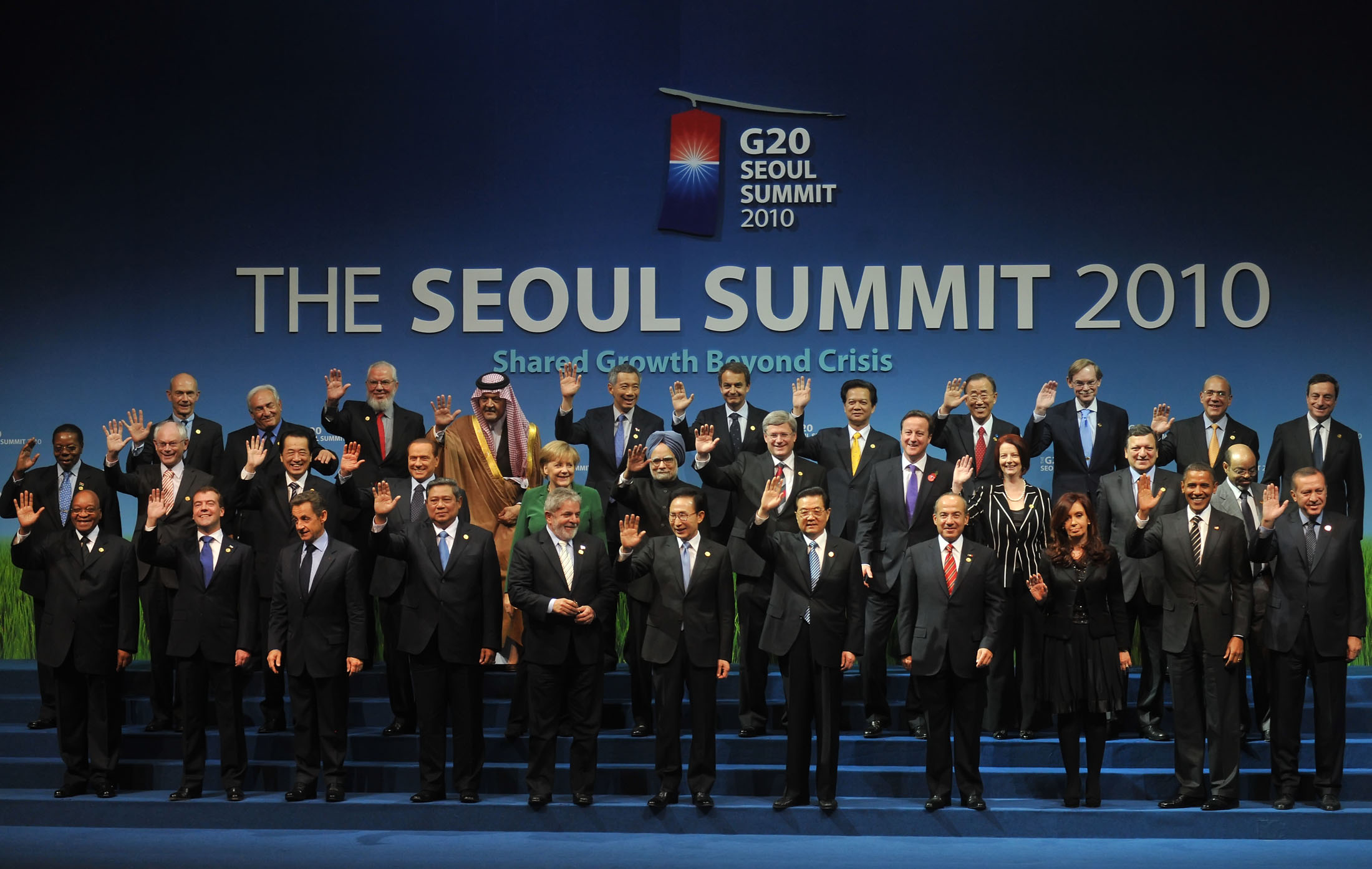
What on earth was with this painfully cringeworthy waving at the Seoul G20? Heavens above – this is supposed to be a summit, not a school outing. If you look closely at the big version (click on photo), you can see that the world’s leaders fall into 4 categories:
1) Those who are waving and – horror of horrors – think that the whole thing is not only acceptable, but great fun. Ban Ki-moon, Silvio Berlusconi, Herman Van Rompuy – fire your PR advisers and get new ones immediately. (Especially you, Van Rompuy – I just had to look you up on Wikipedia to confirm your first name. That’s how much impact you’ve had, that is.)
2) Those who are waving, but dying inside as they do so. Look at Hu Jintao or Recep Tayyip Erdogan. Fellas – we feel your pain, but we’re a bit alarmed that you felt the need to go with the crowd and wave anyway. Your citizens pay you to lead.
3) Those who refuse to wave, but give embarrassed rictus smiles instead. David Cameron and Jose Barroso, you get modest props for not going with the crowd. But those sheepish looks tell a different tale. You pass, but without distinction.
4) Those who not only refuse to wave, but make no secret of their amused contempt for everyone else for going along with what some duff photographer is demanding of them. Meles Zenawi, Angela Merkel, Lula da Silva, Nicolas Sarkozy – we salute you. Go set up a G4 together. You have my vote.
by Richard Gowan | Aug 29, 2011 | Africa, Conflict and security, Cooperation and coherence, Global system, South Asia
Last Thursday, I published a grumpy post over on the blog of the Takshashila Institution, an excellent Indian think-tank. Why was I in a bad mood?
On Friday, India will use its month-long presidency of the United Nations Security Council to convene a discussion on the state of peacekeeping. This is timely, as UN operations have been through a turbulent year, navigating crises in Côte d’Ivoire and Sudan. There is talk of a new mission in Libya. But this meeting is likely to be a bore.
And why did I think that the debate would be a snooze-fest? Demonstrating a remarkable degree of foresight, I guessed that “Security Council diplomats will be thinking of how to beat the traffic from New York to Long Island’s beach resorts once the debate is finished.” Er, no. With Hurricane Irene almost literally on the horizon, everyone was probably wondering when they could go and stock up on bottled water and black truffles, or whatever ambassadors consume during hurricanes.
The debate was also overshadowed by the tragic attack on the UN offices in Nigeria. Nonetheless, a quick read of the summary of the discussions suggests that they were every bit as tedious as I had predicted. Let’s get a quick taster:
Most speakers in the ensuing discussion stressed the continuing importance of United Nations peacekeeping and the need for increased engagement by the partners involved. In that context, many welcomed more regularized consultations with troop- and police-contributing countries and urged continuous improvement in cooperation among all stakeholders. Many also called for innovative thinking in closing resource gaps, particularly in supplying such enablers as helicopters, and in implementing the recommendations of previous peacekeeping reviews.
Enough already! When multiple speakers are highlighting the importance of “implementing the recommendations of previous peacekeeping reviews”, you know that “innovative thinking” is probably in short supply. I’m afraid that I fault the Indian conveners for not shaking up the discussions:
A background paper prepared for the Security Council’s meeting contains a solid but all-too-familiar litany of diplomatic statements about how peace operations are resourced and managed. It fails to grapple seriously with the hardest cases facing the UN or offer a serious framework for resolving them.
As I’ve argued before, peacekeeping is an issue on which New Delhi can show global leadership, but holding debates in New York in which everyone says more or less exactly what they’ve always said isn’t the way to achieve that.
by Andy Sumner | Aug 26, 2011 | Cooperation and coherence, Economics and development, Global system

Foreign aid from ‘new donors’ (aka emerging economies) now makes up around $10bn/year.
And this has doubled in the last five years as the Economist noted last week in a piece on ‘aid 2.0’ triggered by the news that India is to set up its own aid agency with a budget of at least US$1.5-$2bn/year (or triple the annual value of UK aid to India leading to the appearance UK aid is being subcontracted).
One might well ask what if most of the world’s poor live in new donor countries – does it suggest the poor overseas are more deserving than the poor at home?
So, what might aid 2.0 looks like?
One way to take a look is with Chinese foreign aid now that there’s a fascinating dataset on Chinese aid projects (here) that has been painstakingly put together by the Aid Data guys. (By the way a health warning: I am not a Chinese aid expert – read a good read here or the new Chinese government aid white paper here or search Duncan Green’s blog for various China pieces).
The Aid Data dataset of Chinese aid projects covers some 500 Chinese foreign aid projects from 1990-2005 by the year, project description and country recipient and in a very few cases the financial value. For example, in 1991 Chinese aid funded a duck breeding farm in Ecuador breeding 70,000 ducklings a year (wonder if it’s had a Randomised Evaluation yet?).
Of course this is just the project aid declared by the Chinese Ministry of Commerce and data only runs up to 2005 but it makes fascinating reading if you’ve ever wondered what ‘new’ donor’s aid looks like and how different or not it is from ‘traditional’ donors aid (meaning the OECD countries).
So what does Chinese project aid look like based on the Aid Data dataset?
A quick scan suggests: (i) About a half of the projects listed have a direct relation to standards of living via social investments in health equipment or education facilities or via economic growth and production or income generation; (ii) As is well known there’s lots of infrastructure spending (aka aid as concrete) – about a quarter of the projects listed relate to infrastructure – water and power infrastructure in particular; and (iii) Perhaps surprisingly, a quarter or so of all the projects listed relate to leisure and sport – there are numerous new or renovated gymnasiums in Africa (eg Niger, Rwanda and Benin to name a few) and new sports stadiums – one of the biggest being a 30,000 seater stadium in Togo ‘covering an area of 36,000 square metres and including, one Olympic track, an electronic scoreboard, quality pitches and a giant screen’.
So, how different is all this from ‘traditional’ aid or aid 1.0? Much bilateral aid in recent years might well fit into the first grouping of social investments and income generation; some would fit into infrastructure but perhaps less so and probably little ‘traditional’ aid would be leisure or sport related I’m guessing…
And, more importantly perhaps is all of this is probably not where the big money is given the package aid deals of trade and investment from China, the real value probably lies in those non-aid, trade and investment aspects of the deal than in gyms and duck farms (even if they do breed 70,000 ducklings a year which sounds pretty impressive to me).