by Alex Evans | May 13, 2011 | Influence and networks, Off topic
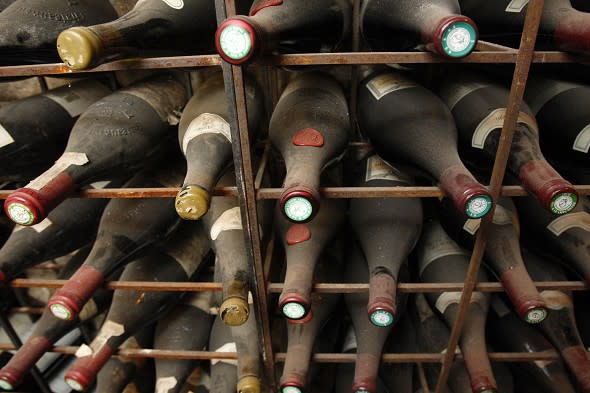
With consular emergencies underway in multiple countries, the eurozone falling apart, climate change gathering pace and a military intervention underway in Libya, it’s good to see that the Foreign Office is focusing its attention on the key issues. Over to FCO Minister Henry Bellingham:
I am announcing today the outcome of a review of the Government Wine Cellar. Government Hospitality provides corporate hospitality services for the whole Government, and has done so for over 80 years. It is administered by the Foreign and Commonwealth Office. As part of its functions, it includes a Wine Cellar.
Bravo! And how eminently sensible of HMG to entrust stewardship of this vital resource to the Foreign Office. But what’s this?
On 18th June 2010 my Rt Hon Friend the Secretary of State for Foreign and Commonwealth Affairs instituted a thorough review of the cellar’s functions to ensure that the purchase, retention and use of wines and spirits for official government events hosted by senior members of Government was appropriate to the contemporary environment and would provide value for money for the tax payer.
Uh-oh. That doesn’t sound good. Bellingham continues,
We will conduct targeted sales of high value stock in order to pay for future purchases.
What?!? Privatisation! Selling off the family jewels! Someone call UK Uncut! Who’s to blame for this outrage?
Answer: Tom Watson MP, who’s been hassling the government for a list of contents of the cellar for over a year. Tom says, “They should sell the good stuff to make ends meet. As the economy heads back into recession nobody will seriously believe that we are all in this together when ministers are quaffing wines at £200 a bottle.”
Pretty crafty of Tom to get his own ministerial quaffing out of the way before blowing the whistle, eh readers? But me, I’m worried about what this means for UK foriegn policy. Who’s going to want to attend our summits and state banquets once all the “good stuff” is gone?

by Alex Evans | May 13, 2011 | Climate and resource scarcity, Cooperation and coherence, Economics and development

This year’s French-chaired G20 has food security as one of its key priorities. Agriculture ministers will be meeting for a summit in mid-June, and their sous-sherpas have been meeting in Paris this week to figure out an action plan to take to the summit.
The key input to that meeting was a joint paper on food price volatility produced by, essentially, all of the international organisations that matter on this issue: the IMF and World Bank; the three Rome-based UN food agencies, plus the UN High Level Food Task Force; the WTO and UNCTAD; and the OECD and International Food Policy Research Institute for good measure.
Now, you might well suppose that such an alphabet soup of agencies would struggle even to agree on the order in which their names should be listed on the cover of the report, never mind hammer out a common analysis. And as for recommendations that go beyond harmless motherhood and apple pie, forget it. Right?
Not at all. The report – which was leaked (pdf, with thanks to ICTSD) earlier this week – is extremely clear and well-written, and sets out one of the most succinct summaries I’ve seen of the main dynamics on the issue. But what’s really surprising is how far the ten agencies have collectively put their heads above the parapet on the most sensitive issues in food security – not just analytically, but in some clear and right-on target recommendations.
Among them: that G20 countries should commit to greater transparency about their stock levels (a very sensitive issue for China, India and other emerging economies); the creation of a new Rapid Response Forum to co-ordinate during crises (a conspicuous gap in the global system’s arsenal during the 2008 food spike); more transparency in derivative and futures markets; some notably tough language on export restrictions, including moves to define exactly what constitutes a “critical food shortage” that makes it OK for a country to impose an export ban; and support for the creation of a system of regional food reserves being developed by the World Food Programme.
All good proposals, and some pretty surprising to see in a document like this. But here’s the really stand out recommendation:
G20 governments [should] remove provisions of current national policies that subsidize (or mandate) biofuels production or consumption.
That’s it. No qualifiers or caveats – and this from ten international agencies, including the Bank, Fund, WTO, OECD and every relevant part of the UN. The report goes on,
Failing a removal of support, G20 governments should develop contingency plans to adjust (at least temporarily) policies that stimulate biofuel production or consumption (in particular mandatory obligations) when global markets are under pressure and food supplies are endangered.
After which the report sets out detailed proposals for how this might be achieved. The interesting thing in all this, of course, is that it really puts the EU and (above all) the US, with their loopy biofuel support policies, on the spot. Well done, the international system. Now let’s see what the sherpas made of it.
by Richard Gowan | May 12, 2011 | Climate and resource scarcity, Cooperation and coherence, Europe and Central Asia, Off topic
Working through the website of the Organization for Security and Cooperation in Europe to gather information for CIC’s annual Review of Political Missions, I have stumbled across one of the great diplomatic photographs of all time. Here is Ambassador Benedikt Haller, Head of the OSCE Office in Minsk, during a field trip to monitor a project in Bragin district on OSCE support for rural development in Belarus:

The photo is a bit blurry, but for an – ahem – enlarged version, click here. As has been said so often, major leeks threaten to make the work of diplomats impossible.
by Richard Gowan | May 12, 2011 | Conflict and security, Middle East and North Africa

Here’s a bleakly amusing extract from a speech by Ban Ki-moon in Sofia:
Just before coming to Sofia, I spoke with President al-Assad of Syria. This was my third call to him, and a lengthy one. We were arguing. “Why do you keep calling me?” he said.
Ban’s response sounds about right:
I told him that, as Secretary-General, I do not interfere with internal politics. But when it comes to fundamental human rights, when there is a clear violation of those rights, I will speak out.
Stop the violence now, I told him. I advised him, strongly, to do what I have advised all other leaders in the region: listen to your people– really listen to what they are asking. Hear their aspirations. Make bold reforms. Change before it is too late.
I actually like a lot of the Sofia speech, which contains convincing passages on the limitations and risks of the Arab Spring as well as its transformational potential. Having written about Ban’s sporadic and often rather hapless efforts at high-flown prose, I’m cheered by his realistic but respectful take on the Arab revolutions.
by Alistair Burnett | May 12, 2011 | Conflict and security, Middle East and North Africa
I’ve done a piece for YaleGlobal about the implications for NATO of its operation in Libya
With Operation Unified Protector in Libya, NATO enters war for the third time in its history. And like its first-ever conflict with Yugoslavia in 1999, the alliance is anything but unified. But gone to war it has, carrying out air strikes against forces loyal to Colonel Muammar Gaddafi and more than 100 sorties on most days. The half-hearted nature of the intervention can be seen as a glass half full or half empty for the alliance. But over time the cherry-picking approach of the members could reduce it into irrelevance … Read more
