by Richard Gowan | Jan 19, 2011 | Africa, Conflict and security, East Asia and Pacific, Global system, Off topic
Do you have one of these?

No? Then you are not a Grand Officier de L’Ordre National de la République de Côte d’Ivoire. Unlike, for example, Ban Ki-moon:
Mr Ban has received numerous national and international prizes, medals and honours. In 1975, 1986 and again in 2006, he was awarded the Republic of Korea’s Highest Order of Service Merit for service to his country. In April 2008, he was awarded the dignity of the “Grand-Croix de L’Ordre National” (Grand Cross of the National Order) in Burkina Faso, and in the same month received the “Grand Officier de L’Ordre National” (Grand Officer of the National Order) from the Government of Côte d’Ivoire.
Two questions arise from this biographical nugget:
- Assuming that Mr. Ban received this award from President Laurent Gbagbo, shouldn’t he do the honorable thing and return it, now that he’s trying to shove Gbagbo out of office?
- Why only officier? Gbagbo could have made the SG a chevalier of the same order, at the very least. Perhaps Ban’s determination to see the back of Gbagbo is based on this chivalric slight?
by Alex Evans | Jan 19, 2011 | Climate and resource scarcity
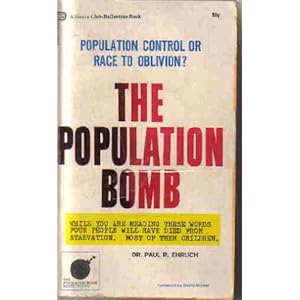
Dominic Lawson’s Independent piece yesterday, in which he debunked the “neo-Malthusian movement” of “population doomsters”, made me chuckle. Here’s a sample:
There is an increasingly noisy claque of Malthusians who insist that an “exploding” global population (as they put it) is going to lead to disaster – from Boris Johnson to Joanna Lumley, not to mention Jeremy Irons and Prince Charles.
Concerns about resource scarcity are completely overblown! Human ingenuity and innovation have always won out in the past! Why should this time be any different?
While the misanthropic Malthusians will gloomily see [the arrival of Earth’s seven billionth human some time in 2011] as just “another mouth to feed”, he might more charitably be seen as another human whose ingenuity, creativity and intellect can be of benefit to the world.
And so:
In AD200, Tertullian wrote: “We are burdensome to the world; the resources are scarcely adequate for us.” Of course, the resources of the planet are not, in the purely mathematical sense, infinite; but neither is the population.
This thought ought to be of some cheer; but I fear that even if the entire world of science and engineering accepts this form of rational optimism, it will not change the mind of a single Malthusian. They’ve been wrong for so long. Why stop now?
What makes me smile about these kind of ‘Promethean’ arguments is that they rest on a sleight of hand. What Lawson implies is that concerns about resource scarcity rest more or less exclusively on arguments about ‘the population explosion’. But that’s not the case. When I sat down to write The Feeding of the Nine Billion (pdf), for instance – a report which was very much concerned with resource scarcity – I took care to note that:
Population growth reached its fastest rate in 1963, at 2.19% a year. Today, the growth rate has almost halved, to 1.15%. It continues to decline, and is projected to fall below 1% in 2020, and to less than 0.5% by 2050. Long term projections suggest that world population will finally stabilise in the year 2200, at just above 10 billion people. The global picture, then, is not the Malthusian nightmare of exponential growth curves of popular imagination. The long term outlook is perhaps less one of constant ‘running to stand still’ on food production than a case of ‘one last push’.
While population is a significant factor in the outlook on food security, today’s scarcity analysts recognise it as just one among a range of factors – a range that also includes: the growing size and affluence of the global middle class, and its changing diet and energy consumption patterns; competition for land, between uses from crops and livestock to biofuels, carbon sequestration and cities; increasing water scarcity, due to unsustainable groundwater extraction and changing preciptiation patterns; higher oil prices, which affect costs of fertilister, on-farm energy use, processing, transport and so on; and of course climate change as the game changer in the background.
Lawson doesn’t discuss any of these other factors as he cheerily rebuts the notion that anyone should be concerned about global food security prospects. Instead, he fires merrily away at the ‘population bomb’, despite the fact that practically no serious analyst of resource scarcity that I can think of still thinks in these back-to-the-70s terms – a point that Lawson unintentionally proves when it transpires that the key champions of the point of view he sets out to rebut are, er, Boris Johnson, Joanna Lumley, Jeremy Irons and Prince Charles.
The truth is that the ‘Malthusian determinism’ that Lawson and his ilk so love to rebut is a straw man. Most analysts working on resource scarcity recognise that we’re dealing with high levels of uncertainty, and hence that it’s ultimately about intelligent risk management. Lawson’s brand of techno-Panglossianism, on the other hand – that’s determinism.
by David Steven | Jan 19, 2011 | Climate and resource scarcity, South Asia
Recently, I wrote about the devastating – and largely unreported – impact that resource scarcity is having on Pakistan’s fragile economy and society. Barely a day goes by without a new data point that illustrates the size of the problem.
Today, for example, the papers report that the two main political parties (the ruling PPP, and its arch opponents, PML-N) have come together to try and fix an economic crisis that they admit has its main roots back in the 2008 resource price spike:
Sources said the government had told almost all parties that most of the economic pressure had built up because of carryover of huge fiscal deficit from the previous government which did not pass on energy prices to consumers even when international oil prices increased from $90 to $147 a barrel and the current government was facing a similar situation. Most public sector corporations have since been bleeding mainly because of this single factor.
Power companies are getting so desperate for fuel oil (which they are using to replace gas, whose shortage has led to an electricity crisis), that they’re signing sovereign-backed contracts for imports on deferred payments, going against the express wishes of the state-run Pakistan Oil Company, and, seemingly, without explicit permission from the government.
In Punjab, meanwhile, grain markets are grinding to a halt, as the government attempts to tax agricultural production in order to plug its yawning fiscal hole and – I suspect – to make it politically easier to raises taxes on urban consumption. Traders are on strike, accusing the government of destroying the ‘backbone’ of the economy.
The impact on ordinary people is marked. The gas shortage is pushing urban residents back towards a reliance on biofuel. “I am purchasing stove to use firewood in the 21st century thanks to the government,” complains one resident of Rawalpindi.
Fortunately, food shortages are yet to hit one of the citizens of nearby Islamabad: President Zardari. He has his own camel in the Presidential Palace, because he thinks the milk is healthier.
The President House also has a herd of black goats. One goat is slaughtered everyday when Mr Zardari is there.
Earlier, his trusted personal servant, Bai Khan, used to buy a goat from Saidpur village every day, but now a herd has been kept in the presidency to avoid frequent visits to the animal market. The animal is touched by Mr Zardari before it is sent to his private house in F-8/2 for slaughtering.
Good to see one man, at least, taking resilience seriously.
by Jules Evans | Jan 18, 2011 | Cooperation and coherence, Global system
Astronaut Edgar Mitchell thinks so. I interviewed Dr Mitchell about how the ‘big picture effect’ transformed many astronauts, including him. For best results, make it big screen, plug in your headphones, and enjoy the trip! [youtube]http://www.youtube.com/watch?v=KE-PUTVULFg&feature=player_embedded#![/youtube]
by Alex Evans | Jan 17, 2011 | Cooperation and coherence, Global Dashboard, Influence and networks, UK
The uncorrected transcript of David and my appearance in front of the Foreign Affairs Select Committee last week on the role of the Foreign Office has now been published on the Parliament website – our summary opening statement is after the jump below.
(If you’re interested in contributing to the inquiry, there is still time to submit written evidence. See here for details on how to do that; the deadline is the end of this month.) (more…)
