by David Steven | Mar 12, 2010 | UK
[youtube]http://www.youtube.com/watch?v=CP9_kkzfN-w[/youtube]
It’s no wonder the markets are raising questions about UK public finances – neither of the main parties has anything approaching a clear message on fiscal tightening.
From Labour, you get blithe assurances on taxes. Liam Byrne didn’t quite ask us to read his lips yesterday when promising no new tax increases, but he might as well have done. Carl Emmerson from the Institute for Fiscal Studies was unimpressed:
I cannot see how the Government can promise to not affect front line services when you look at the scale of the cuts they have got to plan for.
Liam Byrne is talking just about the first four years and after that there will undoubtedly have to be more pain and that is likely to be tax rises or even greater public sector cuts.
But the Tories are not in the clear either. I was baffled by William Hague’s recent speech at the Conservative Party Spring Forum. Half way through his speech, he lays out the Tory pitch to the undecided voter:
And to those who say they do not know what the Conservatives will do, let us tell them. We will cut the spending that cannot go on and the borrowing that leads to ruin.
So what follows? Here are all the commitments Hague makes that will cost money:
(i) Cutting taxes on business to give the UK the ‘most competitive’ tax environment in the G20
(ii) reversal of Labour’s planned national insurance increase
(iii) abolition or reduction of inheritance tax
(iv) two year freeze on Council tax (despite promises of the ‘biggest ever’ transfer of power to Councils)
(v) stamp duty abolished for first time buyers (despite unsustainable prices in the housing market)
(vi) more university places and apprenticeships
(vii) nursing care in their homes for the elderly.
And here are all the commitments is the only commitment that will clearly save money (though not much):
(i) Scrap ‘a large slice’ of expensive quangos.
And voters are supposed to be convinced this adds up to “vision of a Britain restored.”
Both parties need to convince the electorate they can get Britain back on its feet (the slogan I’d advise either to run their campaign under). But as Martin Wolf argues in today’s FT, at the moment it’s shaping up to be an election that both sides deserve to lose.
by David Steven | Mar 11, 2010 | Influence and networks, UK
Just to press on with the Daily Mail vendetta for a tad longer, the superb Will Tooke has caught the ‘newspaper’ in another piece of fakery. This time, taking liberties with James McKie, the war hero who threw a grenade back at the Taliban.
I saw the grenade come over hit Captain Kerr on the back of his body armour and land between me and him, about a foot away from me, right next to him.
Instinctively, Captain Kerr dived, tried to get away from the grenade, but there wasn’t a lot of room. He ended up on top of me, away from the grenade.
I dived forward, picked up the grenade and threw it off the roof. It detonated half way down in the alley, two feet away from us, with most of the frag going into the wall…
When I saw the grenade there, I thought, I hope it doesn’t hurt too much.
(Do watch the whole interview with McKie – it’s quite extraordinary.)
A story that’s right up the Mail’s Straße but – as Tooke points out – there was a catch:
The problem was, the [only] picture was taken when all the action was over, and it seems [it] just wasn’t dramatic enough for the Daily Mail to match the story of intense bravery. If only there was a picture of Rifleman McKie doing the sort of high octane daring do you see in war movies, you know, like that film The Hurt Locker that just won a load of Oscars. Gosh, that would be perfect.
So what did the Mail do? They took this photo of McKie:
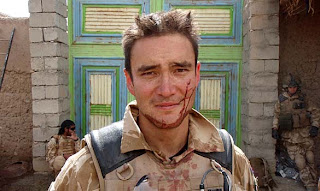
…purloined this one from the Hurt Locker (which pops up in Google image search)…

…and photoshopped the two together to make this doozy…

Journalism – it’s easy. If you’re shameless.
by David Steven | Mar 10, 2010 | Global Dashboard, Influence and networks
[Important updates below – Facebook says the Daily Mail knew its story was untrue, but printed it anyway. Legal action is promised. The BBC has now picked up on Global Dashboard’s story. Journalism.co.uk has a piece as well. Guardian has followed our lead too. Mashable. Belle de Jour chips in.]
In the early hours of this morning, the Daily Mail published an astonishing attack on Facebook under the title “I posed as a 14-year-old girl on Facebook. What followed will sicken you.”
Here’s the opener:
Even after 15 years in child protection, I was shocked by what I encountered when I spent just five minutes on Facebook posing as a 14-year-old girl. Within 90 seconds, a middle-aged man wanted to perform a sex act in front of me.
I was deluged by strangers asking stomach-churning questions about my sexual experience. I was pressured to meet men with whom I’d never before communicated.
So I wasn’t surprised that a vulnerable teenager, Ashleigh Hall, was groomed on Facebook before being brutally raped and killed.
The article is written by Mark Williams-Thomas. Here’s his biog:
Mark is a former police detective who has far-reaching experience of working at the centre of high profile investigations. During Mark’s police service, he specialised in child protection and major crime and he is renowned throughout the UK’s police forces as well as the national media for his expertise in these areas.
It’s an odd story. Facebook isn’t really a chat site – and it’s certainly not Chatroulette, where there are plenty of men ready and waiting to jack off in front of you (sfw). Presumably Williams-Thomas set his privacy settings to zero and befriended loads of strangers. But how did those strangers find him (her) so quickly?
Fast forward twelve hours and the online version of Williams-Thomas’s article has undergone some editing. New title: I posed as a girl of 14 online. What followed will sicken you. And new text, with Facebook replaced with an unnamed ‘social networking site’.
Even after 15 years in child protection, I was shocked by what I encountered when I spent just five minutes on a social networking site posing as a 14-year-old girl. Within 90 seconds, a middle-aged man wanted to perform a sex act in front of me.
The url, though, has not been changed: I-posed-girl-14-Facebook-What-followed-sicken-you.html [This url was subsequently set to redirect to a new one – 12/03/2010]
So what gives? If it was Facebook that Williams-Thomas was using, then why turn so coy? And if it wasn’t, how on earth could the Mail have pretended it was?
Update: Via Twitter, I asked Williams-Thomas for clarification. Here’s his reply:

So why was Facebook named in the first place?
Update 2: Apparently the story – with Facebook named – was a front page splash in the print edition, and then a double page spread inside.
Update 3: Just had a call from Facebook – they’re incandescent and say that:
- Williams-Thomas claims that he was 100% clear that his social network experiment had not involved Facebook.
- When the Mail sent him a first draft of the story with Facebook named, he asked for them to make a correction.
- Even so, they went ahead and published a story their own expert had warned them was untrue.
When Facebook protested, the Mail corrected the online story, but not the printed version, which had already hit the news stands. Their online retraction failed to include any apology or explanation of their mistake.
Facebook says that legal action against the Mail is pending. What an extraordinary piece of negligence and/or malice from the paper!
Update 4: The Mail appended a fairly mealy mouthed correction last night:
In an earlier version of this article, we wrongly stated that the criminologist had conducted an experiment into social networking sites by posing as a 14-year-old girl on Facebook with the result that he quickly attracted sexually motivated messages. In fact he had used a different social networking site for this exercise. We are happy to set the record straight.
Will they be happy to pay damages to Facebook too? Another version here, which begins: “In an article by a criminologist yesterday, we wrongly stated…” – half-maintaining the fiction that Williams-Thomas actually wrote the piece…
Update 5: From last year, another great Daily Mail headline: “How using Facebook could raise your risk of cancer.”
Update 6: Instead of retreating to lick her wounds, Mail journo, Laura Topham has doubled down with another article on Internet safety – again using the Facebook killer as a hook and with the same oddly prurient image from yesterday’s story.
Before her Facebook howler, Topham’s main claim to fame was dating 100 men and writing about it, outing Belle de Jour [or not – see Belle’s comment], and running up huge amounts of debt because the government inveigled her into taking out a student loan.
Her big break in journalism came in 2005 when she shafted David Blunkett.
Update 7: PC Pro quotes Facebook’s spokeswoman as challenging the Daily Mail to name the social networking platform that is really to blame. I was given exactly the same message. Facebook think it knows which service Williams-Thomas used and is desperate for one of its competitors to get shafted.
A representative of Williams-Thomas justifies anonymity thus: “The reason he does not want to [name the service] is because he does not want there to be another opening for paedophiles to head straight for.” Hmm. Maybe.
by Alex Evans | Mar 10, 2010 | Latin America and the Caribbean

This image shows NOAA modelling of the tsunami that followed Chile’s earthquake – which proved to be highly accurate. Yale Environment 360 explains how to decipher the map:
Researchers used seismic information, wave measurements collected from buoy-based equipment, and computer modeling technology to predict the maximum wave amplitude, wave arrival time, and the extent of wave inundation. The colors illustrate the maximum computed tsunami amplitude in centimeters during the 24 hours after the quake, with the highest waves in purple and red and smaller waves in orange and yellow. The red triangles represent buoys.
by David Steven | Mar 10, 2010 | Europe and Central Asia, Influence and networks, UK

In today’s FT, William Hague underlines (again) that a new Conservative government will see the European Union as a platform for achieving progress on global issues.
With David Miliband’s enthusiasm for a G3, we’re left with robust cross-party consensus on Europe’s role as a foreign policy actor (whether it can fulfil this role is another matter).
I’m reminded of how Margaret Thatcher’s press secretary, Bernard Ingham reacted when asked, shortly after the new Tory government took office, to write a report on how the government could build public support for the European Community.
According to Robert Harris, Ingam wrote that:
A community of 250 million could achieve more than a ‘debilitated nation of 55 million, however much the latter may trade on past imperial glory‘.
Government publicity should stress this, ‘with all the instruments of the orchestra, not only central Government, reading the same score, playing the same tune and coming in on cue.’
True in 1980. Even more so thirty years’ later.
(Photo from Iain Dale.)