by David Steven | May 4, 2010 | UK
[youtube]http://www.youtube.com/watch?v=fjMIFNFE6j8[/youtube]
UK Trade and Investment’s Mike Gavin has been caught on camera by Heydon Prowse dishing out the following advice to a company offering ‘security’ services:
“You can also use that embassy to present your company. So you can invite people to a reception or a presentation. Again, you pay for the room but it’s all arranged for you,” he said.
“There is a perception that you’re endorsed by the government because it’s a government building. Of course it’s crap, we don’t.
“All we do is due diligence to check that you’re not going to appear in theTelegraph on Sunday embarrassing the hell out of the British Government.”
He explained that in countries such as Nigeria using the embassy was the “easiest way to get everybody together”.
Prowse asked: “Because of the security situation?”
Mr Gavin replied: “No, because in places like Nigeria they love to show off that they have got this card from the British Embassy, it’s got Ambassador invites, British Government logo and they say ‘Look I’m going to a garden party’.
“It’s all bollocks, but everybody in Nigeria wants one because they want to be seen getting out of the car, going into the High Commissioner’s office. It’s all perception and that’s part of what you don’t have at the moment.”
by David Steven | May 3, 2010 | Middle East and North Africa
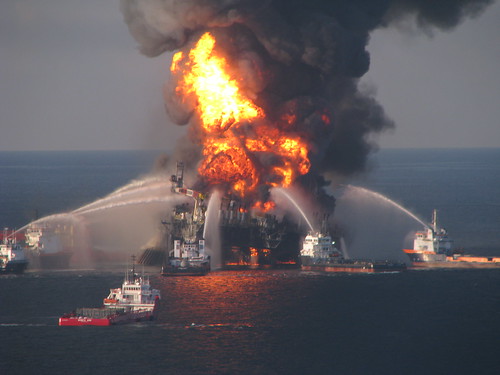
From Cumberland Advisors, a sobering analysis of the possible fallout from the BP oil spill in the Gulf of Mexico. Three bleak scenarios are set out. According to the report, there is no ‘good’ outcome at this stage:
The Bad.
Containment chambers are put in place and they catch the outflow from the three ruptures that are currently pouring 200,000 gallons of oil into the Gulf every day. If this works, it will take until June to complete. The chambers are 30-foot-high steel configurations that must be placed on the ocean floor at a depth of one mile. This has never been done before. If early containment is successful, the damages from this accident will be in the tens of billions. The cleanup will take years. The economic impact will be in the five states that have frontal coastline on the Gulf of Mexico: Texas, Louisiana, Mississippi, Alabama, and Florida.
The Worse.
The containment attempts fail and oil spews for months, until a new well can successfully be drilled to a depth of 13000 feet below the 5000-foot-deep ocean floor, and then concrete and mud are injected into the existing ruptured well until it is successfully closed and sealed. Work on this approach is already commencing. Timeframe for success is at least three months. Note the new well will have to come within about 20 feet of the existing point where the original well enters the reservoir at a distance of 3.5 miles from the surface drilling rig. Damages by this time may be measured in the hundreds of billions. Cleanup will take many, many years. Tourism, fishing, all related industries may be fundamentally changed for as much as a generation. Spread to Mexico and other Gulf geography is possible.
The Ugliest.
This spew stoppage takes longer to reach a full closure; the subsequent cleanup may take a decade. The Gulf becomes a damaged sea for a generation. The oil slick leaks beyond the western Florida coast, enters the Gulfstream and reaches the eastern coast of the United States and beyond. Use your imagination for the rest of the damage. Monetary cost is now measured in the many hundreds of billions of dollars.
by David Steven | May 3, 2010 | UK
I had always assumed that NATS – the UK’s air traffic control organisation, which was at the heart of the volcanic ash crisis – would be covered by Freedom of Information legislation.
After all:
The company… holds a monopoly of air traffic control for aircraft flying over the United Kingdom and, with its Irish counterpart, the North East Atlantic. It also provides air traffic control at most of the large airports around the country.
NATS was once a public body, but was converted into a public-private partnership in July 2001. The government maintains a 49% shareholding, with 46% held by a consortium of airlines, and 5% by employees.
It still provides a quintessentially public service, however, but because it’s not 100% government-owned, it’s not covered by the 2000 FOI Act (nor are any other public-private partnerships).
The public has a right to see information held by the British Potato Council, the Horserace Betting Levy Board, or the Architects Registration Board – but none at all to understand how NATS handles flights on which 200 million passengers travel every year.
The Act, however, gives the relevant Secretary of State the power to “designate as a public authority for the purposes of this Act any person…who appears to the Secretary of State to exercise functions of a public nature.”
Surely that clause should be used to bring all or most of NATS’s work under the act, especially as we try to understand the organization’s highly controversial role in the Eyjafjallajökull crisis.
Wonder if the new government will commit to making this change as soon as it takes office…
by Alex Evans | May 3, 2010 | UK
The difference between the first and second edition headlines of today’s Times, courtesy of PoliticsHome.
Take 1:

Take 2:

Sorry, Mr Murdoch, sir. Won’t happen again, sir.
by Alex Evans | May 3, 2010 | UK
Goes like this (read the whole thing):
Picking a modern leader boils down to a question of which false persona you prefer. At least Brown’s is almost admirably crap. It’s easy to see through it and catch hints of something awkwardly, weakly human beneath.
Clegg’s persona is roughly 50% daytime soap, 40% human, and 10% statesman. Cameron is 100% something. He isn’t even a man; more a texture-mapped character model. There’s a different kind of software at work here, some advanced alien technology projecting a passable simulation of affability; a straight-to-DVD retread of the Blair ascendancy re-enacted by androids. Like an ostensibly realistic human character in a state-of-the-art CGI cartoon, he’s almost convincing – assuming you can ignore the shrieking, cavernous lack of anything approaching a soul. Which you can’t.
I see the sheen, the electronic calm, those tiny, expressionless eyes . . . I glimpse the outlines of the cloaking device and I instinctively recoil, like a baby tasting mould. Don’t get me wrong. I don’t see a power-crazed despot either. I almost wish I did. Instead, I see an avatar. A simulated man with a simulated face. A humanoid. A replicant. An Auton. A construct. A Carlton PR man who’s arrived to run the country, and currently stands before us, blinking patiently, blank yet alert, quietly awaiting commencement of phase two. At which point, presumably, his real face may finally become visible.
