Audio of BASIC shafting the EU at Copenhagen
[youtube]http://www.youtube.com/watch?v=gvpHOBAIyps[/youtube]

[youtube]http://www.youtube.com/watch?v=gvpHOBAIyps[/youtube]
Early today, I pointed out some of the difficulties Europe could cause David Cameron in his early months as PM (should he form either a minority government, find himself leading a coalition, or win a majority tomorrow).
But what would a positive agenda for a new Conservative (or Conservative-led) government look like on the EU, given (i) the dreadful problems facing the Euro (a debt crisis from which sterling is not immune); (ii) broader strains in global strains (fall out from the financial crisis, growing competition for resources, nuclear proliferation etc.); (iii) the Conservatives’ historic ambivalence about the European Union?
Here are six pointers for Cameron, should he become PM.
First, get stuck into the Eurozone crisis aiming for (in order of preference): (i) A strengthening of the Euro with greater sharing of economic sovereignty among Eurozone members (but with the UK left on one side); or (ii) An orderly removal of the weaker economies from the single currency.
Even on the Euro, the UK has some influence as an honest broker, given its position as an interested party, but not a full player. Cameron should adopt this role wholeheartedly – reminding British voters that the disorderly breakup of the single currency would be absolute disaster for the UK economy.
Second, recognise the severe dangers posed to the UK by a loss of cohesion in European societies.
It is tempting, but foolish, to see a breakdown in social order in Greece as only being a peripheral issue, or to fail to take seriously signs of a loss of trust between ethnic and religious groups across a number of European countries.
Maybe this is just a passing blip, but if I was Cameron I’d accept that it only makes sense to talk about a resilient nation within the context of a resilient European neighbourhood. We live in an era where social movements hop borders with ease. The last thing the UK needs is to get sucked into an era of riots, strikes and violence within its communities.
This may be a low probability/high impact threat to British national security, but we all remember a time when global economic collapse was regarded as so unlikely it wasn’t worth planning for, don’t we?
Third, pursue a vision of turning Europe into an outward-facing platform for managing global risks.
As Alex and I have argued, globalization is in the early stages of what is likely to prove a ‘long crisis’. The UK has made a one-way bet on a rules-based international order and we need to fight for our interests in this wager (even though meaningful progress on most issues is going to be hard to achieve).
The world is now shooting the rapids. The new government must be a clear and consistent voice arguing for Europeans to start looking outwards, making whatever contribution we can to charting a course through turbulent waters.
Another era of navel gazing is the last thing the EU can afford.
Fourth, accept that the development of a multi-layered Union is now inevitable, with the EU running at different speeds and on different tracks.
This could be good for the UK, if we: (i) don’t sulk on the sidelines; (ii) see that a distanced-but-engaged stance will often make us a more attractive partner (e.g. for the French, as they seek to balance German hegemony); (iii) take an extremely active leadership role on policy issues that matter most to the UK, compensating for times when we choose not to get involved.
Finally, become an intelligent advocate for subsidiarity.
It should be absolutely clear that Europe is yet to work out which issues need to be managed at European, national, or more local levels. But, so far, the Eurosceptic position on this has won few friends, coming across as unconstructive and lacking nuance to many Europeans.
But that could change if Cameron is prepared to reframe Euroscepticism as an ongoing search for a more balanced, flexible and adaptable union between European nations.
Carefully tuned, that message could resonate well with at least some of our European partners, while also helping Cameron triangulate divergent camps at home, including the pro and anti-European factions on his own backbenches.
[Read the rest of our After the Vote series.]
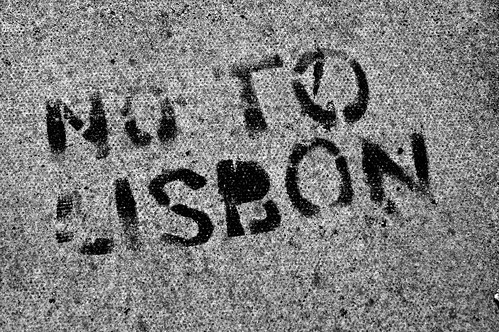
This morning sees early evidence of the difficulties David Cameron will face on Europe, if he ends up leading a minority government or has a very slim majority.
The Spanish presidency has set out proposals to amend the Lisbon Treaty in order to allow 18 additional MEPs to take up their seats (read Bruno Waterfield for background). The Conservative Party’s Eurosceptic wing sniffs an opportunity: maybe this will allow a new PM to throw the entire treaty back up in the air.
The Taxpayers’ Alliance leads the charge:
It has been widely assumed that the hope of a Lisbon Treaty referendum was dead and buried, but this development brings it back to the fore. David Cameron has always claimed that had he been in Government when the Lisbon Treaty passed through Parliament then he would have held a referendum. Will he now promise to hold a referendum on this new version of the Lisbon Treaty if he is in charge after the General Election? […]
Grasping this opportunity would be popular, strategically shrewd and – perhaps most importantly of all – honourable to the spirit as well as the letter of the Conservatives’ EU pledges. The failure to grasp it would not only be astonishingly shortsighted; it would be the final brutal betrayal of the pledges made to the British people in a general election – the election of 2005.
ConservativeHome weighs in, to great excitement in its comments, while England Expects mutters darkly about an entirely new Lisbon Treaty being ‘rammed’ through both Houses of Parliament.
This is a storm in a teacup, it seems to me – but it’s a sign, surely, of battles to come.
If he emerges from the election as PM, I expect David Cameron will need votes from Labour and Lib Dems if he is to avoid a series of fruitless rows with the UK’s European partners.
[Read the rest of our After the Vote series.]

Last month, Ireland withdrew its peacekeepers from the UN peacekeeping force in Chad. Some of their military hardware had tried to get home early:
The Irish troops were trying to keep bandits and various rebel gunmen from several large refugee camps. They quickly discovered that they had to get some suitable aircraft (helicopters and UAVs) to accomplish this task. They ended up leasing some Russian Mi-17 helicopters, complete with East European crews.
The Irish also bought two Israeli Orbiter UAV systems, for $550,000 each. Two of their six UAVs were lost in Chad. One UAV was lost when it apparently tried to fly back to Ireland, after it lost its communications link with the operator. The Orbiter is programmed to head back to the operator if it loses its comm link. But this Orbiter apparently still had a GPS location back in Ireland in its memory, and headed there. Since Ireland is 5,000 kilometers from Chad, the Orbiter ran out of juice and landed about 4,800 kilometers short of its goal.
(NB: on closer inspection, this story turns out to date back a few years, to an earlier phase of the Irish mission. Still tugs the heart-strings though…).
For a while today, Twitter lit up with speculation about a couple of bombs in Aldgate, East London – rumours that swirled around long after the Metropolitan Police had declared the incident a false alarm.
The scare was fuelled by tweets from those inside the security cordon, such as those from consumer affairs journalist, Sarah Modlock, who reported that there were “two IEDs, one in car, one in phone box. One dealt with and one being dealt with. Two roads reopened.”
Modlock has lots of very plausible detail, some of it from “mates” at the Royal Bank 0f Scotland, whose office she said was being targeted by the attack. “I just said what came up here as we were told – no spin,” she said, after the all-clear was given.

So… (i) Modlock is in her office desperate for information about what is happening out on the streets; (ii) she is picking up rumours and passing them on; (iii) her ‘privileged’ position within the evacuated zone gives her reports credibility – weak signals become strong ones.
These feedback loops are not new to social media. Something very similar happened when Katrina hit New Orleans and the media covered, as fact, an orgy of violence in the Superdome, where many of the city’s poorest and most disadvantaged citizens were sheltering.
Extremely graphic tales of how the poor were raping and murdering one another (30-40 bodies in the convention centre’s freezer, for example) turned out to be vastly exaggerated. Few of the reports of violence were later confirmed (though police are now known to have executed civilians).
According to Ed Bush, a public affairs official for the Louisiana National Guard, those inside the centre were hearing reports of atrocities from the media. They were then telling these stories back to journalists, creating a perfect storm of misinformation.
A lot of them had AM radios, and they would listen to news reports that talked about the dead bodies at the Superdome, and the murders in the bathrooms of the Superdome, and the babies being raped at the Superdome and it would create terrible panic. I would have to try and convince them that no, it wasn’t happening.
The Dome, of course, was characterised by information scarcity – “Cell phones didn’t work, the arena’s public address system wouldn’t run on generator power, and the law enforcement on hand was reduced to talking to the 20,000 evacuees using bullhorns and a lot of legwork.”
In contrast, Twitter (plus the rest of the social media) multiplies connections (absent a loss of power/Internet etc.). So, in a more complex emergency than today’s, can we expect denser networks, with the potential they allow for correction and multiple points of view, to provide a quicker or more tortuous route to the truth?
Update: According to the Sun:
Fake improvised explosive devices made up of artillery shell casings, mobile phones and Plasticine were spotted in the Suzuki Ignis car.
But it turned out the men, who work for a legitimate counter-terrorism firm, had just been showing them to business leaders in the Square Mile to warn of the dangers…
A police source said: “They couldn’t have picked a worse day. We will be having strong words with them over their stupidity.”
Ooops. (If true, of course. Maybe the Met could, y’know, put a statement on its website.)