by Daniel Korski | Feb 20, 2009 | Cooperation and coherence
Irrational exuberance is alive and well. Spawned by Obama’s candidature and sustained despite his recent setbacks, many people still seem to believe that all manner of foreign policy challenges can be overcome.
One of the most interesting parts of Barack Obama’s rise to power was the frenzied enthusiasm he garnered along the way. Even the mob-fearing Germans turned out in their thousands to hear him deliver unwelcome policy missives (“The Afghan people need our troops and your troops; our support and your support to defeat the Taliban and al Qaeda”). At times, Obama’s presidential candidacy verged on a cult of personality.
There were a few skeptics, to be sure. But most were curmudgeonly analysts or political adversaries. Few of the change-deniers seemed, well, seemed to be quite with it. In the main, people sang “Yes We Can”, swayed to Obama’s rhetoric and believed with all their hearts.
Little more than a month after his election, the sheen has not quite come off Obama, but his administration has taken a few direct hits. Tom Daschle, a former senator, was nominated as health secretary. As with two other Obama nominees, it subsequently emerged that he had failed to pay all his taxes, and he was forced to withdraw his name from consideration. The new treasury secretary, Timothy Geithner, has proved les adept at handling the economy that hoped. His first press conference saw markets tumble.
Despite these set-backs, there is no shortage of exuberance. Even hard-bitten analysts believe that in 2009-2010, world leaders can agree on a new NPT regime, establish a follow-on to the Bretton Woods systems, re-start the Doha round of multilateral trade talks and hammer our a climate deal in Copenhagen. Some even think that the entire multilateral system can be re-ordered while the US deals with NATO’s Afghan mission, Iran’s nuclear programme, Pakistan’s potential collapse, Russia’s rise, and the threat posed by a festering Middle East.
However, the truth is this agenda is probably too broad for one president, even two terms and certainly for the many stakeholders that now have to be brought into any of the global deals. The multilateral system will not be revamped, but remain a mosaic. If we are lucky, the economic crisis will be contained, but do not expect a new kind of managed globalization. George Soros has called for a eurozone government bond market, but it is hard to see European governments accepting such an overtly federalist move (which, incidentally, they rejected when the ECB was originally set up).
As to the many structural issues –- the NPT regime, climate change, the trade talks –- one or two may be solved, but certainly not all and certainly not in the next two years. Politically, trade-offs will have to be made between Iranian help in Afghanistan or an Iranian nuclear bomb. Between European unity or European energy security. Perhaps even between our economic well-being and poverty-alleviation elsewhere.
Like in the NICE decade — non-inflationary constant expansion — in which people forgot economic gravity, so people now seem to have taken leave of their foreign policy senses.
But a new world awaits. It may not look much different than the 19th century: power politics, “concert of Europe”-style diplomacy, inequality of states, spheres of influence, and interests, not values, as the driving forces behind international politics.
by David Steven | Feb 20, 2009 | Influence and networks
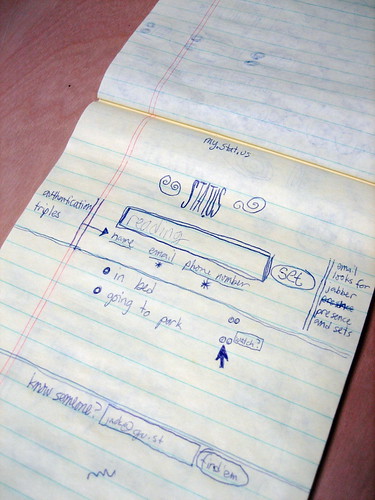
Courtesy Jack Dorsey
Jack Dorsey has been talking to the LA Times about his early sketch (from 2000) for STATUS, a service that would eventually be launched as Twitter.
What’s interesting is that urban resilience was a core part of Twitter’s inspiration:
Twitter has been my life’s work in many senses. It started with a fascination with cities and how they work, and what’s going on in them right now. That led me to the only thing that was tractable in discovering that, which was bicycle messengers and truck couriers roaming about, delivering packages.
That allowed me to create this visualization — to create software that allowed me to see how this was all moving in a city. Then we started adding in the next element, which are taxi cabs. Now we have another entity roaming about the metropolis, reporting where it is and what work it has, going over GPS and CB radio or cellphone. And then you get to the emergency services: ambulances, firetrucks and police — and suddenly you have have this very rich sense of what’s happening right now in the city.
But it’s missing the public. It’s missing normal people. And that’s where Twitter came in.
by Daniel Korski | Feb 20, 2009 | Africa, Conflict and security
The new African Union (AU) chairman Muammar Gaddafi — Tony Blair’s friend, Nicolas Sarkozy’s partner, freer of hostages, and friend to the enslaved –- has said he believes piracy is a way for poor Africans to defend themselves against the greedy Western nations.
On his first official visit to the African Union headquarter in Addis Ababa, Colonel Gaddafi told the union’s staff: Piracy is “a response to greedy Western nations, who invade and exploit Somalia’s water resources illegally”. The Brotherly Leader and Guide of the Revolution went on: “It is not a piracy, it is self defense. It is defending the Somalia children’s food.” So much for getting the AU to help in developing a comprehensive solution.
If the West do not like the Colonel’s views? Simple: “It is our planet and they can go to other planet”, says the Guide of the First of September Great Revolution of the Socialist People’s Libyan Arab Jamahiriya. Yeah, you tell them Colonel. They can go live in another solar system.
by Richard Gowan | Feb 19, 2009 | Conflict and security, Europe and Central Asia, Middle East and North Africa
Long-standing readers may recall that, about a year ago, I wrote a couple of posts about the need for the EU to get involved in stabilizing Iraq in the window of stability offered by the Surge. (What’s that you say, oh long-standing readers? You have no recollection of this? The posts are here, here and here, and related op-eds here and here).
Now, this argument didn’t exactly change the face of the Middle East, but it did start to seep out among the policy wonks back in Europe. Whereas a year ago, arguing for EU engagement in Iraq was roughly equivalent to professional cyanide, it’s now quite respectable. After all, both Nicolas Sarkozy and the German Foreign Minister have popped over to Baghdad this month. Sadly, M. Sarkozy didn’t have a chance to stand on a tank this time, but he looked positively Napoleonic behind his podium:

Taking trips to Iraq is one thing – having a policy is another. What should the EU do? The Heinrich Boell Stiftung published a collection of essays on Europe and Iraq this week, and Daniel and I have contributed an article to this. Daniel summarizes the case over on the ECFR website:
A new EU strategy should focus on: entrenching good governance, especially in the security sector; and investing in a framework for regional stability. Specifically, the EU should strengthen the EU Rule of Law Mission in Iraq, with a particular emphasis on police governance and strategic planning for Iraqi police; Europeanize the existing NATO military/gendarmerie mission in Iraq; and combine these two missions into one European ESDP mission, and add a third pillar dealing with border management and security. A senior EU envoy should be appointed to head this mission as well as an expanded Commission office in Baghdad.
A sign you’ve had a good idea is that someone else has just had it too, and FRIDE has published a good paper promoting similar ideas. I think that they have a medium-to-good chance of getting traction, not least because Swedish FM Carl Bildt has long favored a stronger EU role in Iraq, and Sweden will have the EU presidency from July. Watch out for the circle of golden stars fluttering over Tikrit and Najaf soon!
