by Charlie Edwards | Feb 1, 2008 | Global system
A common theme that has run throughout all presentations at Wilton Park is the reliance on stats. Presentations have been an orgy of numbers and percentages sprayed liberally on the unsuspecting audience. But the blur of digits comes at a price (literally if you are speaking about world energy demands in 2030). First and foremost we lose all sense of perspective. Faced with a succession of boxes on MTOEs it’s very easy to lose sight of what the real story is. Second, it becomes extremely tempting to use stats to support a set of questionable assumptions on the basis that your stats will trump everyone else’s. I reckon if we had taken a recording of all the presentations over the past couple of days then we would find a host of numerical discrepancies. Finally we dismiss the social and political issues at our peril. In our pursuit of hard facts and proven numbers we often miss the more nuanced conversations that are critical in understanding how the world works. Context in this game is everything.
by Alex Evans | Jan 29, 2008 | Climate and resource scarcity, Influence and networks
Last year’s big issue at Davos was climate change – unsurprisingly, given that it was the first time the WEF crowd had convened since the Stern Review was published and An Inconvenient Truth was released. This year, for all the worry about meltdown in financial markets, the big issue was by all accounts scarcity.
Gideon Rachman, writing his weekly column in yesterday’s FT, agrees:
Without a big short-term crisis to distract them, the international politics crowd were able to look at longer-term trends. They too are trying to understand the consequences of globalisation. But while the bankers grapple with the top end of the process – the movement of billions of dollars around the world financial system – the political analysts are increasingly preoccupied by the way globalisation is affecting people at the bottom of the pile. The costs of food and energy are rising fast. The availability of water is also becoming an issue, from Australia to Africa. The struggle for these three basic commodities – food, energy and water – came up repeatedly in Davos.
And he’s not only worried about the problem. Just as much of a concern is whether the world’s institutions and policy elites have the capacity to manage it:
Soccer crowds in England like to abuse match referees by chanting: “You don’t know what you’re doing.” If protesters had been able to get near the World Economic Forum in Davos last week, they could justifiably have aimed the same chant at the world leaders who assembled in the Alps.
These people are meant to be the “masters of the universe”: presidents, prime ministers, bankers, billionaires. If anybody can make sense of world events, it should be them. But the air of confusion in Davos was both palpable and alarming.
Update: rising food prices also got a mention in President Bush’s State of the Union yesterday…
by Alex Evans | Jan 21, 2008 | Cooperation and coherence, Influence and networks, UK
Adam Boulton at Sky News, travelling with the PM in India, gives us a heads-up of another speech on multilateral reform:
The Prime Minister believes that the world has changed so much since then that we need to rewrite the rules. He is particularly interested in the growing might of the so-called BRICs – Brazil, Russia, India and China – the last two of which he is visiting on this tour. Mr Brown cheered his hosts by repeating Britain’s longstanding view that India should join Britain, France, the US, Russia and China with a permanent seat on the United Nations Security Council. But in return he wants India to do more in the global conflict against fundamentalist terrorism. The Prime Minister also wants the UN to establish a standing rapid response team of judges, police, and civilian experts who can be deployed immediately to stabilize countries immediately following violent conflicts.
He seems to have the sub-prime mortgage crisis and the knock on collapse of Northern Rock on his mind in his ideas for the IMF. Mr Brown says it shoud become the “early warning system for financial turbulence”, with the powers to intervene as soon as potential financial crisis are identified. He wants the World Bank to focust on the environment as well as it’s existing mission of poverty reduction. He wants to set up a global climate change fund (Britain has already earmarked $1.6 billion for a similar project). This would be the carrot for poor countries to do something about their carbon emissions complementing the stick of rich nation threats.
Hang on, you say, isn’t there a slight sense of deja vu here? Why yes: it’s the same as his last speech on multilateral reform – and as I observed at the time, that speech in turn read like a re-run of the 2004 UN High Level Panel on threats, challenges and change. To be fair, it’s hard to find fault with the content. But it would be welcome to hear more about how the PM plans to achieve all this, given the snail’s pace of multilateral reform discussions over the last few years.
by Alex Evans | Jan 15, 2008 | Conflict and security, Cooperation and coherence, Influence and networks
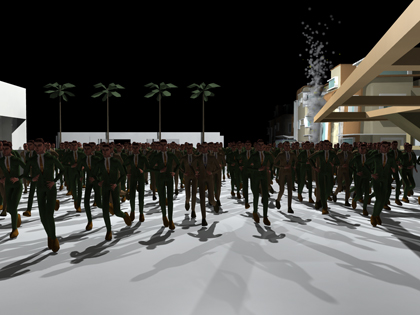
Regular readers will know that we do love a good old-fashioned urban panic here at Global Dashboard. So imagine the delight here when Bruce Schneier noted yesterday that Paul Torrens of the Arizona State University School of Geographical Sciences has devised a new computer simulation that models urban panic. Torrens’ own website has some very cool animated simulations of crowd behaviour, plus urban growth and sprawl too.

Torrens explains that “the goal of this project is to develop a reusable and behaviorally founded computer model of pedestrian movement and crowd behavior amid dense urban environments, to serve as a test-bed for experimentation. The idea is to use the model to test hypotheses, real-world plans and strategies that are not very easy, or are impossible to test in practice.” Schneier cites some examples which already have us drooling with envy and anticipation:
1) simulate how a crowd flees from a burning car toward a single evacuation point;
2) test out how a pathogen might be transmitted through a mobile pedestrian over a short period of time;
3) see how the existing urban grid facilitate or does not facilitate mass evacuation prior to a hurricane landfall or in the event of dirty bomb detonation;
4) design a mall which can compel customers to shop to the point of bankruptcy, to walk obliviously for miles and miles and miles, endlessly to the point of physical exhaustion and even death;
5) identify, if possible, the tell-tale signs of a peaceful crowd about to metamorphosize into a hellish mob;
6) determine how various urban typologies, such as plazas, parks, major arterial streets and banlieues, can be reconfigured in situ into a neutralizing force when crowds do become riotous; and
7) conversely, figure out how one could, through spatial manipulation, inflame a crowd, even a very small one, to set in motion a series of events that culminates into a full scale Revolution or just your average everyday Southeast Asian coup d’état — regime change through landscape architecture.
Or as Pruned puts it more colourfully, you could decide to
… quadruple the population of Chicago. How about 200 million? And into its historic Emerald Necklace system of parks, you drop an al-Qaeda sleeper cell, a pedophile, an Ebola patient, an illegal migrant worker, a swarm of zombies, and Paris Hilton. Then grab a cold one, sit back and watch the landscape descend into chaos. It’ll be better than any megablockbuster movie you’ll see this summer.
by Mark Weston | Jan 10, 2008 | Off topic
A Dutch company has taken steps to address my complaint about the ugliness of Israel’s West Bank wall. You pay the firm 30 Euros and it pays a Palestinian to spray a message on the wall. Paper-free greeting cards, anyone?
