by David Steven | Apr 8, 2008 | Cooperation and coherence, Global system, Influence and networks
In our Progressive Governance paper, Alex and I argued that ad hoc ‘shared platforms’ are a vital part of the management of a globalised world, particularly at times of rapid change. In Newsweek, David Rothkopf provides a glimpse of how these platforms have swung into action during the current financial meltdown:
To get a sense of how the world’s elite acts in a moment of global crisis, a moment like the one we are in now, it’s instructive to watch a player like Timothy Geithner at work. The New York Federal Reserve Bank president has been at the center of frantic behind-the-scenes efforts to stem the spread of the U.S. credit collapse, to manage the bank run that brought down Bear Stearns, and many crises before it…
Because interest-rate changes and cash infusions have less lasting impact on markets than in the past, the power of central banks is effectively more limited. In today’s world, no one institution, not even the U.S. Fed, has the power to contain a crisis. Being a successful central banker now depends on what Geithner calls “a convening power … that is separate from the formal authority of our institution and which can be a very powerful tool.” […]
Recalling an earlier crisis in global securities markets that he helped to manage, Geithner said the Fed brought together the leaders of the world’s 14 major financial firms, from five countries, representing 95 percent of all the activity in global markets. The Swiss were there, the Germans were there, the British were there. Interestingly, no Asians were there, not even the Japanese. Goldman Sachs chairman and CEO Lloyd Blankfein “jokingly called them ‘the 14 families,’ like in ‘The Godfather’,” says Geithner. “And we said to them, “You guys have got to fix this problem. Tell us how you are going to fix it and we will work out some basic regime to make sure there are no free riders to give you comfort; you know that if you move individually everybody else will move with you.”
There was nothing in writing, no rules, no formal process, and while no one asked the Fed to act, the Fed let everyone in the markets know it was acting. The beauty of the process was its absolute efficiency, seeing what a tight circle of large firms with “some global reach” could get done, fast-with an executive committee of only four running the weekly conference call until the crisis was past. “There is no formal mechanism we could have used to force this on anybody, so we had to invent it. I think the premise going forward is that you have to have a borderless, collaborative process. It does not mean it has to be universal, every jurisdiction or every institution,” said Geithner. “You just need a critical mass of the right players. It is a much more concentrated world.”
In Superclass, his new book on global elites, Rothkopf identifies a group of around 6000 key movers and shakers – literally ‘one in a million’. Their role is generally a stabilising one, if they can keep in line with the wishes of the wider population (a point echoed by Gideon Rachman in the FT today). But sometimes it doesn’t work out this way:
I once overheard a dinner conversation among the CEO of a leading aircraft manufacturer and a senior member of the U.S. House Armed Services Committee. “Here’s the deal,” said the CEO. “I want to sell a plane to Muammar Kaddafi and he wants to buy one. But we have sanctions in place that won’t let me sell to him. The U.S. wants this guy dead. So, what I’m thinking is, if you help me get the OK to sell him the plane, I’ll build with explosive bolts connecting the wings to the fuselage. Then, one day he’s up flying over the Med and we push a button. He’s gone. I make my sale. Everyone’s happy.” Fortunately, the conversation took place in the 1990s, a time before U.S. foreign-policy makers began bending international laws to achieve national security goals. The congressperson declined the offer.
by David Steven | Apr 7, 2008 | Climate and resource scarcity, Conflict and security, Cooperation and coherence, Global system, Influence and networks
On Saturday, Alex and I presented our paper on multilateralism and global risks to heads of state at the Progressive Governance Summit, which was chaired by Gordon Brown.
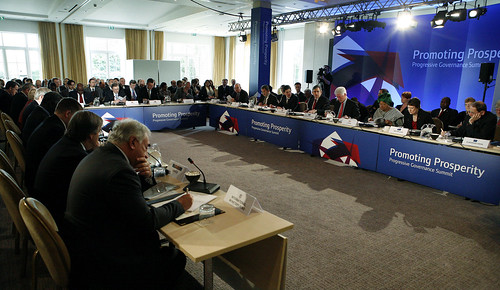
The summit was held at the Grove Hotel in Watford – which is more used to hosting the England football team and posh weddings. Locals – who were warned they would be searched before entering the hotel’s spa – seemed less than impressed at the interruption, though a few did manage to sneak in for a round of golf (though perhaps they were snipers in disguise).
And inside? We got a nice plug from Helen Clark, New Zealand’s PM, and from Africa’s first elected female head of state, Ellen Johnson-Sirleaf. Bill Clinton was also lucky enough to be collared by Global Dashboard’s Charlie Edwards on his way back from the lav, which I am sure was a highlight for both of them.
In discussion, two topics predominated. First, the global financial meltdown, with Kevin Rudd (surely the wonkiest head of state ever) fretting that ‘technology has got ahead of the regulatory environment,’ or in other words, men with computers are doing stuff with money that no-one, including the men themselves, really understands or can control.
A few leaders, Austria’s Alfred Gusenbauer among them, were calling for a World Finance Organisation to be created as an institutional big brother to the WTO (can you imagine the protests outside a WFO annual meeting?). But most were happy to settle for a revamped IMF to act as an ‘early warning system’ and for rapid action to, in the words of the head of the IMF, “disentangle the good and the bad banks”.
A global trade deal was also seen as a vital part of restoring confidence, with the WTO’s Pascal Lamy making it sound as if the conclusion of a ‘strong pro-development, pro-growth round’ was just around the corner. Peter Mandelson, who leads on trade for the Europeans, was a little less bullish, I thought.
Mandelson agreed that ‘night and day drilling’ into the detail of a proposed agreement was yielding results, but he argued that any further delay could be fatal for a deal. 2009 should be written-off, he said, due to a changing of the guard in the US in the first half of the year and in the European Commission in the second. Any agreement would have ‘turned to mush’ by 2010, he concluded.
It was a provocative point and a worrying one, given that 2009 is supposed to be the year the world does a deal on climate. How’s that going to work if everyone is too busy settling into new jobs to pay attention?
I thought the climate discussion was rather disappointing, despite Kevin Rudd’s attempt to muscle some shape into it. The climate paper was presented by Laurence Tubbiana (co-author Nick Stern had a more pressing engagement!) and she set out the same ‘seven elements for a global deal’ that Stern was promoting at Bali. It’s an unobjectionable list, but I am unconvinced by Tubbiana and Stern’s optimism that a deal will be easily struck.
Their framework, they argue, could “allow all countries to move quickly along what they see to be a responsible path”.
What is very striking here is how broadly basic understandings have already been established. Country-by-country we see targets being erected and measures being set by individual countries recognising their own responsibilities as they see international agreement being built. People seem to understand the arguments for action and collaboration on climate change much more readily than they do for international trade.
In the discussion, it was clear that leaders accepted the need for targets. After all, who doesn’t? But there seemed very little consensus on who should do what. It’s only when countries start to work out whether a global deal seems fair to them that we’ll really know whether or not it’ll be a rocky road to Copenhagen.
But climate felt like a little bit of a sideshow, with leaders keen to spend time on another scarcity problem – food. This is an area where my co-author, Alex Evans, is carrying out pioneering work (also see this summary) and it was clear how worried leaders are by rocketing prices.
But will that make any difference? In my part of our presentation (we’ll have text and perhaps some video later), I wondered whether food was going to be another ‘slow motion car crash’ like HIV/AIDS twenty years ago. Is it one of those problems that everyone can see coming, knows is going to be catastrophic, but is unable to do anything useful about? Time will tell.
by Jules Evans | Mar 26, 2008 | Global system, Middle East and North Africa
Record commodities prices have given countries like China, Singapore, Russia, Kuwait, Abu Dhabi and UAE control over trillions of dollars, which they have stowed away in sovereign wealth funds (SWFs), that are now hovering over the global financial system like mighty hoovers, sucking up whatever assets cross their path.
The SWFs have, in the last 12 months, been on an almighty spending spree. Gulf SWFs, for example, spent an extraordinary $83 billion on 173 deals in 2007. That means SWFs are now, in the opinion of some experts, the main driver of merger & acquisition activity in the world.
Stephen Barrett, international chairman of corporate finance at KPMG, says: “With the right people in place – and experience of some major deals under their belts – the SWFs could rapidly assume the mantle of deal-making kingpins, relegating the private equity houses and corporates to second and third place.”
Perhaps with a view to getting ‘the right people in place’, many Asian and Gulf SWFs have been forging close links with leading Wall Street banks, both by getting their advice on major acquisitions, and by actually buying stakes in those banks.
Thus in the last 12 months, the Kuwait Investment Authority has invested $3 billion in Citigroup and $2 billion in Merrill Lynch; the Abu Dhabi Investment Authority has invested over $7 billion into Citigroup; the Mubadala Development Company from the UAE invested $1.3 billion into the Carlyle Group and another $1.2 billion into the hedge fund Och-Ziff Capital Management Group; the DIFC from UAE invested over $4 billion building up stakes in OMX and the LSE; while the Qatar Investment Authority has also spent billions of dollars building up stakes in Credit Suisse and, it is rumoured, Royal Bank of Scotland – and says it intends to spend a total of $15 billion on western financial stocks.
In other words, Gulf SWFs have taken a massive bet on the continued health of the western financial system. Whether these are good bets remains to be seen – so far, for example, Citigroup’s stock price is down 21% since Abu Dhabi invested $7.5 billion in November. The China Investment Corporation’s $5 billion investment in Morgan Stanley is down by a similar amount.
But the challenge for the SWFs is where to put all their money. They have, literally, an embarrassment of riches. And this could prove to be a historical low for western bank share prices, and a great buying opportunity for SWFs.
On the other hand, some analysts are wondering if SWFs could, themselves, replace Wall Street banks as the biggest deal-makers, the biggest global lenders, and the biggest hirers of financial talent. Banks like Merrill Lynch, Credit Suisse and Citigroup are already scrambling to set up big offices in the main Gulf and Asian countries, so as to offer their financial advice to the SWFs and other big emerging market investors.
So, rather than paying banks millions of dollars in advisory fees, why don’t the SWFs just hire the cream of Wall Street’s deal-makers and get them to work for them? Wouldn’t that be cheaper? But if they did poach bankers from Wall Street, wouldn’t that undermine their investment in the banks and funds where these deal-makers used to work?
Such are the confusing dilemmas presently facing SWFs. As one banker I spoke to said yesterday: ‘They don’t have a plan as such. They are making it up as they go along.’ SWFs have abruptly and unexpectedly found themselves at the driving wheel of the global financial system. Freaked out by this, they have handed the wheel to…Wall Street bankers, who are exactly the people who crashed the car last time!
by Jules Evans | Mar 18, 2008 | Global system, Influence and networks
Back in September 2002, I wrote a cover story for Euromoney called ‘The End of Unfettered Capitalism’. I interviewed various wise sages of finance (Joseph Stiglitz, George Soros, er…Ann Pettifor) who opined to me of the end of neo-liberalism and the need for a new economic model.
Back then, in the aftermath of Enron and the bursting of the internet bubble, the financial press was full of soul-searching and chest-beating articles, usually by John Plender, wondering where free market capitalism had gone wrong and where it was heading.
My article was the culmination of two years of quiet guerilla warfare against free market finance, which I had waged since becoming a financial journalist after university. I secretly hated the free market, which I blamed for frustrating my desire to be a Sixties-style creative hippy. So I spent most of my time writing articles trying to find chinks in the armour of international finance, as an exercise in self-liberation…
It was quite fun to do this, while working at Euromoney – perhaps the arch-organ of international capital. And it was pretty easy to do, in 2000-2002, while financial markets were imploding.
But then, you know what happened? Firstly, I started to find proper outlets for my frustrated hippy creativity, so I became less of an emotional malcontent (one wonders how much radical criticism emerges as much from the emotional maladjustment of the critic as from the political maladjustment of their society); and secondly, I started to realize that actually private financial markets worked quite well, and the people who criticized them – people like Ann Pettifor, for example, or John Pilger, or Noreena Hertz – were by no means experts about the financial systems they criticized. (more…)
by Alex Evans | Mar 17, 2008 | Europe and Central Asia, Global system
…as the eurozone overtakes the United States of America.
FRANKFURT (AFP) — The dollar’s plunge has made the eurozone the world’s biggest economy by one measure and has underscored shifts that are reorienting the 15-nation bloc towards Asia, Russia and oil-rich Gulf states, analysts say.
“With the euro now trading around 1.56 against the dollar, the size of its annual output (at market value) has exceeded that of the United States,” US investment bank Goldman Sachs estimated last week.
