by Alex Evans | Jan 7, 2009 | Cooperation and coherence
Here is what happens when you arrive for a meeting at the United Nations (where David and I currently find ourselves).
Once you’re through security, you go to a reception desk in the large hall of the General Assembly building.
If you are naive enough to present yourself to one of the people behind the desk and ask for the person whom you’re due to meet, a rude awakening awaits.
Instead, you are pointed towards a small bank of telephones further along the desk, where you must phone the person you’re meeting yourself and announce your own arrival.
No, there is not a directory of staff phone numbers (duh). But let us assume that you display adaptability and have your contact’s number stored in your phone. What next?
In due course, someone will arrive from Upstairs to escort you.
Finding each other is no easy task. A number of people are waiting for meetings (this being the main reception hall for the whole UN); in addition, there are people waiting for guided tours, people using the free internet terminals, people buying special UN commemorative stamps and people looking at the nice exhibition organised by the Department of Economic and Social Affairs.
But let us assume that you manage to find each other. Together, you now move around to a new window on the reception desk.
Here, your escort will fill out a form with their details.
The person behind the desk takes your ID and scrutinises it carefully. He or she then fills in some more details on the form.
Your escort is handed a chit.
You and your escort then move another metre or so around the reception desk (for it is circular) to another window. Two uniformed security officers await you.
Your escort hands over the chit.
The first security officer warily examines the chit that their colleague (standing approximately half a metre to their left) has just issued.
Should it prove satisfactory, he or she will then fill out another chit (one assumes that there may be a degree of overlap in the respective content of the forms).
The second chit is then handed to the second security officer, who scrutinises it warily. Should it prove satisfactory, you are then awarded a special prize given to the UN’s most persistent guests: a Visitor’s Pass.
You are now back where you started before you were pointed to the phones.
Elegant, no?
by David Steven | Dec 2, 2008 | North America

Marc Ambinder writes:
So where does Hillary Clinton’s foreign policy cabinet hang its hat for the next four years?
Her main team consists of:
Richard Holbrooke, the former U.S. Ambassador to the United Nations and Dayton Peace Accord broker; Clinton’s chief defense adviser, Bob Einhorn, a Clinton administration veteran and non-proliferation expert, Andrew Shapiro, Clinton’s chief foreign policy adviser, Wendy Sherman, a senior adviser to Madelieine Albright and Warren Christopher, and Melaine Verveer, a former Clinton chief of staff and longtime Clinton confidante.
Now — signing up for Team Obama, especially when things were not looking so hot in late 2007, was a real act of professional courage for many Obamaites. And there was quite a bit of tension between the two camps — although it’s not clear whether the principals listed above were involved.
Tensions have cooled; Clinton advisers are assisting Obama’s transition team and serving on several advisory committees. But staff is destiny, and there are conflicting reports about how much latitude Clinton will have to bring her own team aboard.
I’d say Ambinder underplays the irony of the situation. As Alex noted over a year ago, the Clinton camp let it be known that no foreign policy expert associated with Obama’s primary campaign would be welcome to change sides once Hillary won her inevitable nomination.
Team Clinton has put the word out that the usual process – whereby foreign policy advisers to other candidates are allowed to switch horses as and when their candidate gets eliminated during primary season – has been abolished, at least as far as Hillary as concerned. The ‘you’re with us or against us’ ethos is no longer limited to the GOP, it seems…
Clinton’s people are lucky that their boss’s new boss is a more forgiving type…
by Richard Gowan | Nov 25, 2008 | Africa, Conflict and security, Global system, Off topic
Like the UN didn’t have enough problems already… After Darfur and Congo, the blue helmets have to take on Jack Bauer. The two-hour prequel to the new series of 24, aired in the U.S. last weekend, appears to have been scripted by John Bolton:
JACK Bauer sustains the usual bumps and bruises in the long-awaited two-hour “24” movie on Fox, but it’s the United Nations that really takes it on the chin.
The producers of “24” evidently have zero respect for the UN. To hammer the point home, their two-hour movie – “24: Redemption,” premiering Sunday, Nov. 23 – includes a representative of a UN “peace-keeping” force who just might be the most spineless, loathsome character ever created for this show.
First, this weasel refuses to believe urgent, eyewitness accounts that heavily armed rebels in the fictional African country of Sangala are sweeping the countryside kidnapping schoolboys and forcing them to become soldiers in the rebel army.
Then, when some of the rebels come rolling up to the rural school where Jack (Kiefer Sutherland) has been helping a former Special Forces colleague (Robert Carlyle) work with orphans, the UN guy (played by Sean Cameron Michael) declares that he’ll pacify the rebels simply by chatting with them.
After catching a glimpse of them, however, he immediately runs to join the children in an underground shelter, leaving Jack to fend off the rebel group all by himself. As if that wasn’t cowardly enough, he later decides to save his own skin by telling the rebels where Jack and the children are hiding.
The producers took pains to make the UN rep look as foolish as possible, even though the impotence of the UN is not even a major plot point in this movie, whose real purpose is to set up the seventh season of “24,” scheduled to start, at long last, in January.
I’d quite like to see a version of “24” accurately depicting the UN’s impotence: tremble as Jack Bauer attempts to get a code cable agreed by all parties, and fails. Thrill as there is a dispute over whether Mr. Bauer can take non-insured personnel in a UN 4×4. Gasp as he has holds a multi-stakeholder workshop with the World Bank and European Commission…
by Charlie Edwards | Nov 16, 2008 | Economics and development, Middle East and North Africa, North America, UK
The web-comic Shooting Wars, hit people’s screens in May 2006. It followed a young journalist named Jimmy Burns, who found himself video-blogging across the front lines of Iraq in the year 2011. At the time of its release, only a handful of people were ready to believe US forces would be in the country for much longer. In 2006 sectarian violence was spilling across streets and districts in Iraqi cities. Infighting, both between Iraqis and the coalition forces occurred with depressing regularity. Most notably, a British Brigadier attacked America’s ‘Hollywood’ generals in April, while later in the year, the Iraq Study Group “strongly urged” a large pull back of American troops in Iraq in a private note leaked to the media. The Independent’s Middle East journalist Patrick Cockburn summed up the hopelessness of the conflict at the end of 2006:
The sense of Iraqi identity may have been damaged beyond repair. But, more than most states, Iraq is dominated by its capital and Shia and Sunni will continue to fight to rule Baghdad until they either win or know there is no hope of victory.
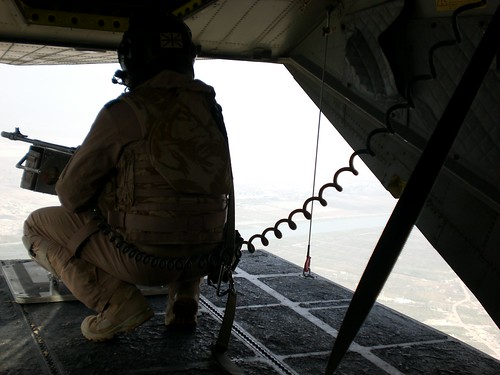
View of Basra from a Merlin Helicopter
What a difference two years makes.
(more…)
by Alex Evans | Nov 13, 2008 | Climate and resource scarcity, Cooperation and coherence, Global system, London Summit
Ahead of this weekend’s G20 summit, David and I have published a short paper entitled A Bretton Woods II worthy of the name. Key points:
– The summit is unlikely to be able to live up to its billing. Leaders do not yet understand the nature of the problem well enough to be able to implement viable solutions. However, the problem is more fundamental than a simple lack of shared awareness.
– History suggests that leaders will only think the unthinkable on institutional reform once the challenge they face has really hit rock bottom. But history also suggests that we are wrong to think that the worst of the crisis is now past, given that many past banking crises have taken five years or more to unravel.
– Bretton Woods 1 looked across the whole international economic waterfront in 1944, while this weekend’s summit will be much more narrowly focused. Leaders will make a big mistake if they try and tackle finance in isolation, given the growing impact of resource scarcity, and that 2009 is supposed to see another ambitious global deal – on climate.
– We need to recalibrate what we expect from globalization through a serious debate about subsidiarity. Where has globalization gone too far, too fast? Where do we need more integration at a global level? These were exactly the questions that preoccupied Keynes in 1933, when he weighed the relative benefits of global versus local across a range of variables. We need a similar debate today as a precursor to serious international economic reform.
– Leaders need to extend their horizons in (at least) five directions: onto longer time scales; beyond financial regulation into wider resource scarcity challenges; into other international processes, especially climate; towards grand bargains with emerging powers; and beyond government, to non-governmental networks.
Full version after the jump, or better yet here’s the pdf.
(more…)
