by Alex Evans | Oct 27, 2008 | North America
Since I’ve already renounced any and all claims to knowing anything about US politics, I’m happily unburdened by any pressure to predict the shape of an Obama cabinet should he win. But what are the experts of the commentariat predicting?
I spent some time this afternoon ranging far and wide over t’internet in search of speculation on who’s in line for the key foreign policy-related posts in an Obama Administration (Secretary of State, Secretary of Defense, Director of National Intelligence, National Security Adviser and Ambassador to the United Nations) – using a thoroughly unscientific but broadly mainstream selection of 20 newspapers, magazines, foreign policy experts and foreign policy bloggers.
As I surveyed this glittering array of insight, these were the names that came up at least three times each:
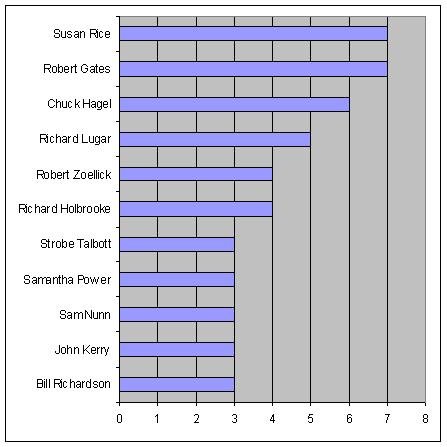
Why yes, since you ask: four out of the top five names are Republicans. A ‘government of all the talents’, as you might say.
(Gideon Rachman goes further than most in applying this admirable principle: he’s gleefully suggesting Sarah Palin for Ambassador to Russia. As he observes, “The governor’s taste for hunting, plain-spoken talk, and foxy boots—not to mention long years of staring at Russia from Alaska—ensure a special relationship with Putin.”)
by Alex Evans | Oct 22, 2008 | Cooperation and coherence, Influence and networks
If you haven’t read it already, World Bank President Bob Zoellick’s speech on multilateral reform earlier this month is definitely worth a read. One of best nuggets in it is his call for “a Facebook for multilateral economic diplomacy” – the rationale for which goes like this:
The G-7 is not working. We need a better group for a different time. The G-20, though valuable, is too unwieldy in moving from discussion to action. We need a core group of Finance Ministers who will assume responsibility for anticipating issues, sharing information and insights, exploring mutual interests, mobilizing efforts to solve problems, and at least managing differences.
For financial and economic cooperation, we should consider a new Steering Group including Brazil, China, India, Mexico, Russia, Saudi Arabia, South Africa, and the current G-7. Such a Steering Group would bring together over 70 percent of the world’s GDP, 56 percent of world population, 62 percent of its energy production, the major carbon emitters, the principal development donors, large regional actors, and the primary players in global capital, commodity, and exchange rate markets.
But this Steering Group would not be a G-14. We will not create a new world simply by remaking the old. It should be numberless, flexible, and over time, it could evolve. Others may be added, especially if their rising influence is matched by a willingness to help shoulder responsibilities.
This new Steering Group should meet and videoconference regularly to foster group responsibility. The Deputies should have frequent and informal discussions. An active network of bilateral consultations within and beyond the group will support it. We need a Facebook for multilateral economic diplomacy.
It’s a timely reminder that there’s no hard and fast rule to say that multilateral cooperation has to revolve around formal multilateral organisations – and especially refreshing to hear this coming from the head of the World Bank. (And yes, he does have a Facebook page, since you wonder.)
Responses to the financial crisis over the last few weeks seem to bear out Zoellick’s point. Although multilateral cooperation has been central, multilateral organisations haven’t been: the IMF, for example, has been largely absent from the main action, and while the EU managed in the end to be at the forefront of marshalling a collective response, it was the Council of Ministers – not the Commission – that pulled it all together.
In this light, it’s perhaps ironic that while Gordon Brown has come to be seen as one of the main organisers of this non-organisationally-based but nevertheless fundamentally multilateral crisis response, his stated vision for multilateral reform is very organisationally focussed, what with emphasis on a new Bretton Woods, an enhanced early warning role for the IMF and so on.
by Richard Gowan | Oct 12, 2008 | Europe and Central Asia, Global system, Off topic
In a new series, I will be introducing a series of commentators on international affairs whose views are (in my opinion) inherently redundant. First up, Borislav Milosevic on the Nobel prize:
MOSCOW – The brother of late Serbian leader Slobodan Milosevic on Friday condemned the choice of the former Kosovo negotiator Martti Ahtisaari for the Nobel Peace Prize.
“It’s rare for the Nobel Prize to be used for political goals, this is one of those,” Borislav Milosevic, the former Yugoslav ambassador to Russia, told Echo of Moscow radio.
“I’m distressed by this decision and I do not consider Ahtisaari a deserving winner,” said Milosevic, the Moscow-based brother of the former autocratic Serbian president who died in 2006.
by Richard Gowan | Oct 11, 2008 | Climate and resource scarcity, Conflict and security, Cooperation and coherence, Europe and Central Asia, Global system
The UN and NATO have signed a – not very radical – declaration about their cooperation in places like Afghanistan and Darfur, and the Russians are peeved:
Moscow on Thursday accused NATO and the United Nations of secretly forging an agreement that tightens their cooperation without informing Russia, a U.N. Security Council member whose relations with NATO are badly strained.
Foreign Minister Sergey Lavrov said Russia was aware an agreement was in the works and assumed it would be shown to member states for review. “This did not happen, and the agreement between the secretariats was signed in a secretive way,” Lavrov said.
Russia’s anger reflected its wariness that closer relations could give NATO more clout at the United Nations, where Moscow holds veto power as a permanent Security Council member. Russian Foreign Ministry spokesman Andrei Nesterenko suggested that top U.N. officials went back on their word. “We were assured at the highest level of the U.N. secretariat that no such document would be signed without informing us in advance,” he said.
It was silly of the UN to let this come out the same week that the Security Council agreed to extend the UN monitoring mission in Georgia. But this agreement has been in the works for ages. I recall seeing a draft in 2006, although this was covered in scribbled deletions from the French, who didn’t want it to overshadow cooperation between the UN and EU. For a time, it looked like the deal was dead, but there’s been a lot of interest in it at the very top of both NATO and the UN.
I don’t think the Russians should worry too much: this is a piece of paper that summarizes a vast amount of UN-NATO cooperation that is already happening.
But signing it was a mistake for the UN. As a report overseen by Lakhdar Brahimi implied earlier this year, UN staff are seen as legitimate targets for terrorists and malcontents worldwide because it is associated with U.S. and Western interests. The challenge in an Afghanistan is for the UN to maintain some political autonomy. Even a low-profile declaration like this makes it just a little harder to do that.
And this minor diplomatic incident points to a growing conceptual problem for fans of multilateral security cooperation. This is a naive belief that all international security institutions have, or could have, shared goals and that we simply need to link them up better to meet those goals. This is a hangover from the happy days of the 1990s, when the West still had a grip on pretty much every organization from the UN to Boy Scouts, but it’s not sustainable in a more competitive world.
NATO and the UN have fundamentally different roles: the first is still, in the final analysis, a framework for Western security while the latter is a place to do deals between disunited states. The two can cooperate case-by-case, but this deep political difference remains. And it should remain – our best hope for resolving threats in a competitive world is to keep our range of political options open.
I think the only really interesting question in security cooperation at present is how we maintain and nurture sufficient institutional pluralism in the international system. “Diverse institutional responses to diverse threats” is my new slogan.
Acute readers will note that this is rather different to what Alex and David have been saying about climate change, commodity prices, etc. – i.e. we need shared awareness and shared platforms to tackle new challenges – not to mention the swirling demands for an international response to the financial crisis.
I’ll freely admit that I’m skeptical about the idea of truly shared understanding in ANY political realm (isn’t it just an old Enlightenment fallacy back to disturb the system?) but I do share the analysis that on an issue like climate change, international convergence on a (probably rather minimal) shared awareness of the threats involved and mechanisms to respond is necessary and just possible. Maybe. Climate change now is probably in the same category as nuclear proliferation during the Cold War: everyone can be scared into signing a big deal to tackle it, which is how we got the NPT, a pretty amazing treaty in retrospect.
But even as Russia and the U.S. were moving towards the NPT, they were on alert in Europe and Asia. It is possible to converge on global problems while competing on diverse localized security issues. So I’ll leave the search for common platforms to my colleagues, and argue for uncommon platforms down below.
by Charlie Edwards | Oct 6, 2008 | Latin America and the Caribbean, North America
Last week Fox News interviewed CIA Director Michael Hayden on which countries the next US administration should focus their attention on. In summary:
North Korea: ‘Aid weakness and poverty have made North Korea more aggressive as it threatens to restart work on its nuclear weapons program.’
“Axis of Oil”: ‘$100 per barrel have emboldened Iran, Venezuela* and Russia. Russia’s invasion of Georgian territory in August and Iran’s continued work on acquiring nuclear weapons only compound the threat’.
For background read this.
* Is Venezuela the new Cuba, Iran the new Russia?
