by Richard Gowan | Sep 30, 2008 | Africa, Conflict and security, Cooperation and coherence, Europe and Central Asia
Readers will know that I have an unhealthy interest in the supply of helicopters for peace operations. There aren’t enough of them, and those that do exist aren’t always reliable – one crashed in Darfur yesterday, with four fatalities. So you might have imagined that I’d welcome the news that the EU is about to get four Russian transport helicopters, complete with ground crews, for operations in Chad:
The EU force commander, General Patrick Nash, says talks about the Russian helicopters are “very advanced”. The operation – called Eufor Chad/CAR – has been hampered by a shortage of helicopters, needed to reach refugees scattered over a vast area of desert.
The Russian helicopters – expected to arrive in November – will boost by one-third the number available to the EU forces in Chad, Gen Nash said. “With 3,500 troops in an area of operations the size of France, you cannot have enough air assets,” he told a news conference on Monday.
That’s true, but there’s obviously a bigger question at stake here: should the EU be accepting Russian support in one peace operation just when it is deploying monitors for another in Georgia? As I’ve pointed out before, there’s a risk that the EU guys watching South Ossetia and Abkhazia will be seen as stooges for the Russians. Today’s IHT reports that the Russians are setting new limits on the EU observers even as they arrive. This news from Chad may not help improve that picture.
Of course, it’s arguable that working with Russia in conflict areas outside its self-declared sphere of interest may be one way to stop it detaching from the international community altogether. Before the Georgian war, French officials were musing on how involving Russia more closely in Western-led operations – including Afghanistan – might improve ties with the Kremlin. Now European and American diplomats are on the look-out for signs that Russia wants to heal scars left by Georgia. The agreement of a pretty anodyne resolution on Iran at the UN last week was duly welcomed as proof that Moscow doesn’t want to lose touch.
I don’t want to be a miserable bugger, but I’m not convinced that we have the optics right here. Getting Russia to provide limited help in Chad, or say the right things without serious consequences on Iran, is smooth diplomacy. But does it compensate for Russia’s behavior in Georgia? And is the fact that Moscow has four helicopters out in the desert going to alter its geopolitical priorities? The answer to those questions is, in essence, “ha ha no”. Our excitement about getting Russian choppers to sustain our – still fumbling – mission in Chad makes us look weak.
I’m not saying that the international community should refuse all Russian help. I believe that the UN, meant to promote collective security efforts among countries that don’t necessarily share common viewpoints, does have a significant interest in keeping Russia in the peacekeeping game. But the EU is not just the UN for White Guys (as I’ve just shown for ECFR, the EU is gradually losing its power to shape the UN’s agenda). It’s an alliance that will be taken seriously if it projects some power in its own interests. If it’s going to mount serious military operations, it needs to show that it’s self-sufficient, and not reliant on potential and/or actual competitors.
I hope the Russian helicopters are helpful in Chad, but they shouldn’t be there.
by Charlie Edwards | Sep 26, 2008 | Off topic
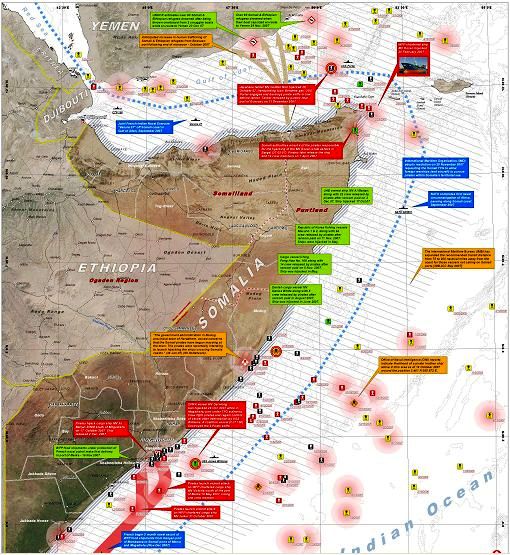
I know what you’re thinking. What are pirates going to do with 30 Russian T72 tanks? Not much probably but the rest of the cargo, a mixture of RPGs and the Zu-23 anti-aircraft guns will soon find their way into Somalia’s arms markets. The situation off the cost of Somalia is getting progressively worse. And while we will post more on piracy in the near future here’s a map outlining some of most recent attacks.

This passage from The Times gives you a sense of the scale and nature of the problem
Earlier this week the Danish navy freed 10 pirates it had captured at sea, saying they had insufficient evidence to prosecute them. But at the same time French officials have filed preliminary charges of hijacking and kidnapping against six suspected pirates captured earlier this month. Commandos snatched the six in a daring raid to free a French couple seized as they sailed their yacht along the Somali coast towards the Suez Canal. They are currently awaiting trial in a French prison. Six naval vessels are currently patrolling the waters around the Gulf of Aden and the Indian Ocean as part of an international task force to tackle piracy. However commercial shipping companies have criticised the mission for failing to make a difference.
“This is an international problem and needs an international solution. It will take more than the six or seven ships we have in 2.4m square miles of sea.”
Meanwhile, the Canadian navy has said that it will continue to escort emergency shipments of food into Mogadishu. Its frigate, HMCS Ville de Quebec, was due to return to the Mediterranean tomorrow but will spend another month ensuring that desperately needed supplies can reach Somalia. The World Food Programme of the United Nations had given warning that its deliveries would cease if an escort could not be found.
by Alex Evans | Sep 23, 2008 | Influence and networks, UK
Listening to Gordon Brown’s speech today, Philip Stephens notes that “Mr Brown kept his audience in its comfort zone”:
Though he set out the challenges Britain faces in a period of tumultuous global upheaval, Mr Brown did little to challenge his audience’s preconception that the present mess was all the fault of greedy capitalists.
Reading that brought to mind another Labour Conference speech in times of global upheaval: Tony Blair’s back in 2001. Remember this?
This is a moment to seize. The kaleidoscope has been shaken. The pieces are in flux. Soon they will settle again. Before they do, let us re-order this world around us.
I re-read the whole thing this afternoon, and was struck by a) its brilliance, b) its insight, c) how it soars compared to Brown’s speech today and d) the extent to which – in retrospect, with all that’s happened since – it shines with an eerie messianic fervour. It’s well worth another look: full text below the jump.
(more…)
by Alex Evans | Sep 22, 2008 | Global system, North America, UK
I’m not even going to try to form any kind of overview while things are moving so fast, but here are a few observations in no particular order:
First, just look at what happens to US indebtedness if the Paulson proposal proceeds. Alan Beattie moots the prospect of “the first trillion dollar deficit in history”. Today, the US federal government has $5,400 in debt, and according to the Congressional Budget Office planned to run a deficit next year of $438bn (3% of GDP). Now the Paulson plan is for $700bn over 2 years, meaning that next year’s federal deficit could easily top the $1,000bn mark. Former IMF chief economist Ken Rogoff concludes: “I can’t imagine this crisis is going to end up costing the government less than six to seven per cent of GDP.” Liam Halligan observes that “default by the US government is no longer unthinkable”. [Incidentally, UK government borrowing also looks set to double next year, to £90bn rather than £43bn as planned.]
Push-back against the Paulson plan is starting in earnest. Paul Krugman: “I hate to say this, but looking at the plan as leaked, I have to say no deal. Not unless Treasury explains, very clearly, why this is supposed to work, other than through having taxpayers pay premium prices for lousy assets.” He continues:
Here’s the thing: historically, financial system rescues have involved seizing the troubled institutions and guaranteeing their debts; only after that did the government try to repackage and sell their assets. The feds took over S&Ls first, protecting their depositors, then transferred their bad assets to the RTC. The Swedes took over troubled banks, again protecting their depositors, before transferring their assets to their equivalent institutions.
The Treasury plan, by contrast, looks like an attempt to restore confidence in the financial system — that is, convince creditors of troubled institutions that everything’s OK — simply by buying assets off these institutions. This will only work if the prices Treasury pays are much higher than current market prices; that, in turn, can only be true either if this is mainly a liquidity problem — which seems doubtful — or if Treasury is going to be paying a huge premium, in effect throwing taxpayers’ money at the financial world.
And there’s no quid pro quo here — nothing that gives taxpayers a stake in the upside, nothing that ensures that the money is used to stabilize the system rather than reward the undeserving.
Sebastian Mallaby agrees: “The plan is being marketed under false pretenses. Supporters have invoked the shining success of the Resolution Trust Corporation as justification and precedent. But the RTC, which was created in 1989 to clean up the wreckage of the savings-and-loan crisis, bears little resemblance to what is being contemplated now. The RTC collected and eventually sold off loans made by thrifts that had gone bust. The administration proposes to buy up bad loans before the lenders go bust.”
But as Gillian Tett notes this morning, the flipside problem is that if the Paulson plan doesn’t go ahead, it’s not clear what the alternatives are: “the unpalatable truth is that if this latest salvo does not calm the panic, then Mr Paulson simply does not have many more bazookas left in his arsenal … recent events have left market participants so exhausted that nerves are stretched to breaking point. That creates the risk that euphoria could flip to terror again. And while the equity markets might have ended last week in a jubilant mood, in the arena where it matters most – the murky bowels of the credit and debt world – terror remains widespread”.
Nouriel Roubini, meanwhile, reckons that in the wake of the first four elements of the crisis (collapse of the Structured Investment Vehicle system; a run on big US broker-dealers like Bear Stearns, Lehman and Merrill Lynch; the collapse of other leveraged institutions like Fannie Mae, Freddie Mac and AIG; and panic in the money markets), “the next stage will be a run on thousands of highly leveraged hedge funds“.
One last thought: the intellectual bankruptcy of the left in all this. A confident, forward-looking centre left would right now be moving forward into the breathtaking amounts of political space suddenly opening up as the ‘liberal capital markets’ storyline collapses. (Let’s remind ourselves of Milton Friedman’s sage advice once again:
Only a crisis — actual or perceived — produces real change. When that crisis occurs, the actions that are taken depend on the ideas that are lying around. That, I believe, is our basic function: to develop alternatives to existing policies, to keep them alive and available until the politically impossible becomes politically inevitable…)
But instead, the left is (as usual) unable to move beyond the politics of whingeing, offering its usual lame messages about “fat cats” and so on – which is why, as Gordon Brown seeks to play to the gallery at Labour Conference this week, his key lines lead on “irresponsible” City bonuses. Sure, let’s stuff the City and Wall Street; but could we focus on sorting out the mess first?
PS: great aside from Niall Ferguson in the FT –
The bad news is that emerging markets tend to experience more violent financial reactions to reductions in growth … Russia, having shot itself in the foot with its 1930s-style escapade in Georgia, is bottom of the heap – with its stock markets forced to close temporarily last week in order to avoid a complete collapse. (So much for “the return of history”. Memo to Vladimir Putin, Russian prime minister: when Hitler invaded neighbouring countries, he had capital controls in place.)
by Jules Evans | Sep 12, 2008 | Europe and Central Asia, Global system
I’m in Moscow for a few days, where the weather is miserable and the mood is worse. The stock market has lost 50% of its value since May, much of it since the Russian invasion of Georgia, which raised the political risk premium for Russian securities.
I happened to be here at the same time as the Valdai Group, an annual collection of some of the top Russia-watchers from around the world, who come here at the invitation of the government, to meet the Russian political elite. It’s arranged by Novosti, the state news agency. Yesterday the experts met with Putin, this morning they met with foreign minister Sergei Lavrov, and as I write they are meeting with Dmitri Medvedev, in the plush surroundings of GUM, the luxury department store next to Red Square. Why they’re meeting there I don’t know – perhaps Medvedev wants to show how rich and glamorous the new Russia is.
A friend of mine at Novosti let me in to the meeting with Lavrov this morning, on the strict understanding I didn’t directly report any of his comments, as all Valdai meetings are supposedly off-record, though I saw the Times’ diplomatic correspondent feverishly phoning in a story right after the meeting.
Anyway, a couple of interesting perceptions I came away with, which I think I can share without breaking my promise. Firstly, the title of Lavrov’s presentation was: ‘The World Geo-Political Revolution at the Beginning of the 21st Century: Russia’s role’. It made me laugh, because it was so grandiose. And yet it is also typically Russian – Russia has always been annoyed by the feeling it is young and immature compared to the West, and has always dreamt of in fact being in the vanguard, rather than bringing up the rear, and playing some sort of Messianic and revolutionary role in world affairs.
This is what Dostoevsky thought Russia’s role would be – the spiritual saviour of the world via Orthodox Christianity. This Messianism channelled itself easily into Bolshevism, and Russians took immense pride in the idea they were the vanguard of humanity, leading it towards a world geo-political revolution. And now, I guess, they are taking pride in the thought that they are leading a new geo-political revolution, from a unipolar to a multipolar world. Lavrov spoke about how many non-Western countries had expressed their support for Russia’s actions in Georgia, and even expressed nostalgia for the USSR, when the world was a balance of powers rather than unipolar.
The other thing that came up is Russia’s relationship with the UK. Lavrov mentioned an article he had seen, it was on the Telegraph’s blog, which quoted sources in the FCO saying Lavrov had held a very bad-tempered conversation with Miliband in which Miliband had been ‘forced to endure a four-letter-word tirade’. Apparently Lavrov had said ‘who are you to f- lecture me?’ and then asked Miliband whether he had the first idea of Russian history.
Lavrov denied such swearing took place, and said he had ordered the transcript of the conversation to be posted on the Russian Foreign Ministry’s website. I almost wish the story was true and he had told our uppity foreign secretary where to effing go. But you can tell clearly enough what he thinks of Miliband from his response to Miliband’s article in The Times here.
Lavrov must be getting tired of his private conversations with foreign ministers ending up in the press – another conversation with Condoleeza Rice ended up being made public in the UN Security Council, much to Russia’s chagrin.
Meanwhile, Miliband’s tough stance towards Russia just keeps getting tougher. Apparently, he cancelled the scheduled visit of some bag-pipers, who were going to play in a military parade on Red Square to celebrate Moscow Day. That’ll show them.