by Charlie Edwards | Apr 23, 2009 | Global Dashboard, UK
On Tuesday Demos launched a report I’ve authored called Resilient Nation. The report argues that we live in a brittle society with over 80 per cent of Britons live in urban areas relying on dense networks of public and private sector organisations to provide them with essential services. But our everyday lives and the national infrastructure work in a fragile union, vulnerable to even the smallest disturbances in the network. And both are part of a global ecosystem that is damaged and unpredictable.
So how does Britain protect against threats (like terrorism), hazards (such as natural disasters) and major accidents? Much of our infrastructure is outmoded and archaic. And with their narrow focus on emergency services and institutions, so are the policies that underpin it. The pamphlet calls for a radical rethink of resilience. Instead of structures or centralised services, it argues that citizens and communities are the true source of resilience for our society. Resilience, I suggest, is an everyday, community activity. It is people’s potential to learn, adapt and work together that powers it. Only by realising this potential will we succeed in building a resilient nation.
The report connects neatly with the Government’s own work on community resilience – which could be a central plank in the next iteration of the national security strategy and may be a public strategy in its own right. The general feeling I got from meetings with officials in central and local government and relevant agencies as well as from people in pubs, sitting rooms, warehouses and meeting rooms was that citizens and communities were the missing piece of the resilience jigsaw.
More often than not in the past no one really bothered to talk about what role citizens and communities could play and this was reflected in official guidance and advice where they were seen as ‘a problem to be dealt with rather than a source of help’.
In short – the shift towards a more citizen focused approach to resilience is happening…and in the summer the Government will unveil its own thinking on the subject (one hopes using the 4Es of community resilience ).
And then I remembered the Government’s response to the Pitt Review and I began to have serious doubts about whether such a strategy will succeed.
(more…)
by David Steven | Apr 1, 2009 | Conflict and security, London Summit

Space Hijackers have driven their armoured vehicle through the City, making it as far as the Royal Bank of Scotland – much to the amusement of everyone bar the police.
Like Charlie, I wonder whether they – the police – are making a mistake by fixating on demonstrators, rather than lower probability/higher impact threats, and on the capital, rather than the rest of the UK.
After all, the attack on the 2005 G8 came from Islamist terrorists and was not on Gleneagles itself (where security was suffocatingly high).
Following that pattern, I’d expect the threat level to be highest tomorrow morning – and in a city other than London, where many fewer security precautions have been taken. Given the Lahore cricket attacks, I wonder whether tonight’s football international at Wembley might be a target.
Panic not necessary. But a good time to be vigilant…
by David Steven | Mar 2, 2009 | Climate and resource scarcity
Over at The Interpreter, Sam Roggeveen objects to Jules’s call for national service to be used to toughen up the youth in the face of a changing climate.
This strikes me as completely contrary to the spirit of ‘resilience-ism’ (sorry; ugly, I know), which emphasises local knowledge rather than a top-down approach — giving communities the tools to help themselves rather than waiting for government to do it for them. It also raises my libertarian hackles (again): there are few better ways to empower the state at the expense of the individual than to have it conscript its youth.
Two points. First, why do we always want to conscript the young? To be sure, they make excellent cannon fodder, which is why national service was vital to the ‘total wars’ of the late 19th and early 20th century. But modern challenges are knowledge-intensive, needing people with much greater experience and skills.
So if we’re going to have compulsory service of any kind, let’s impose it on the post-war, baby boom generation – surely the most narcissistic generation of them all (in the spotlight as teenagers in the sixties, hippies in the seventies, yuppies in the eighties, middle aged and smug in the 90s, early-retired victims of age discrimination in the noughties)?
And second, I want to pick up on his Sam on his comfortable equation of resilience with bare-chested libertarianism. Alex and I began to delve into the politics of resilience in the most recent issue of Renewal. Our conclusion? Resilience is tough on all major strands of political thinking – libertarianism (or what Brits still think of as liberalism) included: (more…)
by Alex Evans | Feb 21, 2009 | Cooperation and coherence
One thing all serious experts on disasters and resilience agree on is the need to keep your morale up while everything you thought you could rely on is crumbling around you.
Brian Clegg’s Global Warming Survival Kit , for instance, has checklists to see if your outlook is flagging under the pressure. “Everything seems pointless” – check! “Always feeling sad, or simply blank” – check! “Feeling worthless and without value” – check!
Fortunately, help is at hand. The final chapter of his book offers a range of techniques for keeping chirpy: from ‘relaxation by breathing’ (Amanda Ripley‘s keen on that one too), making music, or – best of all – simply playing games. As Brian so rightly observes,
A stash of games is very useful if you have to entertain yourselves, and they will make good bartering objects too.
Well, here at Global Dashboard we know good advice when we see it – and of course it also goes without saying that we’re dedicated to helping our readers through these turbulent times as well. So we’re proud to unveil our own special game: Network Disruption Bingo.
During an exhaustive mapping process undertaken over a period of nearly 45 minutes, we’ve identified the key networks we all depend on but rarely stop to consider. Then (here’s the science part – concentrate), we’ve allocated points to each one depending on how bad it would be if it crashed, and put them on a special scorecard.
Print it out, and keep it safe for the dark nights ahead. You never know, you may be able to barter it for something useful.
by David Steven | Feb 20, 2009 | Influence and networks
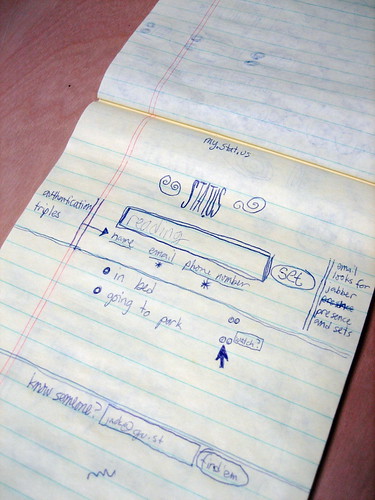
Courtesy Jack Dorsey
Jack Dorsey has been talking to the LA Times about his early sketch (from 2000) for STATUS, a service that would eventually be launched as Twitter.
What’s interesting is that urban resilience was a core part of Twitter’s inspiration:
Twitter has been my life’s work in many senses. It started with a fascination with cities and how they work, and what’s going on in them right now. That led me to the only thing that was tractable in discovering that, which was bicycle messengers and truck couriers roaming about, delivering packages.
That allowed me to create this visualization — to create software that allowed me to see how this was all moving in a city. Then we started adding in the next element, which are taxi cabs. Now we have another entity roaming about the metropolis, reporting where it is and what work it has, going over GPS and CB radio or cellphone. And then you get to the emergency services: ambulances, firetrucks and police — and suddenly you have have this very rich sense of what’s happening right now in the city.
But it’s missing the public. It’s missing normal people. And that’s where Twitter came in.
