by Charlie Edwards | Feb 3, 2008 | Conflict and security
The excellent FT Magazine has a review by Michael Skapinker of recent books on disaster and resilience. I don’t agree with the selection of books on offer (I think Lee Clarke, for instance, provides a much better analysis of worst case scenarios and their impact on humans), but Skapinker’s article makes for interesting reading all the same.
Aside from the now familiar explanation of black swans, our inability to anticipate them and our frequent failure to ‘connect the dots’ (as with the FBI officer in Minneapolis who told an uninterested headquarters that he was ‘trying to keep someone from taking a plane and crashing it into the World Trade Center’), the most interesting part of this review is about the difficulties that governments and the private sector have in evaluating risks and – based on their analysis – doing something about it.
According to Skapinker tragedy and disaster excites us:
Years after the immense San Francisco earthquake of 1906, which left 3,000 dead and half the city’s population destitute, Kathleen Norris, one of the survivors, said: “How I wish that to every life there might come, if only once, such days of change and freedom … Everyone talking together, dishevelled, excited, running to see what was happening elsewhere, running back, endlessly diverted, satiated for once with excitement.”
Our relationship with disaster is complex.
Our imaginations are drawn to calamity, as the entertainment industry knows: consider disaster movies such as The Towering Inferno or Titanic, or the popularity of fairground attractions such as the “ride of death”. When real disaster happens, we cannot help feeling something of the same thrill – provided we are not among the injured or bereaved. From the survivors and the families, as well as from the media, comes the demand to find out who knew what and when, who could have prevented the tragedy, and how the government plans to ensure it never happens again. The call for revenge is strong: 9/11 resulted in two wars that are still unwon.
The bad news is that we remain both unable to forecast calamity, and reluctant to pay the price of prevention.
Consider climate change: the overwhelming consensus of scientific opinion is that it is man-made, yet how many of us are prepared to give up our cars or holiday flights to mitigate its effects? The good news however is that we are becoming increasingly more resilient to shocks.
As Skapinker says much of the official response to 9/11 for example resulted in improvements for the future – the replacement buildings on Ground Zero will be sturdier and safer than the Twin Towers, for example. And it has always been the case that disasters create the spur for better infrastructure: fires and floods in the earliest days of American settlement led to the creation of insurance, fire brigades and safety regulations.
(more…)
by Alex Evans | Feb 1, 2008 | Climate and resource scarcity, Conflict and security
John Robb’s thinking about resilient communities over at Global Guerrillas:
It should be clear, as we watch the gyrations and excesses of global markets, that no organization/state/group has any meaningful control over its direction. The same is true for almost every other aspect of globalization, from the environment to transnational crime to energy flows. In short, we’ve lost control and our collective future is in the hands of a morally neutral system that is operating in ways that we don’t fully understand (nor will we).
The best defense against this emerging situation is not to call for new Manhattan projects or global treaties or Marshall plans, which won’t work since we can neither marshal the resources necessary nor collectively agree on anything other than the most basic rules of connectivity, it is to slowly introduce organic stability into out global system. The concept I’ve latched onto as a solution is what I call the resilient community.
This conceptual model creates a set of new services that allow the smallest viable subset of social systems, the community (however you define it), to enjoy the fruits of globalization without being completely vulnerable to its excesses. These services are configured to provide the ability to survive an extended disconnection from the global grid in the following areas (an incomplete list): energy, food, security (both active and passive), communications and transportation.
C.f. my recent post here on top-down versus bottom-up resilience.
by Alex Evans | Jan 31, 2008 | Climate and resource scarcity, Conflict and security, Europe and Central Asia
Charlie and I are both off to Wilton Park this afternoon for a conference on European security in 2020. I’m presenting on scarcity and resilience, and why they’ll matter in 2020.
Here’s my speech – which is also, in part, the beginnings of an attempt to sketch out a reply to Martin Wolf’s questions about civilisation in a zero sum economy…
by Charlie Edwards | Jan 23, 2008 | Global system
Staying with the futures theme – I’ve just come across a great looking project at CSIS called 7 Revolutions. The project’s aim is to promote strategic thinking and long term planning by identifying and analysing the most significant global trends out to the year 2025 and beyond. Do the quiz (some of the answers will undoubtedly surprise you). 7 Revs is quite similar to Tad Homer-Dixon’s 5 tectonic stresses, which in turn has similarities to James Martin’s chunky book on The Meaning of the 21st Century.
It’s become fashionable to think about the future. The UK Government has been doing interesting work on international futures up to 2020; the US National Intelligence Council are beginning their project on global trends to 2025; Chatham House is holding a conference on Security and Defence Futures; a new report ‘Uncertain future’ from the Oxford Research Group is published tomorrow (will blog about it); and there is a conference at Oxford University on different approaches to futures thinking later this year. By December, we may have the future all wrapped up.
Yet herein lies the problem. Scenario planning, futures thinking may be all very exciting, with academics and policy wonks becoming animated when some earnest character near the back row asks nervously about the growth of tupperware sales in the Asian market in 2013. But unless scenario planning exercises are actually used to inform government / business strategy, they become fruitless exercises in speculation. We need to move beyond the scenario planning work and begin to use these interesting and insightful exercises to inform current and future strategy.
by Alex Evans | Jan 15, 2008 | Conflict and security, Cooperation and coherence, Influence and networks
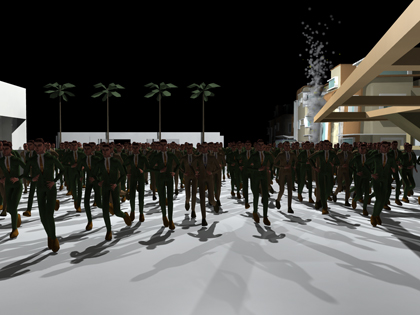
Regular readers will know that we do love a good old-fashioned urban panic here at Global Dashboard. So imagine the delight here when Bruce Schneier noted yesterday that Paul Torrens of the Arizona State University School of Geographical Sciences has devised a new computer simulation that models urban panic. Torrens’ own website has some very cool animated simulations of crowd behaviour, plus urban growth and sprawl too.

Torrens explains that “the goal of this project is to develop a reusable and behaviorally founded computer model of pedestrian movement and crowd behavior amid dense urban environments, to serve as a test-bed for experimentation. The idea is to use the model to test hypotheses, real-world plans and strategies that are not very easy, or are impossible to test in practice.” Schneier cites some examples which already have us drooling with envy and anticipation:
1) simulate how a crowd flees from a burning car toward a single evacuation point;
2) test out how a pathogen might be transmitted through a mobile pedestrian over a short period of time;
3) see how the existing urban grid facilitate or does not facilitate mass evacuation prior to a hurricane landfall or in the event of dirty bomb detonation;
4) design a mall which can compel customers to shop to the point of bankruptcy, to walk obliviously for miles and miles and miles, endlessly to the point of physical exhaustion and even death;
5) identify, if possible, the tell-tale signs of a peaceful crowd about to metamorphosize into a hellish mob;
6) determine how various urban typologies, such as plazas, parks, major arterial streets and banlieues, can be reconfigured in situ into a neutralizing force when crowds do become riotous; and
7) conversely, figure out how one could, through spatial manipulation, inflame a crowd, even a very small one, to set in motion a series of events that culminates into a full scale Revolution or just your average everyday Southeast Asian coup d’état — regime change through landscape architecture.
Or as Pruned puts it more colourfully, you could decide to
… quadruple the population of Chicago. How about 200 million? And into its historic Emerald Necklace system of parks, you drop an al-Qaeda sleeper cell, a pedophile, an Ebola patient, an illegal migrant worker, a swarm of zombies, and Paris Hilton. Then grab a cold one, sit back and watch the landscape descend into chaos. It’ll be better than any megablockbuster movie you’ll see this summer.
