by David Steven | Feb 10, 2008 | Conflict and security, South Asia, UK
The ‘inbreeding’ row, sparked by Environment Minister (!) Phil Woolas, is yet to reach Pakistan – but it will and the consequences are sure to be ugly.
As far as I can tell, Woolas’s remarks were made to the Sunday Times and triggered an article with the headline: Minister warns of ‘inbred’ Muslims. On Sky News, a few minutes ago, Asghar Bukhari, from the Muslim Public Affairs Committee, complained vociferously about the Minister’s comments. He had two main complaints: the use of the highly pejorative word ‘inbreeding’ and the Minister’s assignation of the problem to ‘Muslims’ rather than Pakistanis from certain rural areas.
Good points. In a week where the Archbishop of Canterbury has plunged the UK into a fire storm of controversy over Shari’a law, how could the Minister be so stupid as to make the cardinal error of using such an insensitive term, and then compounding it by lumping together all Muslims as if they come from a single homogeneous community? These errors poison relations between communities in the UK, and play directly into the hands of those who want Muslims to behave like a group unified by their persecution.
But then I read the article, which Mr Bukhari appeared to have in front of him as he made his complaints. Here are all the direct quotations from the Minister that the article re-printed (the words in [square brackets] are not his) :
[the culture of arranged marriages between first cousins was the] “elephant in the room”
“The issue we need to debate is first cousin marriages, whereby a lot of arranged marriages are with first cousins, and that produces lots of genetic problems in terms of disability [in children].”
“If you talk to any primary care worker they will tell you that levels of disability among the . . . Pakistani population are higher than the general population. And everybody knows it’s caused by first cousin marriage. That’s a cultural thing rather than a religious thing. It is not illegal in this country.
“The problem is that many of the parents themselves and many of the public spokespeople are themselves products of first cousin marriages. It’s very difficult for people to say ‘you can’t do that’ because it’s a very sensitive, human thing.”
“The health authorities look into it. Most health workers and primary care trusts in areas like mine are very aware of it. But it’s a very sensitive issue. That’s why it’s not even a debate and people outside of these areas don’t really know it exists.”
And here’s a crucial indirect quotation:
Woolas emphasised the practice did not extend to all Muslim communities but was confined mainly to families originating from rural Pakistan. However, up to half of all marriages within these communities are estimated to involve first cousins.
So if Woolas used the word ‘inbred’, it’s not quoted in the article. Instead, it can be found only in the headline. Woolas also went out of his way to underline that first-cousin marriage was a cultural matter, not a religious one; and that it was not a custom followed by all British Muslims, but was confined to those whose families come from rural Pakistan.
It would be nice to have answers to three questions. Did Woolas claim that Muslims were inbred in parts of the interview that have not been quoted in the Times report? If not, what on earth did the paper think it was doing? And would Asghar Bukhari accept that MPACUK’s mission to “defend Muslim interests and Islam throughout Britain and the world” was not best served by hard line he took in his Sky interview?
I’ll post more as the Pakistani media begins to react to the Minister’s remarks…
by David Steven | Feb 9, 2008 | South Asia
As I write, police here in Islamabad are just finishing breaking up a demonstration by Pakistan’s lawyers. The lawyers had been holding a convention and were attempting to march on the enclave where the city’s judges live – in support of the deposed Chief Justice, Iftikhar Muhammad Chaudhry.
The authorities were having none of it. An hour or so ago, three or four hundred lawyers marched past the hotel where I am staying. They didn’t get far, however. Just a few yards up the road, the police blocked their progress and started to drive them back down the street.
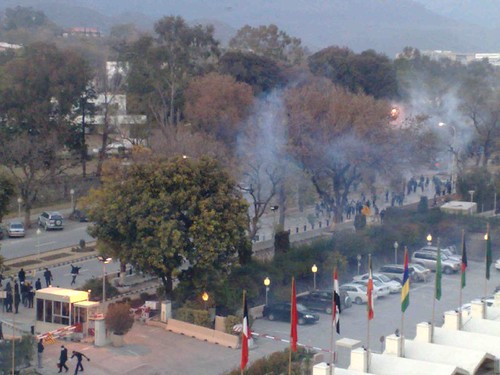
Volley after volley of tear gas was fired – much of it thrown back by the demonstrators, who jeered derisively as the police scattered to avoid the acrid fumes. A water cannon seemed to have little impact and a stand-off ensued. Eventually, though, the police had had enough and the final charge was a concerted one, with the crowd scattering in a panic, and the slowest to react suffering a beating.
Today is the first real day of campaigning for a general election that is just over a week away. It’s a late start – with the official period of mourning for Benazir only ending yesterday. Already, reports are coming through of a bombing in Charsadda in North-West Frontier Province, where the provincial leader of the ANP was holding a rally.
He survived, but unconfirmed reports suggest others in the crowd may not have been so lucky.
Update: According to the Dawn News TV channel, there have been large numbers of arrests and injuries at the lawyer’s demonstration, with a number of leaders of the lawyers’ movement taken into custody. To add to the mayhem, six secuity agents have been seriously, and possibly critically, injured in a bomb blast in Noshki in Balochistan. The anchor is unperturbed, telling viewers that it’s been a ‘busy day’.
by David Steven | Feb 9, 2008 | South Asia
Pakistan’s election will be held on the 18th – Monday week – and the campaign has already proved a violent one.
“Gujrat is a district where violence and bloodshed during the election campaigning and polling is considered a routine matter,” Iqtidar Gilani writes in the Nation. “Display of weapons as a show of strength is also common. Almost all the candidates are accompanied by large number of guards carrying sophisticated weapons.”
But there is at least one compensation:
According to local people the crime rate especially the road robbery incidents have recently decreased due to the engagement of criminals and proclaimed offenders in election campaign of different candidates.
by David Steven | Feb 9, 2008 | South Asia
These are dark days for Pakistan.
Eighteen months ago, when I was first in Islamabad, Pakistanis could see a route that would take the country towards greater democracy and political stability. For sure, there were fears about rising extremism and anger about American influence, but the general mood was confident.
Pakistan would not follow Iran towards revolution; Afghanistan towards anarchy; or Iraq on the road to disintegration. Its society and institutions were more resilient than that. Progress might be messy and compromised, but things were unlikely to get worse.
But then on 9 March 2007 – less than a year ago – came the disastrous clash between General Pervez Musharraf and Pakistan’s Chief Justice, Iftikhar Muhammad Chaudhry. Musharraf was stunned when Chaudhry refused his order to resign and by the protests that followed. His humiliation was complete when Chaudhry was reinstated to his role in July.
Overnight, the general was transformed from world leader to tragic figure. Not in the trivial sense that we should feel sorry for him, but with the original meaning of a man whose flaws had begun to trap and entangle him. Suddenly, the talk was no longer of his power and competence, but of his vanity and weakness. He had lost control of his own destiny. At any time, his supporters in the army and US administration might decide enough is enough, and abandon him to his fate.
But still the country had options. One was Nawaz Sharif, the man Musharraf ousted in his 1999 coup. When I was here in October, Nawaz tried to return to challenge a man he loathes and despises. But he got no further than the airport lounge, before being sent back into exile in one of his lavish overseas pads.
And then there was the deal with Benazir, Pakistan’s most famous daughter. Musharraf saw it as his get-out-of-jail card and the international community was falling over itself to be supportive. Whether or not they liked the proposed fudge, the Pakistanis I talked to understood it. They took comfort in the fact that they knew what was supposed to happen next.
But now they don’t, because of two further cataclysms.
On November 3rd, Musharraf imposed a state of emergency, moving against Chaudhry, the rest of the legal establishment, and the media. And finally, on December 27th, the assassination of Benazir, after a couple of months in which a squadron of suicide bombers had tracked her around the country.
Reportedly, Bhutto was resigned and fatalistic in the days before her death. Perhaps this explains her reckless decision to leave the safety of her bomb-proof car, sticking her head through an escape hatch to wave to supporters as the car inched away from a rally. Her attacker was standing only 2 metres away when he exploded the bomb, crushing her skull against the lip of the hatch.
It is hard to overestimate the shock that her death caused here in Pakistan or the mood of apprehension that has followed. People I have talked to describe is as the most traumatic day in Pakistan’s history, whether or not they were Benazir’s supporters. It marked the point where people began to give up hope and to consider the possibility that they do indeed live in a failing state.
“The crunch is coming,” a veteran political campaigner told me yesterday in Lahore.
“A good crunch or a bad crunch?” I asked.
“It could go either way,” he replied gloomily, “but it seems that we are staring into a black hole.”
by Charlie Edwards | Feb 7, 2008 | Influence and networks, Middle East and North Africa
Gary Anderson from George Washington University has a good piece in the Washington Post. Al-Qaeda is losing. As he argues:
The conventional wisdom is that al-Qaeda is making a comeback from its rout in Afghanistan. Many point to its success in killing Benazir Bhutto in Pakistan and to its support of Islamic insurgents there as evidence. Not so. Al-Qaeda is waning. Its decline has less to do with our success than with the institutional limitations of the al-Qaeda organization. Simply stated, to know al-Qaeda closely is not to love it.
Everyplace where al-Qaeda has gained some measure of control over a civilian population, it has quickly worn out its welcome. This happened in Kabul and in Anbar province in western Iraq. It may well happen in Pakistan as a reaction to the killing of Bhutto.
No one likes to be brutalized and dominated by foreigners. The weakness of al-Qaeda is that everywhere it goes its people are strangers. This is no way to build a worldwide caliphate.
Why, then, are we supposedly losing the information war in the Muslim world, and why has there not been more of an outcry among Muslims over this slaughter of innocents? A big part of the reason is that we spend too much time wanting to be liked rather than turning Muslim anger on our enemies.
We preach some values that are viewed as alien and threatening to the traditional order of things. Our popular culture is seen as decadent at best and downright threatening at worst in traditional cultures. Our message isn’t selling. We can’t change what we are, nor would we want to. No matter how much the government may disapprove, the government’s official propaganda will be overwhelmed by the deluge, both positive and negative, from the popular media. We need to accept this fact and move on, rather than waste more millions on strategic communications “charm campaigns.”
What we can do is to expose our Islamic extremist enemies for what they are. The people of Afghanistan and Anbar found this out the hard way and threw the rascals out. But when al-Qaeda kills scores of innocents, we report it as a statistic without context. We may see weeping relatives and bloodstained bodies from a distance, on video or in photographs, but they are depersonalized, and people quickly become desensitized to anonymous images. Ironically, Stalin was right: One death is a tragedy; millions are a statistic. We need to help Muslims understand how these people really treat other Muslims.
The original Islamic movement spread its doctrine by a combination of military action and compassion. Charity was a key tenet. This is largely why Hamas and Hezbollah gain a degree of popular support in the areas they control. That ingredient is missing in the al-Qaeda/Taliban approach to the world. To them, winning hearts and minds means, “Agree with us or else.” That is largely the reason that the U.S. government dropped its early “for us or against us” approach. It has taken us some time, but we seem to be recovering from that approach.
