by Alex Evans | Apr 26, 2008 | Global system, Off topic
David Miliband writes:
My visit this week to Pakistan, Kuwait, Saudi Arabia and Iraq was punctuated with people describing their links to Britain. One conversation particularly sticks in the memory.
I was told by someone that they had great affection for British education. “I studied at Eton, Oxford, Nottingham and London universities”. I congratulated him and said I would not hold his Eton past against him.
He replied: “Why, did you go to Harrow?”.
by Alex Evans | Apr 22, 2008 | Conflict and security, Middle East and North Africa, South Asia
Barney Rubin has an excellent post updating on latest developments in Pakistan’s federally administered tribal areas. Start, he says, from a clear recognition of one thing at least: the US has no plan. Here’s a graph from the US Government’s General Accountability Office which proves the point:
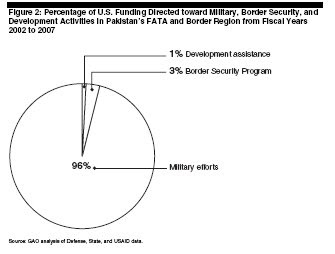
Note especially the amount being allocated to political reform, he says: 0%. Meanwhile, Khalid Aziz – the former chief secretary of NWFP – has been doing some serious strategising about what needs to happen next (in the wake of Pakistan’s elections – which as the BBC put it “saw an overwhelming vote for parties that advocate secularism, or the separation of religion from politics” in the NWFP). Aziz writes:
…the Feb 18 election has clearly indicated that the people of Pakistan voted against militarism and violence. The Taliban recognise that resort to force alone will not lead to the achievement of their main political objective which is the creation of an Islamist Caliphate.
However, while everyone waits for good sense to prevail, there may be forces amongst the non-state fighters planning another strike in the West. If that happens, one may be certain of an air war in FATA and this could lead to incalculable harm to Pakistan. This in a nutshell is the danger surrounding the process of talks. . . .
Many conservative Pakhtuns believe that the fighting in Swat, Kohat and Waziristan is a war of liberation against US occupation of Afghanistan; they fight the Pakistani state because of its alliance with the US. However, it does not make it a US war alone. Whatever may be the case at the start, this is now Pakistan’s war, since the objective of the insurgents is to change the nature of the Pakistani state. To fellow Pakistanis I would say that it is our war, whether we like it or not.
Compare that, Rubin says, to Musharraf – with whom “all negotiations with militants… had as their aim to balance the imperative of acting against al–Qaida with that of saving the Taliban as a strategic asset for Pakistan”. His conclusion:
We now have a full partner in Pakistan, elected, ironically enough, by Pakistani voters angry at what the GAO calls the “lack of a comprehensive plan,” rather than just a military approach. It is indeed time to “sit down and think through what we can collectively do” with these partners.
by Charlie Edwards | Apr 7, 2008 | Middle East and North Africa
Robert Mueller the head of the FBI, believes the West can achieve victory over al-Qaeda within three-and-a-half years.
In a speech to Chatham House Mueller describes the West confronting a three-layered threat from al-Qaeda:
The top tier is the core of the organisation which has established new sanctuaries in Pakistan’s tribal areas.
The middle tier is the most complex, consisting of small, self-directed groups like the London bombers of 7/7 who had some ties to al-Qaeda’s leadership.
The bottom tier is made up of homegrown extremists who met on the internet instead of in foreign training camps.
His speech is available here.
The speech hid no obvious surprises (aside from the headline that AQ will be defeated in three and a half years)
- Quote from Churchill – check-
- Number of terrorist plots -check-
- Quote on the need for close partnerships – check-
- Quote on AQ being a resilient network – check-
- Quote on freedom – check-
- Story + quotes from Eliza Manningham-Buller (past DG MI5) and Jonathan Evans (present DG MI5) What?
Mueller:
I met Dame Eliza Manningham-Buller just after the September 11th attacks. I was new to my job, and I asked her what she considered the key to MI5’s success in thwarting terrorist attacks. She said, “Two things: sources and wires.”
I don’t think I have ever heard EM-B publicly say that the key to success against AQ is sources and wires – I was under the impression the Security Service didn’t talk about operational matters.
It also became a bit disconcerting to hear him quote both EM-B and Evans so extensively. It was an interesting speech but you can’t help wondering why British officials don’t want to discuss success against AQ (we just hear how many networks and terrorists are active) and, come to think of it, why we only learn about British intelligence, terrorist plots and the UK’s response to terrorism from the US administration … as Churchill once said… [enough Ed.]
by Charlie Edwards | Mar 5, 2008 | South Asia
The International Narcotics Control Board has published its report on narcotics in Afghanistan. The increase in opium cultivation which is taking place in the south of the country (Afghanistan is estimated to supply more than 90 per cent of the world’s illicit opium) the effects of the drug trade: an increase in organised crime, corruption and drug dependence (which is severe in Iran and has led to a major HIV epidemic in the NE of the country) and the impact on Iran, Pakistan and the central Asian republics all make for an increasingly familiar story and one that will come as no surprise to GD readers. The facts are still worth thinking about.
- Iran, the chief transit country for drugs from Afghanistan, now has the highest rate of opiate abuse in the world.
- More than half of inmates in Iran’s prisons have been convicted for drug-related offences, and seizures of opium, morphine and heroin have risen rapidly.
- Pakistan, through which an estimated 35 per cent of Afghanistan’s opiates are smuggled, faces growing problems, with seizures in 2006, the last year for which figures were available, rising 46 per cent.
- An estimated 21 per cent of Afghanistan’s heroin and morphine transit via central Asia, the report says, leading to large increases in seizures in Tajikistan, Turkmenistan and Uzbekistan.
- Drug trafficking and abuse in Armenia, Azerbaijan and Georgia, which have long borders with Turkey and Russia, will deteriorate further
- Drug abuse in Iraq appears to have risen dramatically and while opiate use in western and central Europe has remained stable or declined, it has increased in Russia and eastern Europe.
- The rise of cannabis cultivation in Afghanistan, including in some areas that have been declared poppy-free.

Aside from these devastating facts and the sense of powerlessness that comes with them the annual report is a timely reminder that Afghanistan’s drug addiction is a primary indicator for how well the Karzai Government, NATO and all the other international organisations are managing the stabilisation and reconstruction of the country.
The INCB report also clearly demonstrates the negative influences the drugs trade is having across a broad spectrum of issues. My concern, however, is that our conventional approach to countering narcotics in Afghanistan, a so-called wicked issue, remains hamstrung by a set of assumptions that is actually making it more not less difficult to manage. The Narcotics problem is only one node in a complex system. All of which reminds me of a saying from the gritty, realistic and addictive American TV series The Wire – ‘ follow the drugs, all you find are drug users and drug dealers, but if you follow the money, you don’t know what you’ll find’.
by David Steven | Feb 26, 2008 | Conflict and security, South Asia
The world is beginning to resemble a low-budget television comedy:
A Pakistan ISP that was ordered to censor YouTube accidentally managed to take down the video site around the world for several hours Sunday.
The Pakistani government ordered ISPs to censor YouTube to prevent Pakistanis from seeing a trailer to an anti-Islamic film by Dutch politician Geert Wilders. YouTube has since removed the clip for violating its terms of service, but a screenshot of the film, available via Google, shows a crude drawing of a pig defecating with the word Allah underneath it.
Pakistan Telecom complied by changing the BGP entry for YouTube — essentially updating its local internet address book for where YouTube’s section of the internet is. The idea was to direct its internet users to a page that said YouTube was blocked.
Unfortunately, the ISP announced the new route to upstream providers. The upstream providers didn’t verify the new route but accepted it and then passed it along, cascading the bad address around the net, until most everyone using the net on Sunday would have been directed to the Pakistani’s network block. The blunder not only took down YouTube, but also choked the Pakistani ISP, which was quickly deluged with millions of requests for talking cat videos.

