by Alex Evans | Jun 20, 2008 | East Asia and Pacific
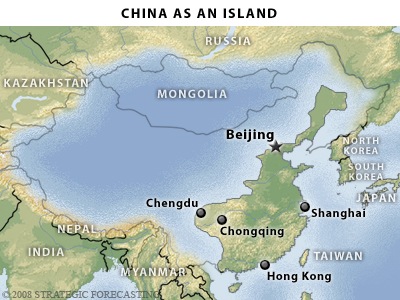
So says Kevin Kelly on what is now my favourite blog. Here’s why:
China shares borders with more countries (14 in total) than any other country on earth. Very few of those borders have ever been very permeable to migration of culture, commerce and ideas because of mountains, deserts, swamps, and high altitudes. In many ways China has acted as an island for millennia. The very large zone of an impermeable buffer, and mountainous and unfarmable land is shown in this image as water.
What’s left is the island of China. This is the traditional center of China, of fertile river valley farming, and home to the Han people. It is also the zone of manufacturing today. It is where all of its giant, throbbing cities lie. The island alone is huge, still among the largest countries in the world.
Prosperity in China is found only on the island. Off the island, in the waters deep, China remains remarkably undeveloped. In fact the level of development in the “Chinese waters” is about equal to the low levels of the neighboring countries. I was surprised to find in my own travels that many towns in the Chinese waterland were as remote, poor, and disadvantaged as any places I had seen in Nepal, Burma, Bangladesh, Pakistan, Afghanistan — all neighbors of China. Not coincidentally, this waterland is also inhabited by non-Han peoples, what the Chinese call their minorities. It is not just Tibet where the nan-Han are outnumbered. In most of the counties covered by this buffer zone (shown as water), minorities dominate. There are lots of them, speaking their own language, often their own dress. What is most remarkable is how remote the rich island seems from the outer waterlands.
The China everyone talks about is the island. China’s worry is the outer zone will leave. Will they go the way of the Soviet Union and break off one by one? Will there be two futures? Much of the control-freak nature of the central political party has been trying — at almost all costs — to keep the whole waterland under control of the island — to keep the country intact. And when you look at this map, it is clear that a break up, or at least a break down, is a very real possibility. In fact the more you look at it, the more amazing it is that China has not devolved before now.
by David Steven | Jun 12, 2008 | Global system, South Asia
Last week, I gave a talk at the Defence Academy on the new public diplomacy, focusing in particular on its implications for Afghanistan.
The full text is after the jump or read it as a pdf.
(more…)
by Mark Weston | Jun 5, 2008 | Africa, Climate and resource scarcity, Economics and development
Among the most popular policy responses to recent rises in food prices are export bans. Cambodia has banned rice exports, for example. Kazakhstan, Pakistan and Iran have refused to export wheat to hungry neighbours like Afghanistan. And Burkina Faso, one of the West African countries that has been hardest hit by the price rises, has banned cereal exports to neighbouring Ghana.
Such measures have been widely criticised, but they are not new. I recently came across FJ Pedler’s ‘Economic Geography of West Africa’, published by Longmans in 1955. Among many other interesting topics, he writes about the maize shortages of 1947. He notes the wildly fluctuating price of guinea-corn in the Zaria region of Nigeria, which rose from £8 per ton in 1946 to £38 per ton a year later. “These price movements,” he says, “are an indication that too little food is produced to meet the needs of the people throughout the year.” Traders take advantage of this, buying up food at harvest time to sell it later when prices rise (a bit like today’s commodities traders, who have been stocking up on food): “They are often blamed for high prices and scarcity [plus ça change…], but their action is the result of shortage, not the cause of it.”
As in today’s crisis, Mr Pedler reports that governments “often get frightened by the high prices and shortages…and prohibit the movement of food from one place to another.” Like Burkina Faso today, West African governments in the 1950s banned the export of guinea-corn from one state to another – in this case, from Katsina Province into Zaria Province. It didn’t help then either, and Pedler explains why the approach is flawed:
It is difficult to defend these bans on economic grounds. If they are effective, they prevent food from moving to the place where people will pay most for it. This must drive prices even higher in the needy area: while in the producing area an artificially low price is maintained, so that there is less economic incentive for farmers to increase their production.
Little has been learnt, it seems, in the intervening half-century. However, as Mr Pedler observed back then, the bans are easily evaded; “their principal effect is to add to the cost of transport by making it necessary for traders to avoid control posts or bribe the guards.” Good news for the corrupt, then, but bad news for the hungry.
by David Steven | Jun 2, 2008 | Conflict and security, Europe and Central Asia, South Asia
Commenting on today’s ‘cartoon bombing’ in Islamabad, Pakistani blogger NB argues:
Calling this an an attack on the Danish Embassy is a little misleading. It should be called an ‘Attack on Pakistani Civilians Standing Outside the Danish Embassy’.
The eight casualties are said to include an Embassy employee – but he was a local cleaner, not a diplomat…
by Charlie Edwards | May 22, 2008 | Conflict and security, North America, UK

Noticed while browsing the ever insightful Kevin Drum: The graph, from the Human Security Report 2007 shows that as terrorist incidents have risen in Pakistan, opposition to terrorism has also risen. The report goes onto suggest that ‘terror campaigns that lose public support will eventually be abandoned, even if the terrorists themselves remain undefeated.’ This is something government’s understand but their actions suggest otherwise. The idea that without public support terrorism will fail is, I think, the principle reason for why the UK Government has switched a good chunk of its resources to the Prevent strand of CONTEST.
