by David Steven | Nov 15, 2008 | Conflict and security, South Asia
In an email exchange with George Packer, David Kilcullen sounds a pessimistic note about prospects in Afghanistan. The situation is ‘dire’ but there’s a chance to win it around.
He’s even more downbeat about Pakistan:
Pakistan is extremely important; indeed, Pakistan (rather than either Afghanistan or Iraq) is the central front of world terrorism. The problem is time frame: it takes six to nine months to plan an attack of the scale of 9/11, so we need a “counter-sanctuary” strategy that delivers over that time frame, to prevent al Qaeda from using its Pakistan safe haven to mount another attack on the West. This means that building an effective nation-state in Pakistan, though an important and noble objective, cannot be our sole solution—nation-building in Pakistan is a twenty to thirty year project, minimum, if indeed it proves possible at all—i.e. nation-building doesn’t deliver in the time frame we need. So we need a short-term counter-sanctuary program, a long-term nation-building program to ultimately resolve the problem, and a medium-term “bridging” strategy (five to ten years)—counterinsurgency, in essence—that gets us from here to there. That middle part is the weakest link right now. All of that boils down to a policy of:
(a) encouraging and supporting Pakistan to step up and effectively govern its entire territory including the FATA [Federally Administered Tribal Areas], and to resolve the current Baluch and Pashtun insurgency, while
(b) assisting wherever possible in the long-term process of state-building and governance, but
(c) reserving the right to strike, as a last resort, at al Qaeda-linked terrorist targets that threaten the international community, if (and only if) they are operating in areas that lie outside effective Pakistani sovereignty.
by Charlie Edwards | Nov 14, 2008 | Conflict and security, North America, South Asia
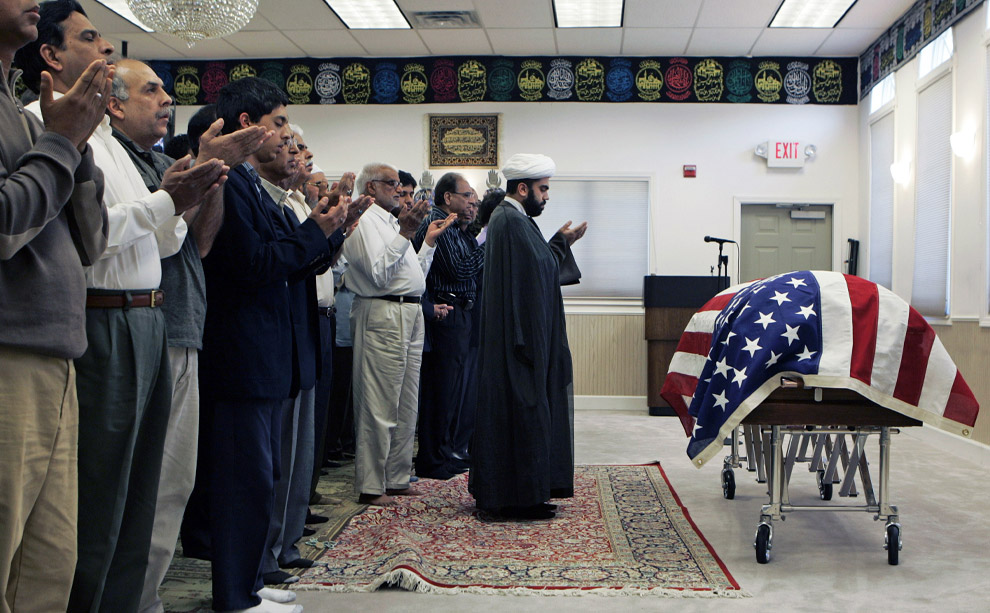
One of thirty-one photos recently published in The Boston Globe:
Imam Hashim Raza leads mourners in prayer during a funeral for Mohsin Naqvi at al-Fatima Islamic Center in Colonie, N.Y., Monday, Sept. 22, 2008. Naqvi was a Muslim, a native of Pakistan (he emigrated to the U.S. with his family when he was 8 years old and became a citizen at 16) and a U.S. Army officer. He was killed by a roadside bomb while on patrol last week in Afghanistan. (AP Photo/Mike Groll)
by Alex Evans | Nov 13, 2008 | Climate and resource scarcity, Cooperation and coherence, Global system, London Summit
Ahead of this weekend’s G20 summit, David and I have published a short paper entitled A Bretton Woods II worthy of the name. Key points:
– The summit is unlikely to be able to live up to its billing. Leaders do not yet understand the nature of the problem well enough to be able to implement viable solutions. However, the problem is more fundamental than a simple lack of shared awareness.
– History suggests that leaders will only think the unthinkable on institutional reform once the challenge they face has really hit rock bottom. But history also suggests that we are wrong to think that the worst of the crisis is now past, given that many past banking crises have taken five years or more to unravel.
– Bretton Woods 1 looked across the whole international economic waterfront in 1944, while this weekend’s summit will be much more narrowly focused. Leaders will make a big mistake if they try and tackle finance in isolation, given the growing impact of resource scarcity, and that 2009 is supposed to see another ambitious global deal – on climate.
– We need to recalibrate what we expect from globalization through a serious debate about subsidiarity. Where has globalization gone too far, too fast? Where do we need more integration at a global level? These were exactly the questions that preoccupied Keynes in 1933, when he weighed the relative benefits of global versus local across a range of variables. We need a similar debate today as a precursor to serious international economic reform.
– Leaders need to extend their horizons in (at least) five directions: onto longer time scales; beyond financial regulation into wider resource scarcity challenges; into other international processes, especially climate; towards grand bargains with emerging powers; and beyond government, to non-governmental networks.
Full version after the jump, or better yet here’s the pdf.
(more…)
by Charlie Edwards | Oct 20, 2008 | Influence and networks, Middle East and North Africa, South Asia
The soldier-scholar General Petraeus is launching a major reassessment of U.S. strategy for Afghanistan, Pakistan, Iran, Iraq and the surrounding region, the result of which will be a new campaign plan for the Middle East and Central Asia.
Two major themes have emerged from some of the initial brainstorming:
1. A Government-led reconciliation of Taliban insurgents in Afghanistan and Pakistan,
2. Leveraging diplomatic and economic initiatives with nearby countries that are influential in the war.
Interestingly:
In appearances this month in Washington, however, Petraeus has sought to manage expectations of any repeat of the Iraq performance in Afghanistan – often suggested by Republican presidential candidate John McCain – stressing that Afghanistan is not Iraq, and that while some concepts are “transplantable,” Afghanistan has daunting challenges likely to require a far lengthier effort.
As befits a soldier-scholar Petraeus is now recruiting a brain trust of advisers, to join his Joint Strategic Assessment Team – led by a longtime adviser, Col. H.R. McMaster. Experts will be handpicked from State Department, Pentagon and other civilian and military officials as well as from outside. To begin with the 100 people, will be split into six subregional teams, tasked with investigating the root causes of insecurity in the region with the goal of finding solutions that integrate military action, diplomacy and development work. Experts currently touted to join the assessments group include: Shuja Nawaz, Ahmed Rashid, and Clare Lockhart.
by Charlie Edwards | Oct 3, 2008 | UK
As news of Hutton’s new role as Defence Secretary travels across Politics Home, Twitter and email a few quick thoughts:
Next week John Hutton will face his first test as Defence Secretary when he walks down Whitehall to Parliament for a debate on Defence in the World. Given his new brief, politicians from across the floor may be gentle in their questions and speeches. Some people may even advise him that he should stay away and let Bob Ainsworth do the job. But this would be bad idea.
The MoD is not in a great place right now, morale is low, there is no strategic direction and people are exhausted. Unlike Browne, Hutton has to show commitment right from the start. On Sunday, having spoken to senior officials he should board a plane and visit Iraq and Afghanistan. There he should listen to senior commanders, FCO and DFID personnel, get up to speed with what’s happening on the ground and give a short pep talk to the troops before coming home. When the debate comes around next week he should enter the chamber and let it be known there are three things he cares about in his new brief – people, people, people.
Back in Main Building things won’t be so easy. There are three key things he will need to focus on. First: Operations in Iraq and Afghanistan. As has been reported in the French press – not all is well in Helmand – and while the people on the ground are the one’s who will stabilise the situation, getting a grip on Whitehall is as just as important.
Second: Strategy – Main Building is rudderless, that said there is hope in the shape of a new Director of Strategy, and a new head of policy & planning is also on the way. Coupled to this political consensus on a strategic review is close to reaching a tipping point – all parties publicly and privately now agree that a a review must happen, but when? With limited time until a General Election it may not be in the best interests politically and organisationally to kick a big review off now, instead it would be better to prepare the ground work. Laying the foundations is crucial and should never be underestimated. It may be a thankless task but Hutton will get kudos for doing it.
Third: Strategic Communications. Forget we are staring into an economic abyss for a moment and the other important issue the British Government is dealing with today are the conflicts in Afghanistan and Pakistan, the fragile peace in Iraq and general instability in East Africa and elsewhere. And yet no one is entirely sure what we are doing and why these places are important. For reasons best known to the MoD senior commanders and officials don’t seem to be able to get their message out – this may be down to personal, bureaucratic and organisational interests but this needs to be corrected in days not weeks – the British public need to know what their armed forces are doing abroad and how it connects to issues like terrorism at home. Newspaper features on our men and women [insert country/ operation here] isn’t a sustainable policy. If Hutton is feeling bold he should copy No.10 and the FCO and overhaul the entire of MoD’s communications – website and all.
And what about procurement? This may prove, in time, to be Hutton’s Achilles heel. His constituency is home to a major defence contractor (BAE Systems) so it may be advisable to steer clear of procurement issues to begin with. He will have enough on his plate with savings that still need to be found, projects and platforms given the chop – a bit more transparency around the MoD budget wouldn’t go a miss either (but perhaps save this for another day). He should learn from US SecDef Bob Gates who has been weaving a completely new approach in the Pentagon and set the context and narrative first before doing anything major on procurement. After all – the question that has been buzzing around Main Building for the last couple of years is relatively straight forward: what is defence for?
