Friday caption contest
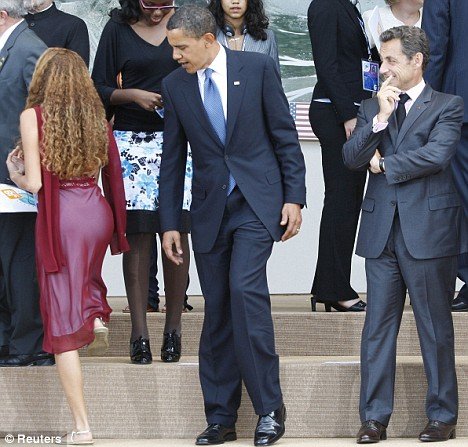
Context that seems to let Obama off the hook here.
Alex adds: well, maybe – but then what about this one?
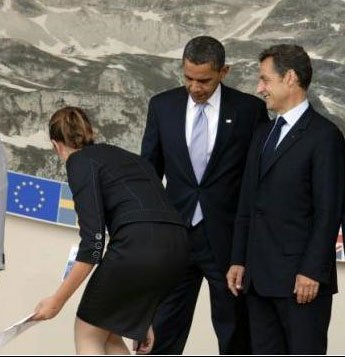
H/t Guido.

Context that seems to let Obama off the hook here.
Alex adds: well, maybe – but then what about this one?
H/t Guido.
I think part of what’s hampered advancement in Africa is that for many years we’ve made excuses about corruption or poor governance; that this was somehow the consequence of neo-colonialism, or the West has been oppressive, or racism — I’m not a big — I’m not a believer in excuses.
I’d say I’m probably as knowledgeable about African history as anybody who’s occupied my office. And I can give you chapter and verse on why the colonial maps that were drawn helped to spur on conflict, and the terms of trade that were uneven emerging out of colonialism.
And yet the fact is we’re in 2009. The West and the United States has not been responsible for what’s happened to Zimbabwe’s economy over the last 15 or 20 years. It hasn’t been responsible for some of the disastrous policies that we’ve seen elsewhere in Africa. And I think that it’s very important for African leadership to take responsibility and be held accountable.
– Barack Obama’s take on Africa. (From an interview with AllAfrica.com, reproduced in full on the White House website – worth scanning the whole thing.)
– With yesterday’s US-Russian pledge to reduce strategic nuclear arsenals came news of the death of Cold Warrior, Robert S. McNamara, former US defence secretary and later president of the World Bank. Thomas Lippman offers a sympathetic portrait of a man who will be forever remembered for his role in Vietnam. Indeed, The New Yorker asks whether the original Whiz Kid is likely to be the “Ghost of Wars Past, Wars Present, or Wars Yet to Come”.
– Turning to those wars present, Rory Stewart, the former British diplomat turned Harvard academic, offers a critical perspective on current Af-Pak strategy in the current LRB. “Obama and Brown”, he reflects, “rely on a hypnotising policy language”, which “misleads us in several respects simultaneously: minimising differences between cultures, exaggerating our fears, aggrandising our ambitions, inflating a sense of moral obligations and power, and confusing our goals. All these attitudes are aspects of a single worldview and create an almost irresistible illusion”.
– In a similar vein the American military scholar, Andrew Bacevich, laments “the consequences of strategic drift” in current US overseas engagements. “The urgent need”, he suggests, “is for the administration to articulate a concrete set of organizing precepts — not simply cliches — to frame basic U.S. policy going forward”.
– Finally and on a different note, offering a preview of his latest book, Cass Sunstein – of Nudge fame – asks what leads us to hold extreme views. His answer: “group polarisation”.
In Washington, Iran isn’t about Mousavi, Khamenei or Neda, it’s about Obama. It’s a pincer movement. The establishment media behaves as if there’s some Geneva Convention stating that all international crises must have the American president in the starring role.
The right, meanwhile, see a golden opportunity to prove that a cuckoo has inveigled its way into the White House – and a Muslim-loving cuckoo at that. Take Andy McCarthy, a commentator at the National Review, who believes that as “a man of the hard Left, Obama is more comfortable with a totalitarian Islamic regime than he would be with a free Iranian society.”
It would have been political suicide to issue a statement supportive of the mullahs, so Obama’s instinct was to do the next best thing: to say nothing supportive of the freedom fighters. As this position became increasingly untenable politically, and as Democrats became nervous that his silence would become a winning political round for Republicans, he was moved grudgingly to burble a mild censure of the mullah’s “unjust” repression – on the order of describing a maiming as a regrettable “assault,” though enough for the Obamedia to give him cover.
Now, both sides have a smoking gun. Obama, the Washington Times tells us, has been writing love letters to the Supreme Leader himself, pleading for better relations, nuclear negotiations and an Iranian takeover of Kansas (I made the last bit up).
On Twitter, the paper’s national security reporter, Eli Lake, appears to have wet himself in excitement (as well as using the opportunity to suck up to his editor big time). She, Barbara Slavin, is putting “more Iran heat than Persian narcos” (eh?) with her bold exposé, he tweets.
Big news, eh? Except that we knew that a letter from Obama to Khamenei was being written in January. And that it was being sent in March. So why the surprise now? Because, whatever else is at stake, the most important thing we can do now is keep the spotlight on the demonstrators fuel another solipsistic partisan Washington squabble.
Update: Reagan managed this with more style, it must be said. His missive to the Iranians, at the outset of the Iran contra scandal, was a bible with a handwritten verse inside. Oliver North took a key shaped cake made by an Israeli baker.
Update the second: To be fair to Slavins, she has an email exchange with National Review’s K-Lo where she makes a great deal of sense.
Slavin: Apart from my paper, most journalists still write about Iran as though it is a theocracy. What we have been seeing is the raw exercise of force on the part of the government and people power in the streets. The clerics have had very little to do with it.
Lopez: What has been most surprising to you about the White House response to the election protests there?
Slavin: I haven’t been surprised by the White House response.
Lopez: Are there any lessons from history Obama ought to heed?
Slavin: I think Obama has learned from the mistakes of past U.S. administrations in dealing with Iran and has put the emphasis where it should be, on the legitimate aspirations of the Iranian people. The U.S. has no embassy in Iran and few levers it can pull to impact events there. Aggressive action through the military or more sanctions will probably wind up helping the government, unfortunately.

Over at Hot Air, Ed Morrissey is itching for Obama to get stuck in to the Iranian regime:
We have an opportunity to get the Iranians to use this thick-skulled blunder by the mullahs to press for real regime change. It wouldn’t take an expression of support for Mousavi from Obama to help increase the momentum in the streets of Tehran and elsewhere for the removal of the theocracy. An expression of support for self-determination in a free and fair election system in Iran would be plenty. Obama could use his bully pulpit to point out that the mullahs handpickedall of the candidates, which has obviously left the Iranians feeling manipulated and unrepresented by their government. Obama could call on the Guardian Council and Ali Khamenei to stage actual elections, without the GC’s interference, and an election with international observers to certify that the Iranian people are allowed to choose their own government.
Morrissey, to his credit, details the other side of the argument – that overt expressions of support from the US could be counter-productive, helping the Iranian regime paint its opponents as stooges of the Great Satan.
I find this argument much more compelling that Morrissey does. It’s not a perfect comparison – but in Pakistan, vocal US support for President Musharraf cut the ground from under the feet of a leader the US was desperate to shore up. Pakistanis love conspiracy theories and I used to joke with them that the Bush adminstration was, in fact, trying to bring down the Musharraf regime – and had chosen vocal praise as a novel, but deadly, weapon.
So I think Obama and his proxies should remain studied, neutral. They shouldn’t recognise the election result, but neither should they get dragged too far in the fray. (Some of Morrissey’s messaging around the importance of democracy would actually work quite well, if the tone and rhetoric were kept low key.)
Instead, I’d like to see the Europeans (with behind-the-scenes encouragement from Obama) start to play bad cop, steadily ramping up the pressure as the regime tries to crack down on demonstrators. In particular, we should look to Germany – a major trading partner for Iran – to take a lead. (The UK probably needs to take a back seat – for similar reasons to the US.)
Will this happen? Probably not. The statement from the Czechs, who hold the EU Presidency, was not just weak – it was barely literate.
The Presidency is concerned about alledged irregularities during the election process and post-electional violence that broke out immediately after the release of the official election results on 13 June 2009.
The Presidency hopes that outcome of the Presidential elections will bring the opportunity to resume the dialogue on nuclear issue and clear up Iranian possition in this regard. The Presidency expects the new Government of the Islamic Republic of Iran will take its responsibility towards international community and respect its international obligations.
But Angela Merkel has gone on the record to says that the election was irregular and to say that she is ‘very worried’ about events that have followed. France, too, has shown some signs of disquiet. Reuters detects signs of an emerging EU campaign to question the election results. So maybe there is hope.
The Americans and Europeans badly need to find a way to work in unison on major foreign policy risks. My fingers are crossed that this crisis in Iran will see the emergence of a deeper, more media savvy, and – above all – more effective mode of transatlantic cooperation. But for that to happen, we need to see the Europeans pull their fingers out and show they too can talk tough.