by Charlie Edwards | Nov 19, 2008 | Influence and networks
While one part of the US Navy argues for a next generation of frigates, elsewhere a small band of reformers in the USN including US Marines are experimenting and adapting to new missions:
Colonel David Coffman, Commander of the Marines, USS Boxer (yes, it does have its own website)
“We don’t see [humanitarian missions] as a ‘that might happen.’ We’re preparing for that as a fundamental tasking of what expeditionary strike groups and Marine expeditionary units are forward-deployed to do.”
As David Axe suggests: In other words, humanitarian “soft power” now has taken its rightful place alongside old-fashioned, firepower-heavy “hard power.”
by Daniel Korski | Nov 17, 2008 | North America
The rumour that Barack Obama may appoint Hilary Clinton as his top diplomat has filled the Sunday papers. Personally, I think she would be a better Defense Secretary or a nominee to the Supreme Court, although she is bound to do well as Secretary of State too.
If she were given the State Department, she is more likely to follow Colin Powell’s management style -– which a place like Foggy Bottom sorely needs –- than emulate Condi Rice’s neglect of the department. At the same time, she is likely to play a key role in foreign policy, unlike General Powell, as President Obama is compelled to focus on the economy.
It is just that I think Senator Clinton would do better at the Pentagon. She supported the Iraq War, which will make her better at coaxing the military into a draw-down of forces and a shift of focus onto Afghanistan. Though the officers and soldiers will accept the democratic transition from Bush to Obama, a military that has gone to war twice, suffered both casualties and reputationally, and seen itself as the sharp end of U.S foreign policy for eight years will need to be helped to make the switch by someone they trust. With her hawkish views, time on the Senate Armed Services Committee, and work on Unified Action, a large U.S military exercise, the New York senator is well placed to take this role on.
(more…)
by Charlie Edwards | Nov 16, 2008 | Economics and development, Middle East and North Africa, North America, UK
The web-comic Shooting Wars, hit people’s screens in May 2006. It followed a young journalist named Jimmy Burns, who found himself video-blogging across the front lines of Iraq in the year 2011. At the time of its release, only a handful of people were ready to believe US forces would be in the country for much longer. In 2006 sectarian violence was spilling across streets and districts in Iraqi cities. Infighting, both between Iraqis and the coalition forces occurred with depressing regularity. Most notably, a British Brigadier attacked America’s ‘Hollywood’ generals in April, while later in the year, the Iraq Study Group “strongly urged” a large pull back of American troops in Iraq in a private note leaked to the media. The Independent’s Middle East journalist Patrick Cockburn summed up the hopelessness of the conflict at the end of 2006:
The sense of Iraqi identity may have been damaged beyond repair. But, more than most states, Iraq is dominated by its capital and Shia and Sunni will continue to fight to rule Baghdad until they either win or know there is no hope of victory.
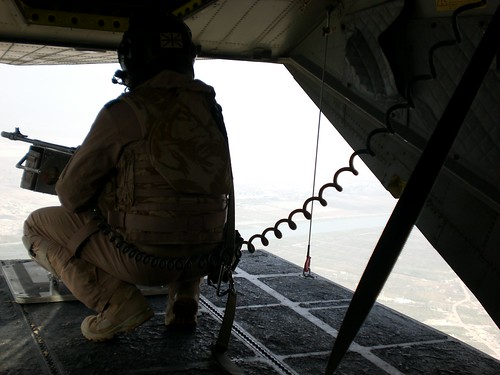
View of Basra from a Merlin Helicopter
What a difference two years makes.
(more…)
by David Steven | Nov 15, 2008 | Conflict and security, South Asia
In an email exchange with George Packer, David Kilcullen sounds a pessimistic note about prospects in Afghanistan. The situation is ‘dire’ but there’s a chance to win it around.
He’s even more downbeat about Pakistan:
Pakistan is extremely important; indeed, Pakistan (rather than either Afghanistan or Iraq) is the central front of world terrorism. The problem is time frame: it takes six to nine months to plan an attack of the scale of 9/11, so we need a “counter-sanctuary” strategy that delivers over that time frame, to prevent al Qaeda from using its Pakistan safe haven to mount another attack on the West. This means that building an effective nation-state in Pakistan, though an important and noble objective, cannot be our sole solution—nation-building in Pakistan is a twenty to thirty year project, minimum, if indeed it proves possible at all—i.e. nation-building doesn’t deliver in the time frame we need. So we need a short-term counter-sanctuary program, a long-term nation-building program to ultimately resolve the problem, and a medium-term “bridging” strategy (five to ten years)—counterinsurgency, in essence—that gets us from here to there. That middle part is the weakest link right now. All of that boils down to a policy of:
(a) encouraging and supporting Pakistan to step up and effectively govern its entire territory including the FATA [Federally Administered Tribal Areas], and to resolve the current Baluch and Pashtun insurgency, while
(b) assisting wherever possible in the long-term process of state-building and governance, but
(c) reserving the right to strike, as a last resort, at al Qaeda-linked terrorist targets that threaten the international community, if (and only if) they are operating in areas that lie outside effective Pakistani sovereignty.
by Charlie Edwards | Nov 13, 2008 | Conflict and security, Cooperation and coherence, Influence and networks, Middle East and North Africa, North America, UK
The received wisdom within the British Government and the higher echelons of the Ministry of Defence’s Main Building is that the situation in Basra is safer and better since Charge of the Knights, the Iraqi led operation earlier this year. Given the situation on the ground, the argument goes, it makes sense that British Armed Forces should depart soon.
This argument is seductive and credible – but not without risk. Senior Ministers who have recently returned from Basra, like Douglas Alexander, have argued that it makes sense to leave now. In theatre the discussion is more nuanced and centres on the progress of each Military Transition Team (MiTT) in Basra and the surrounding areas. If one was to characterise the general feeling then it would be something along the lines of: ‘We have done our best but now it is up to the Iraqis’.
But should we really be thinking of leaving Basra so soon?
(more…)
