by Leo Horn Phathanothai | Oct 16, 2008 | Climate and resource scarcity, Global system
With a global recession looming, international efforts to curb greenhouse gas emissions may be in jeopardy, as concerns are voiced in the US, Canada and Europe about the wisdom of adopting measures that would impose an additional cost burden on already fragile economies. Such thinking is misguided, and it is dangerous. A recession may in fact ease the introduction of carbon emissions trading schemes.
At the recent EU summit in Brussels there was widespread reluctance to meet pledges all EU governments made last year to cut CO2 emissions by 20% by 2020. Eight Eastern European countries – including Poland, Hungary, Romania, Bulgaria, Slovakia, Latvia, Lithuania and Estonia — released a joint statement urging the EU to balance the wish for cleaner air against “the need for sustainable economic growth” at a time of “serious economic and financial uncertainties.” Italy threw its weight behind these countries, threatening to veto the proposed EU plans.
Likewise in the US, top power industry executives seized the opportunity to lobby for delaying carbon emissions legislation, at the recent New York Utility Conference. More dramatically in Canada, the Liberals were dealt an electoral defeat on Wednesday largely on the basis of their strong advocacy in favour of a carbon tax (see story here).
All this backtracking is akin to forfeiting the forest for the tree. Financial crises are short-term phenomena, global warming on the other hand is with us for the long haul, and the window of opportunity for addressing it is fast narrowing. The prospect of economic recession does not in any way reduce the magnitude or the urgency of the climate problem, nor does it provide any compelling reason for delaying action. Or as EU President Barroso put it:
“Saving the planet is not an after-dinner drink, a digestif that you take or leave. Climate change does not disappear because of the financial crisis.
Moreover, as David Wheeler of the Center for Global Development argues, smart carbon regulation will be easiest, not hardest, to introduce during a recession, since a slowing economy emits less, and smart cap-and-trade regulation can “lock in” this head start on emissions reduction at almost no cost during the recession. His proposal for the US is to:
• Immediately pass a cap-and-trade bill that sets the initial total limit at the pre-recession emissions level, and schedule a progressive decline in the overall limit that will achieve the needed long-run goal.
• Establish an annual auction for 100% of the emissions permits.
• Set aside a healthy share of the auction proceeds to provide a compensating rebate for every American
In this way the consumer is shielded from cost increases, and the power provider incentivised to develop less carbon-intensive energy options for the future.
It is amply clear that big emitting developing countries such as China and India will not make significant commitments to curb their greenhouse gas emissions unless the US and EU lead by example. With only about a year to go before the new global deal to replace the Kyoto Protocol is due to be reached in Copenhagen conference, the US and EU have no room to falter. More than ever, political courage and leadership is needed to ensure global efforts to address climate change are not jeopardized.
by Leo Horn Phathanothai | Oct 12, 2008 | Africa, Conflict and security, Economics and development, Global system
So far, many observers and experts point out, developing countries seem to be holding out quite well amidst the global financial turmoil. In reality the current global financial crisis poses multiple and profound risks to development, which I will briefly outline.
Finance ministers from 24 developing countries (the Group of 24, or ‘G-24’) meeting last Friday at the IMF, noted that:
“many emerging markets and developing economies are not immune to the spillovers of the ongoing global financial crisis”
and that:
“preventing macroeconomic volatility from financial spillovers and sustaining continuous growth were key priorities for developing countries”
See the G-24 public communiqué here.
There are several ways in which the global financial crisis can impact on development. Impacts will be highly country-specific. Key factors include:
- Cuts in international development aid – Jakaya Kikwete, President of Tanzania and Chairman of the African Union, expressed his ‘deep concern’ about the financial crisis dampening rich countries’ commitment to development aid (see news report here). And for good reason: development aid tends to be strongly pro-cyclical, in other words a nation’s generosity to other nations tends to be proportional to its own good fortunes.
- Reduced access to international financial capital markets – The impact will likely be bigger for middle-income countries and some emerging markets (excluding China, given it is a super high saver). Much of sub-Saharan Africa had limited access to international private capital to start with, and will therefore not be strongly affected by this.
- Possible reversals in capital inflows to developing countries – due to the global credit crunch and as investors’ appetite for risk abates.
- The spread of stock market turbulence to emerging markets – in one day last week, markets in Brazil, Mexico, South Africa and Turkey plunged 10%.
- Downturn in global demand for developing country exports.
- Postponement of large investment projects. There is emerging evidence that large investment plans (e.g. in India’s power sector) are being delayed or cancelled as turbulence in capital markets undermine prospects for raising funds.
- Remittances will be impacted by the economic downturn, as well as inflation and a weak dollar. See a recent news report on how remittances to the Caribbean are being hit.
It is of course unrealistic to expect that developing countries can be wholly insulated from the global financial crisis. However, the one very powerful instrument that rich countries do have at their disposal to help keep development on track is aid. A cutback in aid at this point can have severe impacts, as high food and oil prices justify increases in aid. Aid will be needed for countries with reduced sources of revenue and finance, as social expenditures are typically the first to get cut when fiscal resources tighten. Emergency support should be targeted to countries that are fiscally highly vulnerable (the IMF has identified 22 such countries).
by Charlie Edwards | Oct 3, 2008 | Climate and resource scarcity, Economics and development, Global system, Off topic
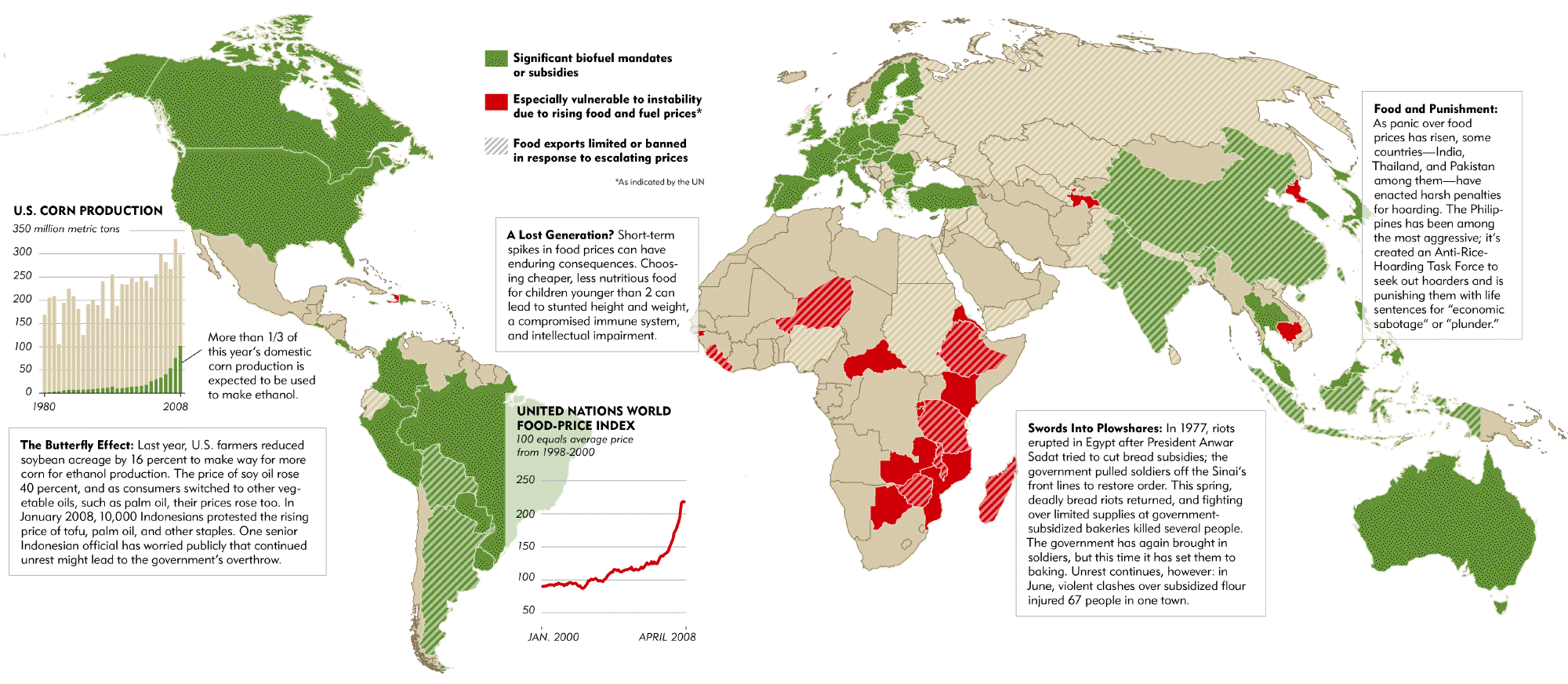
Just spotted the following map in The Atlantic .

From The Atlantic
Riots and protests over food prices have broken out in 30 countries since 2007. Haiti’s prime minister was tossed out of office in April, largely because of protests over the price of food, and the Malaysian government is looking none too stable for similar reasons. In South Africa, discontent over soaring food and fuel prices provided the spark for violence that killed dozens of illegal immigrants last spring. Even in the United States, wholesalers such as Costco limited the amount of rice each person could buy, unsettling some consumers. It’s possible that the most consequential price spike of 2008 will be in food, not oil.
High food prices, like high oil prices, are partly the result of rising demand by a larger, wealthier world population. But food-supply problems have also contributed to the recent spike in prices, and food has become a source of international tension.
The growth of the global food market has meant more food for billions of people, yet it has also led to a greater concentration of supply. In 2006, the top five oil producers supplied 43 percent of the world’s oil. By comparison, the top five corn producers grew 77 percent of the world’s supply; rice producers, 73 percent; beef and wheat producers, 66 percent each. Because of this concentration, a supply disruption in even one place can ripple through the food market worldwide.
Some disruptions are unavoidable. Last year, for instance, drought in Australia, a major wheat exporter, helped drive up wheat prices by nearly 100 percent. But some disruptions are the result of political decisions. For example, in response to the high wheat prices, India, then the world’s second-largest rice exporter, decided to rely on rice, not wheat, for its public food program—and instituted a ban on most rice exports. Vietnam and Egypt, fearing local rice shortages, quickly followed suit. The result was a seize-up in the global market for rice: prices rose from $333 a ton in 2006 to $963 a ton in May of 2008.
by Charlie Edwards | Sep 26, 2008 | Off topic
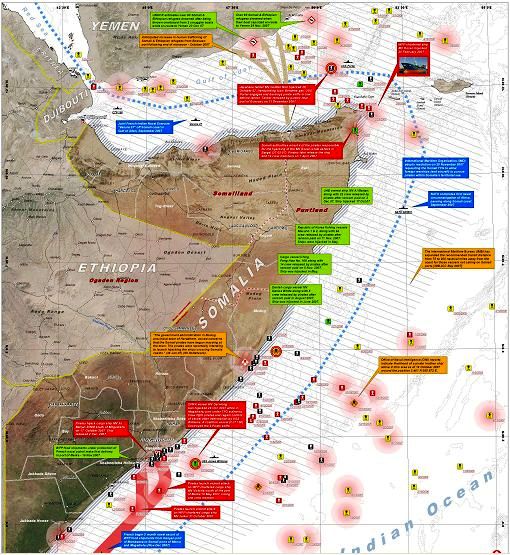
I know what you’re thinking. What are pirates going to do with 30 Russian T72 tanks? Not much probably but the rest of the cargo, a mixture of RPGs and the Zu-23 anti-aircraft guns will soon find their way into Somalia’s arms markets. The situation off the cost of Somalia is getting progressively worse. And while we will post more on piracy in the near future here’s a map outlining some of most recent attacks.

This passage from The Times gives you a sense of the scale and nature of the problem
Earlier this week the Danish navy freed 10 pirates it had captured at sea, saying they had insufficient evidence to prosecute them. But at the same time French officials have filed preliminary charges of hijacking and kidnapping against six suspected pirates captured earlier this month. Commandos snatched the six in a daring raid to free a French couple seized as they sailed their yacht along the Somali coast towards the Suez Canal. They are currently awaiting trial in a French prison. Six naval vessels are currently patrolling the waters around the Gulf of Aden and the Indian Ocean as part of an international task force to tackle piracy. However commercial shipping companies have criticised the mission for failing to make a difference.
“This is an international problem and needs an international solution. It will take more than the six or seven ships we have in 2.4m square miles of sea.”
Meanwhile, the Canadian navy has said that it will continue to escort emergency shipments of food into Mogadishu. Its frigate, HMCS Ville de Quebec, was due to return to the Mediterranean tomorrow but will spend another month ensuring that desperately needed supplies can reach Somalia. The World Food Programme of the United Nations had given warning that its deliveries would cease if an escort could not be found.
by Alex Evans | Sep 24, 2008 | Cooperation and coherence, Europe and Central Asia, Global system, Influence and networks
Over at the UN in New York, where it’s the annual jamboree that is the General Assembly, Nicolas Sarkozy has been calling on world leaders to hold a summit later this year on building a “regulated capitalism”. Four thoughts:
1) if this summit were to go ahead, it would mark the continuation of a trend towards head of state / government level summits on specific issues (as opposed to gatherings that cover a whole range of foreign policy issues, like the G8 or the Security Council). Earlier this year heads of government turned out in force for the FAO food summit; last year, Ban Ki-moon got a good turn out for his high level event on climate change at the UN.
But there’s only value in getting heads engaged if a) their involvement is needed in order to join up the dots between different areas of ministerial or department responsibility within their goverments (e.g. cross-sectoral bargaining that involves energy, climate and trade all at once), or b) their political clout is needed to forge a deal. I’m not sure that either of those conditions applies here – in which case, wouldn’t it make more sense to leave such a summit to finance ministers?
2) Sarkozy also said at a press conference yesterday that “we cannot wait any longer to turn the G8 into the G13 or G14, and to bring in China, India, South Africa, Mexico and Brazil”. Interesting to see this idea reviving; the scale of the current crisis (‘perfect storm’ etc.) might appear to militate in favour. But as ever, the big questions are less over who would be around the table and more about what it would do, how it would work and – above all – whether it would be any more effective than the G8 (which hasn’t achieved very much lately). More on this in a paper I wrote on new global leaders’ forums a while back.
3) While Sarkozy knows he wants a summit, it’s also clear that – so far – he doesn’t have any specific proposals for multilateral action. You can bet this will cause a frisson or two at Number 10, given that Gordon Brown does have a set of proposals for international financial reform, but so far lacks a coalition to push them. There might be potential for France and the UK to team up quite effectively here, not least given that Sarkozy will have recognised that without at least one major financial centre involved front and centre, his idea’s dead in the water (n.b in that regard that Sarkozy mooted London as a possible venue for the summit, along with NYC, Paris and Brussels).
4) Whether Brown’s proposals are the right ones to deal with the current crisis is, of course, a separate question. Looking at them again, the main impression is of the lack of specificity: calling for a “common approach to handling major global market disruptions”, a “clearer, more authoritative watchdog” or “common principles, shared analyses and information and collaborative management of crises” is all very well, but if there was ever a case of the devil being in the detail, this is it. (As for his calls for a global early warning system for financial crisis – by all means, but is now really the time to be thinking about that?)
It’s good to see that someone’s asking the big questions about long term prevention and looking to facilitate a serious high level conversation about where we go from here, and the UK should certainly get involved and think seriously about offering to host. But it’s way too soon to be thinking about shared operating systems or even shared platforms at this point: the key tasks now are a) to put out the immediate fire and then b) to build up shared awareness of what’s happened, why, and what we want to achieve as we consider a new financial architecture.
(For explanation of shared operating systems, platforms and awareness, see here.)