by Charlie Edwards | Jun 24, 2008 | Africa, East Asia and Pacific, Middle East and North Africa, South Asia
Over on ArmscontrolWonk they have been analysing the arc of crisis map from the recent French White paper on national security and defence. They’ve done a great job at distinguishing what all the shapes (originally plotted on the map by hand) mean:
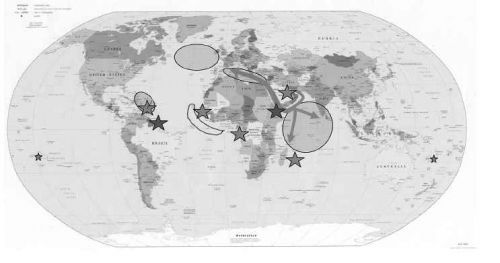
Circles: Main naval areas of patrol/operations.
Dark stars: Bases belonging to the “Forces de souveraineté” category, on French overseas territories.
White stars: Bases on the Atlantic coast of Africa.
Grey stars: Djibouti and Abu Dhabi/UAE bases, on which the French forces will be relying more and more, due to the shift of priorities from Africa to Asia, also reflected in the arrow pointing to the Indian Ocean.
(Hat tip Guy de Loimbard)
Readers of GD will note how similar the French arc of crisis is to the arc of stability – made famous by Tom Barnett:

by Richard Gowan | Jun 20, 2008 | Climate and resource scarcity, Conflict and security, Global system, North America
At the start of the month, I tried to write a wry and whimsical post about signs of scarcity in Putnam County, a beautiful bit of hill country north of New York City. Well, sometimes you’re trying to do whimsy and you come over as a bit of a dick. Although it wasn’t possible to comment on the post (any blog that involves internet hate figure Daniel Korski has to take such measures) one Putnam resident ferreted out my e-mail address to point out that I’d got my facts and analysis wrong.
I won’t reprint the entire correspondence, but the central issue has been Putnam County’s 1970s Indian Point nuclear power station, which I mocked as “Olde Worlde” and a menace to the community. That’s not a unique point of view – heck, even folk legends Pete Seeger and Ani DiFranco claim that “Indian Point is leaking radioactive waste into the Hudson River, is one of the most vulnerable terrorist targets, and has 20 million people without a workable evacuation plan living in its shadows.” And for those who aren’t convinced that folk genius and knowledge of energy security are one and the same thing (I have visions of Steeleye Span commenting on pipeline issues) an organization called Riverkeeper bashes away at Indian Point and other polluters along the Hudson River.
All ostensibly convincing. But my correspondent says it’s all deeply misleading: “Putnamers in general do not subscribe to the PR-based notion of Indian Point as a problem. That notion flies higher the further away from the animal itself one gets.” He counters that Putnamers appreciate the employment Indian Point brings; fear that the alternative would be coal-fired power stations that would ruin the area’s excellent air quality; mistrust Riverkeeper and are generally weary of “negative snark” from ” the gentrification corps up from SoHo”. Now, I live in Brooklyn, but I plead guilty of snarking without fact-checking.
Of course, it’s possible that my correspondent doesn’t speak for a majority in Putnam County either – for once, I’m going to allow comments on this post to see if anyone else from that part of the world wants to contribute (but if you wish to weigh in on the merits of Steeleye Span as political commentators go here instead). Still, I’m convinced for now – as David has pointed out, energy and emissions issues are going to loom large in U.S. politics before and after the elections, so it’s good to look at the issues from the ground up. My correspondent and I ended up 100% agreeing that everyone should spend some time in Putnam County – go to Cold Spring from Grand Central via Metro North. It’s great.
by Charlie Edwards | Jun 18, 2008 | Conflict and security, Cooperation and coherence, Europe and Central Asia
While the national football team’s loss to Italy last night heralded the end of an era for French football and possibly Raymond Domenech tenure as coach, a new era in French national security and defence policy was being ushered in by President Sarkozy.
In a sentence: The new French white paper is a radical departure from traditional French defence policy and recommends a plethora of new policies that seek to transform internal structures of government regarding intelligence and crisis management while simultaneously articulating a shift in approach to international affairs.
It’s good, far better than the US National security’s strategy and better in some areas than the recent UK strategy. Terrorism ranks as France’s primary threat (pourquoi?).
The two key takeaways are the wholesale transformation of France’s crisis management structures and the five strategic functions of national security strategy.
The strategy offers a well worn narrative beginning with the end of the post-Cold War world and the effects of globalisation. There are some clear parallels with work done in the UK, US, Singapore and elsewhere but some notable differences. Like the UK NSS the French white paper takes an all-hazards approach, dealing with active, deliberate threats but also with the security implications of major disasters and catastrophes of a non-intentional nature.
Unlike the UK NSS which was primarily the creation of a small group of policy makers inside the Cabinet Office the French Government have put a huge amount of effort into their new strategy. The composition of the Commission included government agencies, the armed forces, parliamentarians, academia, think-tanks, independent experts and industry. And in a striking similarity with the Conservative Party’s approach, the Commission took evidence from individuals from 14 countries on 5 continents with televised and on-line hearings. Furthermore there were more than twenty in-depth field visits in defence and national security units and facilities.
For a more indepth analysis…
(more…)
by Alex Evans | Jun 3, 2008 | Climate and resource scarcity
One of the catches with this week’s UN food summit is that it’s not immediately clear just what deal the various heads of state and ministers assembled here are supposed to cut – and that leaves the (hundreds of) journalists here looking for story angles. Look at some of the main issues at play in the food prices issue and you start to see their problem:
Humanitarian relief. The World Food Programme’s urgent appeal for $755m needed to keep feeding the 73 million people dependent on it for help has been making headlines all spring – but now the funding gap has been plugged, thanks to a half a billion dollar donation from Saudi Arabia.
(Incidentally, it’s a mystery on a par with the Marie Celeste as to why WFP didn’t wait until the summit to announce the cash. Here in Rome, it would have been the story from the summit. As it was, the news – announced late on a Friday afternoon – sank with hardly a trace. One leading food journalist I spoke to this morning said he didn’t get the press release until two days later. You couldn’t make it up…)
Trade. Numerous policymakers have pointed to the long term importance of trade reform, and pushing ahead with the Doha Development Round. But as far as this summit is concerned, that’s off the agenda, since the Doha Round has its own, separate, negotiations.
Changing diet patterns. The growth of a global middle class eating a grain-intensive western diet is the single biggest driver of rising prices, and as I noted in another post earlier today, it raises the awesomely complex and politically difficult question of fair shares. But there’s no chance of any substantive discussion of that here this week.
Investing in agricultural supply. Everyone agrees that a ‘new green revolution’, or whatever you want to call it, will be essential given that demand is set to rise 50% by 2030. But while the UN’s High Level Task Force sets out a strong analysis in its newly published paper on elements of a comprehensive strategy, it’s hard to see what actual deal this week’s summit could cut in this area. Admittedly, several countries are likely to announce major new funding commitments while they’re here. But the amounts will have to be very big to become the story of the week.
So what does that leave? If I worked for the UN Secretary-General, I’d be putting all of my effort into persuading one or two of the really big producers who’ve imposed export restrictions on crops – like India, Russia, Kazakhstan or Argentina – to announce an easing of those restrictions. That would mark an important step forward, and represent a triumph for the UN and its Secretary-General.
But without that, it looks like the story of the week is likely to be about biofuels – where it’s hard to see any great strides towards consensus being made here in Rome. On the contrary, with the US and Brazil defending biofuels to the hilt even as others (including FAO head Jacques Diouf) fire broadsides off against feeding crops to cars, the risk is of a damaging spat. That will make for a lively story, if it becomes the angle that journalists here go for – but could also lead to all sides entrenching their positions, which would be a Bad Thing.
by Alex Evans | Jun 3, 2008 | Climate and resource scarcity, Cooperation and coherence, Economics and development
The FT’s Gideon Rachman has a terrific column today mulling over the question that this week’s UN food summit in Rome is likely to sweep politely beneath the carpet: the question of fair shares to scarce global commodities like energy, food and ‘airspace’ for our emissions.
It is all very awkward. China and India are getting richer. And it appears their new middle classes want all the things we want: cars, washing machines, even meat. Here in the west, we have to restrain ourselves from saying: “Stop. You can’t live like us. The planet can’t stand it. And our wallets can’t stand it. Have you seen the price of petrol?”
Global equity is the awkward issue lying behind the world food crisis. In the long run, it will also prove fundamental to discussions on energy and global warming.
Gideon’s clearly right that asking China, India and other emerging economies to stay poor is a total non-starter (politically as well as morally) – but on the other hand (as his article also makes clear), the problem is that a burgeoning global middle class also risks leaving the world’s poor in an untenable position, now that supplies of energy, food, water, land and ‘airspace’ for our emissions are all getting scarce. Moises Naim asked in a recent LA Times editorial whether the world could afford a middle class – he might have asked whether the poor can afford one, too.
On climate change, at least, we’ve known for a while where the debate needs to go. Given that stabilising the climate will necessarily entail sharing out a safe global ‘emissions budget’, we can’t duck the question of how to share such a budget out – and, by extension, how to satisfy the different equity claims of both emerging economies and least developed countries. How to do that? In a nutshell, through enshrining the principle of fair shares to the global common resource of the atmosphere through a process of convergence to equal per capita emission rights by some agreed date (2030, 2050, the day after tomorrow – whatever countries can hammer out). More and more people in the climate debate are now accepting that proposition (Nick Stern being a notable recent convert), and discussion of it ought to figure heavily on the road to next year’s Copenhagen summit.
With food, though, it’s very much harder to see how the principle of fair shares can be operationalised. At this week’s UN food summmit, the demand side effects of changing diet patterns aren’t even being talked about seriously, even though most analysts agree they’re the most important driver of rising food prices.
Still, one starting point would be to get some basic analytical tools up on the web. If I want to calculate my lifestyle’s carbon footprint, there are any number of websites that will allow me to do just that – and to see whether I’m living within or beyond my ‘fair share’ of the atmosphere. But if I look for a calculator to figure out my diet’s “grain footprint” – the amount of wheat, corn and other cereals needed not just for my daily bread, but (more significantly) the meat, dairy products and processed food in my western diet – I draw a blank. As a result, I’ve no way of telling whether I’m taking food out of someone else’s food bowl, or being a responsible consumer and living within my fair share.
True, grain footprint calculators hardly represent a comprehensive global solution. But if global food supply fails to keep pace with demand growth – forecast by the World Bank to rise by 50% by 2030 – then they’re not a bad place to start the discussion.
