by Alex Evans | May 7, 2009 | Climate and resource scarcity, Cooperation and coherence
More evidence of increasing awareness of scarcity issues (and the consequent need for integrated policy approaches to managing them) over in the US: this presentation on ‘environmental challenges and global security’ from a colonel on the joint chiefs’ staff, given at a Department of Agriculture meeting on the food crisis held last week.
Intriguingly, it includes a recommendation for a new National Security Council inter-agency policy committee on environmental security – which would develop a strategy to “utilize all elements of national power (diplomatic, information, military and economic)” so as to prevent conflict and promote regional stability.
The Department of Defense isn’t the only part of the US government where there’s innovative thinking happening on this area. As I noted here last November, the National Intelligence Council’s report on global trends to 2025 placed a good deal of emphasis on scarcity issues,which was thanks to NIC’s Director of Analysis Mat Burrows.
Another key player in all of this is Carol Dumaine – like Mat, a career CIA analyst (where the Washington Post called her one of “the CIA’s dissidents”) – who’s now over at the Department of Energy’s Office of Intelligence and Counterintelligence as their Deputy Director for Energy and Environmental Security. Carol describes herself as an “intelligence ecologist” and argues that current global challenges require “generalists who are specialists of the whole” – see this excellent presentation that she gave at an Institute for Environmental Security conference in DC in March.
The signs are also positive that National Security Adviser James Jones recognises the importance of scarcity issues and the need for changes to machinery of government in pursuit of more effective approaches to them. As a Washington Post profile of Jones published this morning observes,
Although the administration is barely more than 100 days old, Jones has launched an ambitious restructuring of the White House national security apparatus so it can focus on modern issues such as energy and climate change.
by Alex Evans | Apr 2, 2009 | Climate and resource scarcity, Economics and development, London Summit
Although the food price crisis has slipped from the agenda as the credit crunch has gathered pace, for poor people around the world it hasn’t gone away – and may now be set to worsen again.
While the FAO’s food price index has fallen by around 30% since its peak last summer, that only takes it back to May 2007 levels: still well above recent norms. Meanwhile, the global total of undernourished people is now over a billion, up from 850m just a couple of years ago. Now, FAO officials say privately that they expect the next findings from the index to show a new increase.
If that’s right, then we’re really moving in to worst case scenario for developing countries, who are already reeling from the credit crunch. So what’s happening here at the London Summit on this front?
I asked that to Douglas Alexander, the UK’s international development secretary, in a press conference he did an hour or so ago. He pointed to the £200m the UK has committed to a new ‘rapid response social fund’ to provide safety nets for the most vulnerable people, and applauded the work of the World Bank and WFP in particular. On increasing supply, meanwhile, he suggested that infrastructure investment is crucial (which it is).
I also caught up with Peter Mandelson, the UK’s business secretary, and asked him how the trade system could be proofed against the kind of crazy security of supply perturbations that caused such problems last summer, when over 30 countries had export restrictions in place. He stressed that what’s needed is to keep markets open, and that any impediments to this would harm supply by undermining incentives.
In analytical terms, I can’t fault anything either of them said. But note the lack of specifics about what this summit should be doing: there’s no getting round the underlying fact that preventing a resumption of the food price spike isn’t on the agenda here. It should be. As a senior IMF official put it to David and I when we were over in DC recently: “the last thing we can afford now is another crisis creeping up on us”.
by Alex Evans | Mar 27, 2009 | East Asia and Pacific, Economics and development
Earlier this week, I noted that the Daewoo land lease deal in Madagascar – under which the South Korean conglomerate secured the lease to one half of Madagascar’s arable land for, er, no money – had emerged as one of the main reasons for Madagascar’s recent coup d’etat, and that one of the first acts of the new President had been to cancel the deal.
Good for Madagascar, you might think: with luck, this will lead to food importing countries becoming a bit more intelligent about getting the politics and the social dimensions right when they negotiate such sensitive food security deals.
Or maybe not. Here’s the view of Chosun Ilbo, one of South Korea’s largest newspapers:
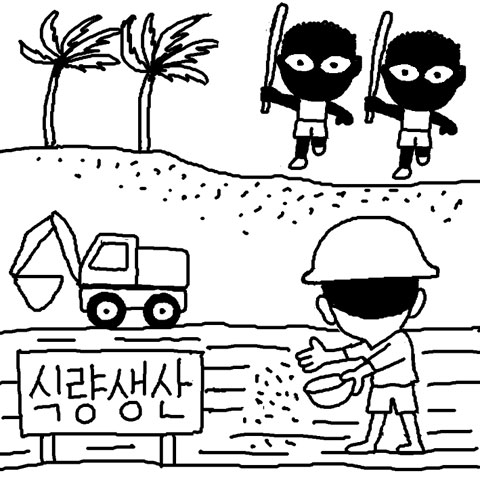
Er… nope, words just fail me.
So instead I’ll just quote what Ban Ki-moon – South Korea’s first Secretary-General of the United Nations – said when speaking to the Korean Parliament last summer:
My friends, Korea is not doing what it must … In truth, I’m somewhat ashamed as secretary-general that Korea is not doing what it should … I hope that Korea reflects on its current standing in the world and [resolves] to contribute more to the UN’s official development assistance [ODA] and its peacekeeping activities.
Looks like he has an uphill struggle on his hands…
by Alex Evans | Mar 24, 2009 | Climate and resource scarcity, Conflict and security
Back in November last year, I blogged on the land lease deal agreed between Daewoo, the South Korean company, and the government of Madagascar, under which the former would lease fully one half of Madagascar’s arable land for a hundred years. Soon afterwards, the news emerged that Madagascar would receive no payment at all for the lease – the only upside would instead be the prospect of some job creation.
Since then, of course, Madagascar’s government has fallen in a coup d’etat. But what I hadn’t spotted until a US Department of Agriculture official mentioned it to me last week is the fact that the land deal was front and centre in what made the coup happen. Here’s Tom Burgis in the FT on Saturday:
“Everything was a monopoly with [President] Ravalomanana,” says Naina, a 41-year-old wood chopper in one of the capital’s poorest neighbourhoods. “The country could not develop.”
The bombshell that turned the discontent into outright anger and so brought an end to Mr Ravalomanana’s rule was news of a deal between the government and Daewoo Logistics. This envisioned leasing vast tracts of Madagascar’s arable land to the South Korean conglomerate to grow crops that would be exported from a country where aid agencies were battling rural starvation. “It was the news that said Daewoo expected to pay nothing for the land that accelerated the trouble,” says one well-connected Malagasy banker who asks not to be named.
At a stroke, alienated members of the Malagasy elite found the banner to which they could rally an urban poor already struggling to cope with rice prices driven higher by the global commodity boom. They also found a figurehead in Andry Rajoelina, a 34-year-old former DJ who had married into Malagasy aristocracy and built the capital’s foremost billboard advertising operation …
Thousands took to the streets, whipped up by the Daewoo deal as the symbol of all that was ill. Protests turned to looting. Scores died as buildings burned. Then, in early February, Mr Rajoelina lead a boiling crowd from the main square to the gates of the state palace. Amid the confusion, the presidential guard opened fire.
By now we’re all well used to the idea that oil, diamonds, coltan, poppies and other high-value commodities can lead to a ‘resource curse’ in fragile states – for instance when the resource endowment ‘crowds out’ other sectors of the economy (e.g. through exchange rate rises), or props up poor governance. Hitherto, though, only a few food crops – like coffee and cocoa – have been on the list of potential resource curse drivers.
I found myself wondering a couple of weeks ago whether the prospect of long term food price inflation and proliferating security of supply concerns in places like China, South Korea and a raft of Gulf countries, might lead to growth in the pool of potential resource curse drivers. Having seen the first government fall as the result of a landgrab deal, I think we now know the answer…
by Alex Evans | Feb 17, 2009 | Cooperation and coherence, Economics and development
I shouldn’t laugh, as clearly it behoves all right-thinking people to applaud examples of UN agencies ‘delivering as one’ wherever we may find them.
But still, perhaps one may be permitted a small chuckle of surprised delight upon receiving a press release from a UN agency proclaiming its assistance to the UN’s food task force – when the agency in question is the International Atomic Energy Agency.
Apparently the IAEA has helped 24 African countries to eradicate the deadly cattle disease rinderpest. Alas, details of how this has been achieved were not provided. But there is much enjoyment to be had in speculating.
IAEA have also provided this photo with their press release, which shows Dr. Chiklu Mba, the head of IAEA’s Plant Breeding Unit. Rather fabulously, the caption explains that he is “examining mutant banana samples”.

Join us here again at the same time next week, when the World Food Programme will be with us to set out their ambitious plan for making a success of the Nuclear Non-Proliferation Treaty review conference in 2010.
