by Alex Evans | Apr 9, 2008 | Climate and resource scarcity, Economics and development, Global system
I’m a big fan of Foreign Policy editor Moises Naim – he was the first person to spot the potential for China’s Olympics to become a debacle, for instance – but I was left a bit cold by his LA Times article yesterday on the pressures that accompany the emergence of a truly global middle class. As he observes, the global middle class is growing at an explosive rate:
Homi Kharas, a researcher at the Brookings Institution, estimates that by 2020, the world’s middle class will grow to include a staggering 52% of the total population, up from 30% now. The middle class will almost double in the poor countries where sustained economic growth is fast lifting people above the poverty line.
For Naim, the central question is, ‘can the world afford a middle class?’. As he points out “the lifestyle of the existing middle class will probably have to drastically change as the new middle class emerges. The consumption patterns that an American, French or Swedish family took for granted will inevitably become more expensive…” This is above all because of the intensifying resource pressures that come with a growing middle class, especially on food (which Naim discusses at length) and energy. Naim’s conclusion is that,
The debate about the Earth’s “limits to growth” is as old as Thomas Malthus’ alarm about a world in which the population outstrips its ability to feed itself. In the past, pessimists have been proved wrong. Higher prices and new technologies that boosted supplies, like the green revolution, always came to the rescue. That may happen again.
But the adjustment to a middle class greater than what the world has ever known is just beginning. As the Indonesian and Mexican protesters can attest, it won’t be cheap. And it won’t be quiet.
But what’s missing for me in Naim’s article is what the emergence of a global middle class means for the poor: the ‘billion at the bottom’ (who may be more like the two to three billion as we get closer to 2050). Yes, there’s a question about how to increase supply (of food, energy and other key resources). But there’s also a demand side – which is all about fair shares.
Take food prices as an illustration. In his book Development as Freedom, Amartya Sen observes that in some cases, famines happen because of relative inequality rather than because of an absolute shortage of food:
“…[some people] who buy food may be ruined because the real purchasing power of their money incomes may have shrunk sharply. Such a famine may occur without any decline in food output, resulting as it does from a rise in competing demand rather than a fall in total supply…”
So what happens if we start to see this globally – whereby a burgeoning global middle class inadvertently takes food beyond the purchasing power of the world’s poorest people?
All of us can see the two megatrends of (a) the increasing tightness of food supply – likely to grow further as population, affluence and scarcity continue to rise – and (b) the growing gulf between the haves and the have-nots. In combination, those trends have the potential to multiply each other’s impact as far as the poorest are concerned. What we’re only just beginning to realise is this: in a world of limits, relative inequality can have absolute implications for the world’s poor.
by Richard Gowan | Apr 9, 2008 | Climate and resource scarcity, Conflict and security, Economics and development
I normally leave scarcity issues to the other, better-informed contributors to this blog, but this week’s food riots in Haiti have brought UN peacekeepers face-to-face with the effects of rising prices, so I can’t keep my head that deep in the sand. UN officials can talk about little except food prices at the moment. John Holmes, the UN humanitarian chief and increasingly cited as one of the Secretariat’s stars, set out the problem today:
Combined with the negative impact of climate change and soaring fuel prices, a “perfect storm” is brewing for much of the world’s population, said Holmes. “The security implications (of the food crisis) should also not be underestimated as food riots are already being reported across the globe.”
His comments came after two days of rioting in Egypt, where the prices for many staples has doubled in the past year. And violent food protests were continuing for a second day in the capital of Haiti. “Current food price trends are likely to increase sharply both the incidence and depth of food insecurity,” Holmes said, noting a 40-per-cent average rise in prices worldwide since the middle of last year.
What to do? Well, not unreasonably, the UN is continuing to push for more food aid to the worst off:
John Powell, the deputy executive director of The United Nation’s World Food Program, emphasized the need for developed countries to help governments in the developing world. Developing countries experiencing unrest over high food prices need help in developing “social safety net programs,” he said.
“Riots today mean you need a solution tomorrow,” Powell said. Governments with no “policy space” and under pressure from organized discontent in urban centres “is not likely to be the best decision” in trying to solve the problem, he said.
So, governments facing serious rioting make bad decisions. Hm. Sometimes, the real problem is that bad governments face riots. That isn’t about “policy space”, but about the fact that autocratic or incapable regimes tend to reinforce or manipulate food shortages to their own advantage. The popular response: rioting.
Throwing food at the problem might be a “solution tomorrow”, if there was food to be thrown. But it seems there isn’t – and the essential response to food riots is creating more accountable (dare one say “democratic”?) governments that are politically motivated to respond to inequalities (rather than simply offer a “safety net”, although that may have to do for now). My colleagues who think about such things will find this blindingly obvious, but there’s a risk that the current crisis will obscure the underlying political dimensions of the inequalities involved…
PS: whatever the precise linkage between scarcity and urban violence, nobody should attempt to intervenc before reading Planet of Slums by Mike Davis. It should be the book of the moment, and even makes UN statistic compelling. If you don’t have time to read that, there’s an article-length version of the case online.
by Charlie Edwards | Apr 7, 2008 | Off topic
Soaring corn prices hit ethanol profits (The Times)
Darling accused of failing to spot credit danger (The Times)
IMF head calls for global action on turmoil (The Financial Times)
‘We are aiming for climate disaster’ (The Guardian)
Web could collapse as video use soars (The Telegraph)
Soaring price of food ‘may lead to riots’ (The Telegraph)
Economic Woes Render Growth Debate Moot (Washington Post)
In Egypt, Technology Helps Spread Discontent of Workers (The New York Times)
by David Steven | Apr 7, 2008 | Climate and resource scarcity, Conflict and security, Cooperation and coherence, Global system, Influence and networks
On Saturday, Alex and I presented our paper on multilateralism and global risks to heads of state at the Progressive Governance Summit, which was chaired by Gordon Brown.
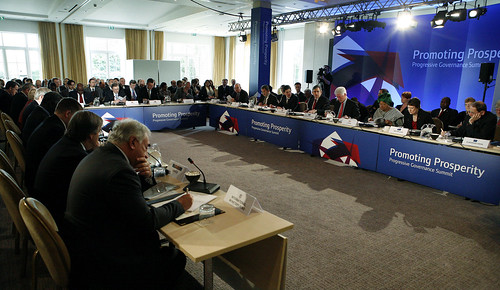
The summit was held at the Grove Hotel in Watford – which is more used to hosting the England football team and posh weddings. Locals – who were warned they would be searched before entering the hotel’s spa – seemed less than impressed at the interruption, though a few did manage to sneak in for a round of golf (though perhaps they were snipers in disguise).
And inside? We got a nice plug from Helen Clark, New Zealand’s PM, and from Africa’s first elected female head of state, Ellen Johnson-Sirleaf. Bill Clinton was also lucky enough to be collared by Global Dashboard’s Charlie Edwards on his way back from the lav, which I am sure was a highlight for both of them.
In discussion, two topics predominated. First, the global financial meltdown, with Kevin Rudd (surely the wonkiest head of state ever) fretting that ‘technology has got ahead of the regulatory environment,’ or in other words, men with computers are doing stuff with money that no-one, including the men themselves, really understands or can control.
A few leaders, Austria’s Alfred Gusenbauer among them, were calling for a World Finance Organisation to be created as an institutional big brother to the WTO (can you imagine the protests outside a WFO annual meeting?). But most were happy to settle for a revamped IMF to act as an ‘early warning system’ and for rapid action to, in the words of the head of the IMF, “disentangle the good and the bad banks”.
A global trade deal was also seen as a vital part of restoring confidence, with the WTO’s Pascal Lamy making it sound as if the conclusion of a ‘strong pro-development, pro-growth round’ was just around the corner. Peter Mandelson, who leads on trade for the Europeans, was a little less bullish, I thought.
Mandelson agreed that ‘night and day drilling’ into the detail of a proposed agreement was yielding results, but he argued that any further delay could be fatal for a deal. 2009 should be written-off, he said, due to a changing of the guard in the US in the first half of the year and in the European Commission in the second. Any agreement would have ‘turned to mush’ by 2010, he concluded.
It was a provocative point and a worrying one, given that 2009 is supposed to be the year the world does a deal on climate. How’s that going to work if everyone is too busy settling into new jobs to pay attention?
I thought the climate discussion was rather disappointing, despite Kevin Rudd’s attempt to muscle some shape into it. The climate paper was presented by Laurence Tubbiana (co-author Nick Stern had a more pressing engagement!) and she set out the same ‘seven elements for a global deal’ that Stern was promoting at Bali. It’s an unobjectionable list, but I am unconvinced by Tubbiana and Stern’s optimism that a deal will be easily struck.
Their framework, they argue, could “allow all countries to move quickly along what they see to be a responsible path”.
What is very striking here is how broadly basic understandings have already been established. Country-by-country we see targets being erected and measures being set by individual countries recognising their own responsibilities as they see international agreement being built. People seem to understand the arguments for action and collaboration on climate change much more readily than they do for international trade.
In the discussion, it was clear that leaders accepted the need for targets. After all, who doesn’t? But there seemed very little consensus on who should do what. It’s only when countries start to work out whether a global deal seems fair to them that we’ll really know whether or not it’ll be a rocky road to Copenhagen.
But climate felt like a little bit of a sideshow, with leaders keen to spend time on another scarcity problem – food. This is an area where my co-author, Alex Evans, is carrying out pioneering work (also see this summary) and it was clear how worried leaders are by rocketing prices.
But will that make any difference? In my part of our presentation (we’ll have text and perhaps some video later), I wondered whether food was going to be another ‘slow motion car crash’ like HIV/AIDS twenty years ago. Is it one of those problems that everyone can see coming, knows is going to be catastrophic, but is unable to do anything useful about? Time will tell.
by Alex Evans | Apr 4, 2008 | Climate and resource scarcity, Conflict and security, Cooperation and coherence, Global system
As David mentioned yesterday, Downing Street’s asked us to prepare a paper on reform of international institutions and present it to various heads of state and international agencies at tomorrow’s Progressive Governance Summit outside London.
Our central argument is that the international system’s core challenge is to get better at managing global risks like climate change, financial instability or food insecurity – and at building resilience to their impacts. To achieve that, a new approach to multilateral reform is needed: one that focuses a lot more on the function of international cooperation – the outcomes we want it to deliver – and less on its form (organisations, structures and institutional paraphernalia).
Download the full paper here.
We’ll be presenting to heads of state tomorrow morning and will report back here…
