by David Steven | May 21, 2008 | Influence and networks
Yesterday’s Brooking’s event on the US and Europe (see this post) included three panels – one on the Presidential election; one on the French EU presidency; and one on Russia.
The Presidential panel combined general rejoicing at the imminent (243 days and counting) departure of George Bush (“somewhat less popular in Europe than Satan”) with caution that expectations may be too high at what will follow.
Gary Schmitt, from the American Enterprise Institute, who advises McCain, thought that Republicans had become much more realistic about the need for transatlantic ties. McCain’s speech at the Munich Conference on Security Policy got a plug (and not just from Gary, but from other speakers too):
The debate in the transatlantic relationship – over who is to lead and who to follow, whether to act in concert or unilaterally, or if the bonds that unite us are stronger than interests that divide us – that debate is over. Our interests, though not always perfectly congruent, are rarely diverging.
The Obama narrative, meanwhile, is ‘deeply attractive’ to Europeans, according to Laurence Freedman, currently promoting his new book, on American and the Middle East – A Choice of Enemies. The Bush administration was forever tarnished in European eyes by Guantanamo Bay, Iraq Abu Ghraib, he said. At a time when Europe is populated by a cast of ‘weak leaders’, a new President will have the opportunity to make a clean break from the past (close Guantanamo) and generate real leadership for the US. (more…)
by Alex Evans | May 20, 2008 | Climate and resource scarcity
For all the media comment criticising biofuels lately, you might have thought that the tide had clearly turned against the increasing trend of using crops for fuel. But you’d be wrong. In fact, as Javier Blas repoted in the FT last week, the proportion of American corn going to biofuels is going up: from 22 per cent of the crop last year to a third this time around.
The reason why is simple: oil price. With oil now at $126 – that’s up $10 just since the start of the month – and lots of analysts pondering $200 by year end, biofuels look like part of a route that leads towards energy independence. And even though corn-based ethanol is about the most idiotic substitute for oil imaginable (on a climate change as well as an energy independence basis), the truth is that in its messed-up way, it kind of works.
The proof: look at the front of today’s FT, where the headline is “US begins to break foreign oil ‘addiction’“. Foreign oil made up 57.9 per cent of imports in the first quarter of this year – as opposed to 58.2 last year. A small drop, you might think, but the Department of Energy is already forecasting a fall to 50 per cent by 2015. And here’s the grim bit:
Although the reduction in oil demand growth is partly because of slower economic growth and a projected 1m-barrel-a-day rise in output from the US’s Gulf of Mexico oil fields by 2012, experts also believe that legislation will accelerate the trend. The Energy Information Administration expects the energy act to help boost biofuel production from 8bn gallons this year to at least 32bn by 2030…
And that’s not all: even as the US starts the long hike towards weaning itself, the oil price is expected to keep on going up, as demand in China continues its ascent skywards. In the background, the International Energy Agency is warning that “the world can not easily afford to retreat from bio-fuels in spite of their possible role in driving up food prices”:
Biofuels already make up about 50 per cent of the extra fuel coming to the market from sources from outside of the Opec oil cartel this year. This explains why fears of a retreat this week helped drive oil prices to record levels. William Ramsey, deputy executive director of the IEA, said: “If we didn’t have those barrels, I am not sure where we would be getting those half a million barrels.”
Bottom line: we must not kid ourselves that we can deal with the food security issue separately from the energy security issue. They’re fundamentally intertwined in over a dozen ways – and the fact that hardly any multilateral institutions cover both energy and food is something that should worry us a lot…
by Alex Evans | May 15, 2008 | Climate and resource scarcity, Conflict and security, UK
How much should people in Britain worry about food security? Here’s a starter for ten, taken from a recent Guardian article by Harriet Green:
For three years, my husband has talked about taking to the hills. About buying a smallholding on Exmoor where, with our four-year-old daughter, we can safely survive the coming storm – famine, pestilence and a total breakdown of society. I would wait for his lectures to finish, then return to my own interests. I had no time for the end of civilisation. As an editor on a glossy magazine until a few months ago, I was too busy. There was always a new Anya Hindmarch bag to buy, or a George Clooney premiere to attend.
But recently, I’ve wavered. Much of what he has been predicting has come true: global economic meltdown, looming environmental disaster, a sharp rise in oil and food prices that has already led to the rationing of rice in the US, and riots in dozens of countries worldwide. This week, the details got scarier. The UN warned of a global food crisis, like a “silent tsunami”, while Opec predicts that oil, which broke through $100 (£50) a barrel for the first time a few weeks ago, may soon top $200.
In one sense, it’s no surprise that food figures so prominently in her list of concerns: along with shelter and water, after all, food is about as basic as human needs get. But on the other hand, you have to wonder: if you can afford Anya Hindmarch bags, do you really have anything to worry about on food prices? Isn’t the problem actually the converse – namely that as the global middle class grows, its appetite for meat and dairy products (and handbags too) also grows – taking staple grains out of the purchasing power reach of poorer consumers in the process?
Still, the fact remains: people in developed countries who think about resilience a lot are worried about food. John Robb, for instance, sees food as a critical dimension of his concept of the Resilient Community. Or look at the Transition Towns movement in Totnes, who are going nuts about food security (literally):
… the idea is to use town-wide plantings [of nut trees] to create a stock of healthy, productive trees that can serve as a great source of local food, and a buffer in times of scarcity. The reason that the group is concentrating on nut trees is their potential to outgrow cereal crops in terms of carbohydrates, and to utilise poorer soils with fewer inputs. The group has already planted hazelnuts, walnuts and almonds across the town …
So: how worried should we be in Britain, the US or other developed countries? Is it time to head for the hills? (more…)
by Alex Evans | May 14, 2008 | Climate and resource scarcity
Just back from ten gorgeous days on holiday in Cornwall – hence radio silence on the blogging front, and a much-needed break from frenetic activity on the food prices research front.
(As I found, Cornwall is actually about the best place you could go to get some fresh perspective on food. The Lost Gardens of Heligan have the most impressive kitchen gardens I’ve ever seen; the Eden Project fizzes with thoughts about how we’ll feed ourselves through this century; and Tim Smit – who led the construction of Eden and the restoration of Heligan – and Tony Kendle, director of the Eden Foundation, were both full of ideas about the future of food. Plus, just over the Devon border is Totnes, home of the transition towns movement – which John Robb admires as an exemplar of the idea of the resilient community.)
So with last month’s briefing paper on food prices out of the way, I’m starting to think in earnest about the content of the main pamphlet that I’ll be writing over the summer.
Although we’re not out of the woods yet on gearing up the humanitarian response to immediate term food price impacts, the issue is firmly on the agenda; by the time of the G8 at the start of July, most governments should have made their initial pledges of increased assistance. Meanwhile, the UN’s new task force on food prices met for the first time on Monday, and will pull together a framework for action over the next few months.
But what about the longer term? What are the big questions we need to think through between now and the Italian G8 in 2009, by which time we’ll need to have thought through a global plan for the longer term challenge of meeting 50 per cent higher demand by 2030 – and a population of nearly ten billion by 2050?
I’m tentatively organising my thoughts into three main clusters: questions about the future of agriculture; questions about the future of trade; and questions about the future of demand for food among wealthier consumers. (more…)
by Charlie Edwards | May 13, 2008 | Climate and resource scarcity, Conflict and security
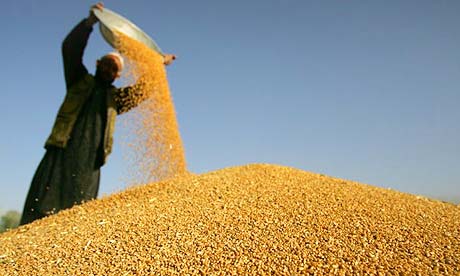
Is the global economic situation having an impact on poppy eradication in Afghanistan? Afghan farmers are capitalising on soaring food costs by growing wheat instead of poppy crops, with the fall in heroin prices further fuelling the switch. This comes at a time when the price of a tonne of wheat in Afghanistan has almost trebled this year, causing acute food shortages.
This may be the case in some regions, but Helmand may be off limits because of instability while some farmers may be put off by difficulties in getting their crops to market as roads are dangerous with bandits roaming the countryside.