by Alex Evans | Aug 1, 2008 | Climate and resource scarcity, Europe and Central Asia, Global system, Influence and networks
Oh dear. First the collapse of Doha, and now this:
Russia plans to form a state grain trading company to control up to half of the country’s cereal exports, intensifying fears that Moscow wants to use food exports as a diplomatic weapon in the same way as Gazprom has manipulated natural gas sales.
The move by Moscow, the world’s fifth-biggest exporter of cereals, has been sharply criticised by US agriculture diplomats as a “giant step back” to the Soviet era.
Morevoer, in the future Russia’s strategic importance as a grain producer is likely to grow as a result of climate change: higher average temperatures are likely to benefit Russia’s agricultural productivity, at least in the short term, as temperate latitudes are projected by the IPCC to see some carbon fertilisation effects between one and three degrees C of warming. (This said, Russia’s yields could still fall in absolute terms if extreme weather events, droughts and changes in water availability impact heavily – but it’s still likely that Russia’s importance as a producer would grow in relative terms.)
Russia (like Canada) looks set to be one of the big winners of the 21st century world of scarcity. Massive investment in new oil production even as the price soars; the prospect of even more resource finds as the Arctic melts; relatively lower exposure to climate impacts; and Russia’s role as a breadbasket of the world (with all the influence that this entails) set to grow and grow.
by David Steven | Jul 30, 2008 | Climate and resource scarcity, Conflict and security
Over at The Interpreter, Sam Roggeveen picks up on Alex’s post on Doha to wonder whether a concern for resilience automatically leads to protectionism:
On one level, it makes sense. If the aim of resilience is to build the capability for society to ‘take a punch’ and rebound, whether from a terrorist attack, natural disaster or even a global economic calamity that restricts food imports, it makes sense to have the capacity for local subsistence.
But following that logic to its end would justify continued and even expanded protection of any industry that can be defined as ‘strategic’. Or at a further extreme, it would put you in the company of the survivalist subculture that stockpiles food in the mountains in preparation for the crumbling of civilisation.
I doubt Alex is in favour of such things, but I’d be interested to know how his resilience doctrine escapes that logic.
Let me chip in with two points. First, I really don’t like the ‘bounce back-ability’ definition of resilience (though it’s a term I often slip into using). The aim is to navigate from one ‘solution’ another, not to stick firmly to where you are.
As Alex and I put it in a forthcoming article for Renewal:
In formal terms, resilience is defined as “the capacity of a system to absorb disturbance and reorganize while undergoing change so as to still retain essentially the same function, structure, identity and feedbacks.” (Walker et al 2004). Perhaps the best practical definition we’ve come across is the one offered by the Harvard Business Review. It states that resilience results from being able to face up to reality, improvise in the face of unfamiliar challenges, while finding a source of ‘meaning’ that encourages long-term thinking (Coutu 2002).
Both definitions emphasize the need to change while maintaining a coherent identity. Systems that are brittle, that try to remain static at all costs, are precisely the ones that are most vulnerable to collapse. On the other hand, systems that are flexible, adaptable, that deal with crisis through renewal are the ones that will tend to survive. This is, in other words, a classic collective action problem. The central determinant of a system’s resilience is the ability to act collectively, coherently, and with the right balance between short and long-term interests.
In a high resilience system, risk – and response to that risk – is distributed throughout the system. Individuals and their groups see their interests as compatible with the collective. They have a common understanding of the challenges a society faces and take decisions accordingly, but this understanding is not a straitjacket. Different actors play to the strengths. There is a balance between initiative and co-ordination. In a low resilience system, on the other hand, risks are felt disproportionately by some groups and responses are thus over-centralized. Individuals pursue narrow self-interest; conflict between groups intensifies; and key institutions are increasingly seen as failing to ‘deliver’.
And from this comes my second point. Resilience of what? My starting point would be that the only way of providing any kind of decent life to 6, 7, 8 or 9 billion people is through an interdependent global system. That means building resilience into the international system, and then nesting it into all systems that sit below.
For me, that should rule out protectionism – though not attempts to hedge against a breakdown at the international level. But of course, it won’t. And that’s a problem. Indeed, collapse has been persuasively described by Joseph Tainter as a loss of complexity and retreat into constituent parts.
The process of collapse…is a matter of a substantial decline in an established level of complexity. A society that has collapsed is suddenly smaller, less differentiated and heterogeneous, and characterized by fewer specialized parts; it displays less social differentiation; and it is able to exercise control over the behaviour of its members.
It is able at the same time to command smaller surpluses, to offer fewer benefits and inducements to membership; and it is less capable of providing subsistence and defensive security for a regional population. It may decompose to some of the constituent building blocks…out of which it was created.
by Alex Evans | Jul 29, 2008 | Climate and resource scarcity, Cooperation and coherence, Economics and development, Global system
No-one quite wants to pronounce the patient dead just yet (US Trade Representative Susan Schwab: “This is not the time to talk about collapse … the US commitments remain on the table”; unnamed EU source: “It’s clearly not a success. But no one will want to say that it’s the end of the round”) – but it’s hard to see much sign of life either, especially after all of Pascal Lamy’s talk of this being the final, final, final deadline.
It’s ironic that at a point when all the talk is of how high food prices are, the issue on which the talks foundered was a mechanism designed to protect developing countries from low food prices. ICTSD explains:
The ’special safeguard mechanism’ would allow developing countries to raise tariffs beyond bound levels, in principle to stall inflows of cheap imports that could displace farmers. The issue neatly splits the interests of import-sensitive developing countries and competitive farm exporters, including those in the developing world: the former want to have recourse to protection, the latter want predictable access to overseas markets.
One of the main sticking points has been whether, and by how much, countries should be allowed under the SSM to impose safeguard duties in excess of current (i.e., pre-Doha) tariff ceilings. The G-33 bloc of developing countries, which includes China, India, and Indonesia, insists that this may sometimes be necessary for safeguard duties to have the desired effect, i.e., protecting farmers.
Or there’s the pithier version from another unnamed official, this time in the IHT:
It risks becoming a totemic issue: subsistence farming versus commodity exports.
That is, in some ways, the long and the short of the issue that led to the talks’ collapse, though needless to say there were many other sticking points too – and it’s another illustration of how debates over agricultural trade are increasingly split into divergent schools of thought. For fans of liberalisation – like the US – the logic is straightforward. With food prices as high as they are, there’s never been a better time to get rid of import tariffs – so why the hell should China and India want to be able to raise them even higher than they were before Doha?
China’s approach, on the other hand, is rooted in concerns about resilience and security of supply in a period of volatility and turbulence: hence its desire to maximise access to imports while at the same time protecting its internal agricultural sector, in which smaller farmers predominate. (While smallholders are inevitably at risk from dumping, they can also be extremely productive in the right circumstances: IFAD cites the example of Vietnam, which has gone from being a food-deficit country to being the world’s second largest exporter of rice – largely thanks to development of the country’s smallholder sector.)
It looks like there will be no further talks until towards the middle of next year, after elections in the US and India – even then, things are likely to be tougher than now given rising protectionist sentiment around the world. Also worth noting that the collapse of the talks – and in particular the acrimony between the US and the two key emerging economies – doesn’t exactly augur well for progress in climate talks.
If you want the full play-by-play, Alan Beattie’s post-mortem is where to go, and ICTSD will have the full details up on their site tomorrow.
by Charlie Edwards | Jul 29, 2008 | Climate and resource scarcity, Economics and development, Global system
This is shocking. Mud is fast becoming a staple part of Haiti’s poor in one of Port-au-Prince’s worst slums. Clay-based food is now a major income earner as mud cakes are the only inflation-proof food available to Haiti’s poor.
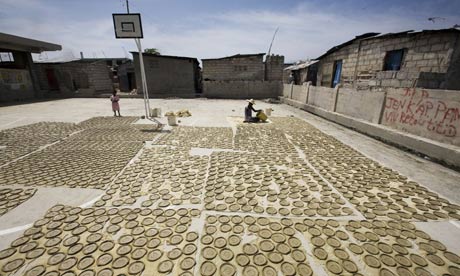
From the Guardian:
As desperation rises so does production of mud cakes, an unofficial misery index. Now even bakers are struggling. Trucked in from a clay-rich area outside the capital, Port-au-Prince, the mud is costlier but cakes still sell for 1.3p each, about the only item immune from inflation. “We need to raise our prices but it’s their last resort and people won’t tolerate it,” lamented Baptiste, the Cité Soleil baker.
Vendors of other foods who have increased prices have been left with unsold stock. In the Policard slum, a jumble of broken concrete clinging to a mountainside, the Ducasse family tripled the price of its fritters because of surging flour prices. “Our sales have fallen by half,” said Jean Ducasse, 49, poking at his tray of shrivelled wares.
by Alex Evans | Jul 28, 2008 | Climate and resource scarcity, North America
It’s been his campaign’s policy since October last year, but in case you needed reassurance, here’s what Obama’s July 15 speech on foreign policy had to say about energy security (one of five national security priorities – the others being “ending the war in Iraq responsibly; finishing the fight against al Qaeda and the Taliban; securing all nuclear weapons and materials from terrorists and rogue states; … and rebuilding our alliances to meet the challenges of the 21st century”):
One of the most dangerous weapons in the world today is the price of oil. We ship nearly $700 million a day to unstable or hostile nations for their oil. It pays for terrorist bombs going off from Baghdad to Beirut. It funds petro-diplomacy in Caracas and radical madrasas from Karachi to Khartoum. It takes leverage away from America and shifts it to dictators.
This immediate danger is eclipsed only by the long-term threat from climate change, which will lead to devastating weather patterns, terrible storms, drought, and famine. That means people competing for food and water in the next fifty years in the very places that have known horrific violence in the last fifty: Africa, the Middle East, and South Asia. Most disastrously, that could mean destructive storms on our shores, and the disappearance of our coastline.
This is not just an economic issue or an environmental concern – this is a national security crisis. For the sake of our security – and for every American family that is paying the price at the pump – we must end this dependence on foreign oil. And as President, that’s exactly what I’ll do. Small steps and political gimmickry just won’t do. I’ll invest $150 billion over the next ten years to put America on the path to true energy security. This fund will fast track investments in a new green energy business sector that will end our addiction to oil and create up to 5 million jobs over the next two decades, and help secure the future of our country and our planet. We’ll invest in research and development of every form of alternative energy – solar, wind, and biofuels, as well as technologies that can make coal clean and nuclear power safe. And from the moment I take office, I will let it be known that the United States of America is ready to lead again.
Never again will we sit on the sidelines, or stand in the way of global action to tackle this global challenge. I will reach out to the leaders of the biggest carbon emitting nations and ask them to join a new Global Energy Forum that will lay the foundation for the next generation of climate protocols. We will also build an alliance of oil-importing nations and work together to reduce our demand, and to break the grip of OPEC on the global economy. We’ll set a goal of an 80% reduction in global emissions by 2050. And as we develop new forms of clean energy here at home, we will share our technology and our innovations with all the nations of the world.
It’s a much more progressive target than the G8 was able to come up with: at Hokkaido, the most leaders could manage was “at least 50%”. It’s more in line with the IPCC, too, which says that to limit temperature increase to between 2.0 and 2.4 degrees C, the 2050 reduction needed is between 50 and 85 per cent: so assuming you want 2.0 rather than 2.4, and adding in the rate of sink failure as well, we should certainly be looking at closer to an 85 than a 50 per cent reduction by 2050 (see page 15 of this).
And lest you wonder, yup, he’s talking about 80 per cent below 1990 levels, rather than the 2000 levels (which would be a lot less demanding). Here’s his campaign’s full energy policy brief.
