by Charlie Edwards | Sep 26, 2008 | Off topic
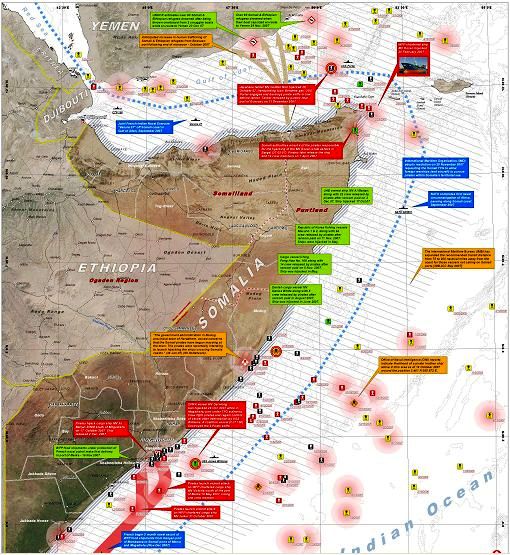
I know what you’re thinking. What are pirates going to do with 30 Russian T72 tanks? Not much probably but the rest of the cargo, a mixture of RPGs and the Zu-23 anti-aircraft guns will soon find their way into Somalia’s arms markets. The situation off the cost of Somalia is getting progressively worse. And while we will post more on piracy in the near future here’s a map outlining some of most recent attacks.

This passage from The Times gives you a sense of the scale and nature of the problem
Earlier this week the Danish navy freed 10 pirates it had captured at sea, saying they had insufficient evidence to prosecute them. But at the same time French officials have filed preliminary charges of hijacking and kidnapping against six suspected pirates captured earlier this month. Commandos snatched the six in a daring raid to free a French couple seized as they sailed their yacht along the Somali coast towards the Suez Canal. They are currently awaiting trial in a French prison. Six naval vessels are currently patrolling the waters around the Gulf of Aden and the Indian Ocean as part of an international task force to tackle piracy. However commercial shipping companies have criticised the mission for failing to make a difference.
“This is an international problem and needs an international solution. It will take more than the six or seven ships we have in 2.4m square miles of sea.”
Meanwhile, the Canadian navy has said that it will continue to escort emergency shipments of food into Mogadishu. Its frigate, HMCS Ville de Quebec, was due to return to the Mediterranean tomorrow but will spend another month ensuring that desperately needed supplies can reach Somalia. The World Food Programme of the United Nations had given warning that its deliveries would cease if an escort could not be found.
by Alex Evans | Sep 24, 2008 | Cooperation and coherence, Europe and Central Asia, Global system, Influence and networks
Over at the UN in New York, where it’s the annual jamboree that is the General Assembly, Nicolas Sarkozy has been calling on world leaders to hold a summit later this year on building a “regulated capitalism”. Four thoughts:
1) if this summit were to go ahead, it would mark the continuation of a trend towards head of state / government level summits on specific issues (as opposed to gatherings that cover a whole range of foreign policy issues, like the G8 or the Security Council). Earlier this year heads of government turned out in force for the FAO food summit; last year, Ban Ki-moon got a good turn out for his high level event on climate change at the UN.
But there’s only value in getting heads engaged if a) their involvement is needed in order to join up the dots between different areas of ministerial or department responsibility within their goverments (e.g. cross-sectoral bargaining that involves energy, climate and trade all at once), or b) their political clout is needed to forge a deal. I’m not sure that either of those conditions applies here – in which case, wouldn’t it make more sense to leave such a summit to finance ministers?
2) Sarkozy also said at a press conference yesterday that “we cannot wait any longer to turn the G8 into the G13 or G14, and to bring in China, India, South Africa, Mexico and Brazil”. Interesting to see this idea reviving; the scale of the current crisis (‘perfect storm’ etc.) might appear to militate in favour. But as ever, the big questions are less over who would be around the table and more about what it would do, how it would work and – above all – whether it would be any more effective than the G8 (which hasn’t achieved very much lately). More on this in a paper I wrote on new global leaders’ forums a while back.
3) While Sarkozy knows he wants a summit, it’s also clear that – so far – he doesn’t have any specific proposals for multilateral action. You can bet this will cause a frisson or two at Number 10, given that Gordon Brown does have a set of proposals for international financial reform, but so far lacks a coalition to push them. There might be potential for France and the UK to team up quite effectively here, not least given that Sarkozy will have recognised that without at least one major financial centre involved front and centre, his idea’s dead in the water (n.b in that regard that Sarkozy mooted London as a possible venue for the summit, along with NYC, Paris and Brussels).
4) Whether Brown’s proposals are the right ones to deal with the current crisis is, of course, a separate question. Looking at them again, the main impression is of the lack of specificity: calling for a “common approach to handling major global market disruptions”, a “clearer, more authoritative watchdog” or “common principles, shared analyses and information and collaborative management of crises” is all very well, but if there was ever a case of the devil being in the detail, this is it. (As for his calls for a global early warning system for financial crisis – by all means, but is now really the time to be thinking about that?)
It’s good to see that someone’s asking the big questions about long term prevention and looking to facilitate a serious high level conversation about where we go from here, and the UK should certainly get involved and think seriously about offering to host. But it’s way too soon to be thinking about shared operating systems or even shared platforms at this point: the key tasks now are a) to put out the immediate fire and then b) to build up shared awareness of what’s happened, why, and what we want to achieve as we consider a new financial architecture.
(For explanation of shared operating systems, platforms and awareness, see here.)
by Alex Evans | Sep 23, 2008 | Influence and networks, UK
Listening to Gordon Brown’s speech today, Philip Stephens notes that “Mr Brown kept his audience in its comfort zone”:
Though he set out the challenges Britain faces in a period of tumultuous global upheaval, Mr Brown did little to challenge his audience’s preconception that the present mess was all the fault of greedy capitalists.
Reading that brought to mind another Labour Conference speech in times of global upheaval: Tony Blair’s back in 2001. Remember this?
This is a moment to seize. The kaleidoscope has been shaken. The pieces are in flux. Soon they will settle again. Before they do, let us re-order this world around us.
I re-read the whole thing this afternoon, and was struck by a) its brilliance, b) its insight, c) how it soars compared to Brown’s speech today and d) the extent to which – in retrospect, with all that’s happened since – it shines with an eerie messianic fervour. It’s well worth another look: full text below the jump.
(more…)
by Alex Evans | Sep 22, 2008 | Africa, Conflict and security, Influence and networks
Yet another ship was hijacked by pirates off the coast of Somalia on Sunday, bringing the total of ships seized there to over 30 this year alone. The current tally is that up to 200 seafarers are being held hostage for ransom.
The US Navy has said bluntly that it can’t guarantee security and that “shipping companies must take measures to defend their vessels and their crews”; shipowners, for their part, are urging EU governments to “recognise the seriousness of the situation and to urgently deploy more warships to the Gulf of Aden and to the seas off the coast of Somalia with the required rules of engagement to enable direct action to be taken against the pirates”. But as US vice-admiral Bill Gortney notes, “this is a problem that starts ashore and requires an international solution. We made this clear at the outset — our efforts cannot guarantee safety in the region”.
In other words, failed states – right? Well, perhaps not entirely. After all, “failed” implies that some kind of effort was underway in the first place, whereas the reality is that for some at least, the absence of formal state control was always the design. Peter Lamborn Wilson notes that:
The sea-rovers and Corsairs of the 18th century created an “information network” that spanned the globe: primitive and devoted primarily to grim business, the net nevertheless functioned admirably. Scattered throughout the net were islands, remote hideouts where ships could be watered and provisioned, booty traded for luxuries and necessities. Some of these islands supported “intentional communities,” whole mini-societies living consciously outside the law and determined to keep it up, even if only for a short but merry life.
Lamborn Wilson is the creator of the idea of Temporary Autonomous Zones, which are more or less what they say on the tin: places where, at least for a while, a zone outside of state control is created. Now while one permutation of TAZs sees them as bases for crime, terrorism and so forth, Lamborn – an anarchistically minded fellow – is as a rule positively enthusiastic about TAZs, as indeed are his libertarian followers (hence the popularity of the concept in rave culture, where free parties can be seen as TAZs).
But where the idea of TAZs really starts to get interesting is when you watch the counter-insurgency / 4GW crowd start to play with it.
(more…)
by Alex Evans | Aug 28, 2008 | Africa, Climate and resource scarcity, Economics and development
Paul Collier, author of The Bottom Billion, is amusing himself by taking shotguns to sacred cows on agriculture and development again. This time, as Owen Barder points out, he’s on Comment is Free, where he regales us with his views on GM technology. As you may have guessed, he’s not in quite the same place as Prince Charles:
[Europe’s] GM ban has three adverse effects. It has retarded productivity in European agriculture; grain production could be increased by about 15% were the ban lifted. More subtly, because Europe is out of the market for GM technology, the pace of research has slowed. GM research takes a long time to come to fruition, and its core benefit – the permanent reduction of global food prices – cannot fully be captured through patents. European governments should be funding this research, but it is entirely reliant on the private sector. Private money for research depends on the prospect of sales, so the ban has not only blocked public research – it has reduced private research …
It is conventional to say that Africa needs a green revolution. The reality is that the green revolution was based on chemical fertilisers, and even when fertiliser was cheap, Africa did not adopt it. With the rise in fertiliser costs as a byproduct of high energy prices, any green revolution will perforce not be chemical. What African agriculture needs is a biological revolution. This is what GM offers, if only sufficient money is put into research. There has as yet been no work on the crops specific to the region, such as cassava and yams.
What to make of his claims? Well, first, I’m curious about his source for the assertion that Europe would have 15% higher grain yields if it permitted GM, as in fact, GM tech hasn’t actually made any major advances in yields for the three main cereal crops (wheat, rice and maize).
What’s certainly true that GM technologies can contribute to making crops more resilient to biotic stresses (pests, weeds etc.). The second generation of GM research is now focusing on abiotic stresses like reduced water availability, soil salinisation etc. But if life sciences represent one R&D approach towards more resilient agriculture, an alternative is ecologically integrated approaches like integrated pest management, integrated soil fertility management and so on.
What both approches have in common is moving away from the Green Revolution’s high-input approach and towards a high-knowledge approach instead. But whereas in life sciences, the knowledge-intensiveness is concentrated at the top end of the supply chain – in R&D labs in biotech and seed companies – with whole systems approaches, the type of knowledge involved is both more participative, and more open to local adaptation. Given adequate investment in extension services to train farmers, then, the latter approach can improve economic resilience as well as crop resilience – by reducing farmers’ dependence on expensive off-farm inputs.
Although there’s much to admire about Collier, when it comes to agriculture, his approach does sometimes come across as a bit, well, ideological. Here he is in The Times a few months back, for instance, where he says:
“The remedy to high food prices is to increase supply. The most realistic way is to replicate the Brazilian model of large, technologically sophisticated agro-companies that supply the world market. There are still many areas of the world – including large swaths of Africa – that have good land that could be used far more productively if it were properly managed by large companies. To contain the rise in food prices we need more, globalisation not less.
Unfortunately, large-scale commercial agriculture is deeply, perhaps irredeemably, unromantic. We laud the production style of the peasant: environmentally sustainable and human in scale. In respect of manufacturing we grew out of this fantasy years ago, but in agriculture it continues to contaminate our policies. In Europe and Japan huge public resources have been devoted to propping up small farms. The best that can be said for these policies is that we can afford them.
In Africa, which cannot afford such policies, the World Bank and the Department for International Development have orientated their entire efforts on agricultural development to peasant-style production. Africa has less large-scale commercial agriculture than it had 60 years ago. Unfortunately, peasant farming is not well suited to innovation and investment. The result has been that African agriculture has fallen farther and farther behind.” [emphasis added]
The remedy to high food prices is to increase supply? Not necessarily. Remember Amartya Sen’s sage observation on this point: food security is less about the overall quantum of food available than about who has the resources to access it: as he once put it pithily, “starvation is the characteristic of some people not having enough to eat. It is not the characteristic of there not being enough to eat”.
So although we do indeed need to increase global food supply – by 50% by 2030, the World Bank reckon – that on its own ain’t enough. The process also has to work for the three quarters of the world’s poor who live in rural areas, most of whom rely at least partly on agriculture. Although these people should have benefited from high food prices, they haven’t – because they’re largely net food buyers, not net food sellers; because fertiliser costs have risen even faster than food prices; because they’ve got poor infrastructure; and so on.
Now, if you’re Collier, you probably think that the best thing for poor people in rural areas would be if they just packed themselves up and decamped to the nearest city. But actually, the evidence set out in the latest World Development Report supports the opposite case. Between 1993 and 2002, the number of people living on less than a dollar a day declined from 28% to 22% of people in developing countries. The principal driver for this improvement, the report continues, has been falling poverty in rural areas (where poverty fell from 37% to 29% over the same period) – and 80% of the decline in rural poverty was due not to migration to cities, but simply to better conditions in rural areas.
Countries like Vietnam show that ag-based growth, export success and smallholder farming can all come together in a virtuous circle: unlike most developing countries, Vietnam has done reasonably well out of high food prices. But to achieve this, various factors need to be in place: infrastructure, access to credit, access to technology, functioning markets, risk management mechanisms, acess to assets backed up by effective rule of law and dispute resolution, etc. etc.
But most small farmers in Africa have never had the benefit of these enabling conditions. In this regard, they’ve been let down by their governments (who despite an African Union target of spending 10% of government budgets on agriculture, mostly spend less than half that level), and by donors (who largely forgot about agriculture until the food price spike, having allowed the proportion of development assistance spent on agriculture to fall from nearly 20% at its peak to around 3% today).
Perhaps it would be worth trying out what real commitment to making smallholder farming work could achieve in Africa, before jumping to the conclusion that the only way forward is to empty Africa’s countryside of people?