by David Steven | Oct 10, 2008 | Climate and resource scarcity, Conflict and security, Cooperation and coherence, Global system, Influence and networks
I’m just back from RUSI, where I spoke about the future of resilience. Full text is below the jump, or you can download the PDF.
The talk complements one from April, at RUSI’s Critical National Infrastructure conference. Alex and I also have a paper on the subject in a future edition of Renewal.
Brief pitch: in turbulent times, we need to build on the work done by emergency planners, and take a broader look at how to make global, national and local systems more resilient to risk. (more…)
by Charlie Edwards | Oct 3, 2008 | Climate and resource scarcity, Economics and development, Global system, Off topic
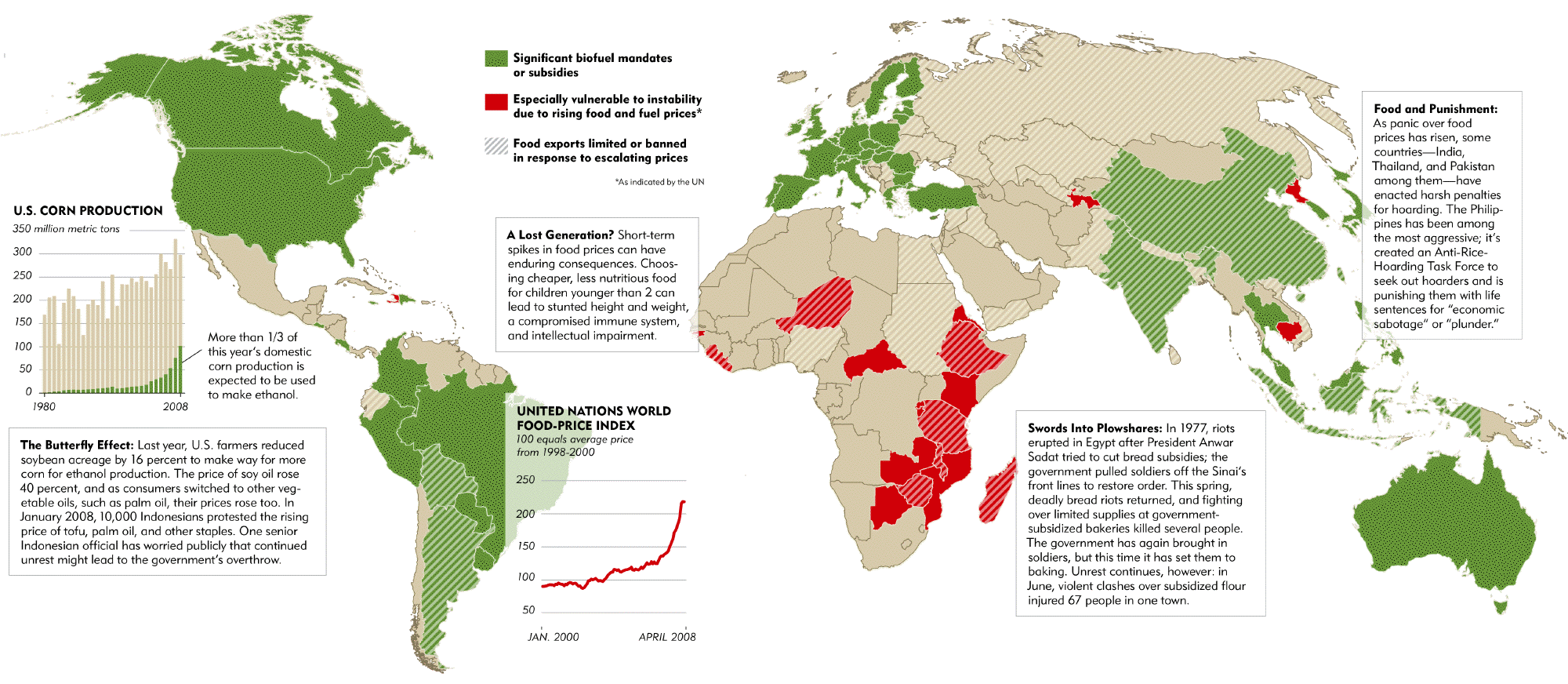
Just spotted the following map in The Atlantic .

From The Atlantic
Riots and protests over food prices have broken out in 30 countries since 2007. Haiti’s prime minister was tossed out of office in April, largely because of protests over the price of food, and the Malaysian government is looking none too stable for similar reasons. In South Africa, discontent over soaring food and fuel prices provided the spark for violence that killed dozens of illegal immigrants last spring. Even in the United States, wholesalers such as Costco limited the amount of rice each person could buy, unsettling some consumers. It’s possible that the most consequential price spike of 2008 will be in food, not oil.
High food prices, like high oil prices, are partly the result of rising demand by a larger, wealthier world population. But food-supply problems have also contributed to the recent spike in prices, and food has become a source of international tension.
The growth of the global food market has meant more food for billions of people, yet it has also led to a greater concentration of supply. In 2006, the top five oil producers supplied 43 percent of the world’s oil. By comparison, the top five corn producers grew 77 percent of the world’s supply; rice producers, 73 percent; beef and wheat producers, 66 percent each. Because of this concentration, a supply disruption in even one place can ripple through the food market worldwide.
Some disruptions are unavoidable. Last year, for instance, drought in Australia, a major wheat exporter, helped drive up wheat prices by nearly 100 percent. But some disruptions are the result of political decisions. For example, in response to the high wheat prices, India, then the world’s second-largest rice exporter, decided to rely on rice, not wheat, for its public food program—and instituted a ban on most rice exports. Vietnam and Egypt, fearing local rice shortages, quickly followed suit. The result was a seize-up in the global market for rice: prices rose from $333 a ton in 2006 to $963 a ton in May of 2008.
by Alex Evans | Oct 1, 2008 | Climate and resource scarcity, Economics and development
I’m speaking tonight at a Global Development Forum event on food prices; Peter Melchett from the Soil Association, Steve Wiggins from ODI and Andrew Coker from Syngenta are also on the panel. My short intro talk is here.
Meanwhile, joy of joys, I have also just finished the pamphlet that’ll be the main output of my Chatham House project on food prices. It’s likely to launch in early November – I’ll post a few of the key findings here next week.
by Alex Evans | Oct 1, 2008 | Climate and resource scarcity, Conflict and security, Global system
Oh, so you thought that the torrent of criticism directed at US Congressmen for voting ‘no’ on the bail-out meant that Senators would be more likely to vote yes tonight, and that this would finally bring some reprieve?
Well, Javier Blas at the FT has news for you: the world’s super-rich don’t share your optimism.
Investors in gold are demanding “unprecedented” amounts of bullion bars and coins and moving them into their own vaults as fears about the health of the global financial system deepen. Industry executives and bankers at the London Bullion Market Association annual meeting said the extent of the move into physical gold was unseen and driven by the very rich.
“There is an enormous pick-up in investment demand. I have never seen a market like this in my 33-year career,” said Jeremy Charles, chairman of the LBMA. “The gold refineries cannot produce enough bars.” The move comes as fears grow among investors over the losses at investment vehicles previously considered almost risk-free, such as money funds. Philip Clewes-Garner, associate director of precious metals at HSBC, added that investors were not flying into gold simply because they saw it as a haven amid Wall Street’s woes. “It is a flight into gold because it is a physical asset,” he said.
Well, that’s a vote of confidence, eh readers? They’ve probably been perusing Nouriel Roubini, who reckons (bailout prospects notwithstanding) that “we are now back to the risk of a total systemic financial meltdown”:
The next step of this panic could become the mother of all bank runs, i.e. a run on the trillion dollar plus of the cross border short-term interbank liabilities of the US banking and financial system as foreign banks as starting to worry about the safety of their liquid exposures to US financial institutions; such a silent cross border bank run has already started as foreign banks are worried about the solvency of US banks and are starting to reduce their exposure. And if this run accelerates – as it may now – a total meltdown of the US financial system could occur.
We are thus now in a generalized panic mode and back to the risk of a systemic meltdown of the entire financial system. And US and foreign policy authorities seem to be clueless about what needs to be done next. Maybe they should today start with a coordinated 100 bps reduction in policy rates in all the major economies in the world to show that they are starting to seriously recognize and address this rapidly worsening financial crisis.
Doom, gloom. Still, readers may also like to be aware that in noting the ongoing travails of Morgan Stanley and Goldman Sachs, Nouriel suggests that “the only institution sound enough to swallow Goldman may be HSBC”. Another reason – as though one were needed! – why those of us who bank with HSBC’s lovely First Direct can shake our heads in bewilderment at those of you who choose not to.
Now, if they only offered safe deposit boxes…
by Leo Horn Phathanothai | Sep 30, 2008 | East Asia and Pacific, Economics and development
As a long-time resident of Beijing, concern about food and product-safety is almost a chronic neurosis. Over the past year alone, health scares have ranged from carcinogenic textiles and toothpastes, to the sale of rancid pork from dug up pig carcasses, to hormone and pesticide-laden fruits and veggies and most recently, melamine-laced milk.
This latest episode of the tainted milk has caused particular outrage because of the life-threatening impact on a large number of toddlers (53,000 affected on the latest count). What appeared at first to be a company-specific incident quickly spread to engulf the entire industry, implicating an ever wider web of co-conspirators including the very people whose job it was to police the corporate malefactors.
The story that is unfolding tells of unbridled greed, political wrangling and high-level cover-up. It has thrown up searching questions about China’s own brand of über-capitalism, characterised by weak regulatory oversight, compromised public institutions and entrenched collusion between businesses, the media and government officials in the brazen pursuit of profit.
(more…)