by David Steven | May 10, 2008 | Climate and resource scarcity, Europe and Central Asia
Yesterday I was at a roundtable on Europe and climate change, hosted by Jim Murphy, the UK’s minister for Europe, with his French counterpart, Jean-Pierre Jouyet, as the main speaker.
France is about to take over the EU presidency and will play a critical role on the road to Copenhagen. Two questions stand out:
- Can the EU show that it is making credible moves towards its unilateral commitment to a 20% emissions cut by 2020?
- How hard will the French push the idea that laggards on climate change should be punished through the global trade regime?
The first question is the most important. In Bali, the Europeans had some success in leading the negotiations from in front. I summed up their strategy as follows in my Bali wrap up:
(i) Take a unilateral commitment first. (ii) Next bring on board others prepared to move ahead of the pack. (iii) Only then bring the US – the problem player – into the thick of the action, and do so at a time [after the presidential elections] when the country will be desperate to re-engage with the wider world; (iv) And finally, persuade developed countries to do their bit, using a blend of three arguments. First, that rich countries have committed to action first. Second, that incentives are on the table, to help the switch from dirty to clean tech. And finally that not to act is unfair on countries that are poorer and more vulnerable (expect India to hear a lot from low-lying Bangladesh, for example).
But that strategy only works if Europe’s partners believe that the EU intends to keep the commitments it has freely made. At the moment, that is far from clear. The roundtable was opened by the FT’s George Parker, who argued that the UK missed half of its own green targets, public interest in the environment was on the wane, and that the EU was failing to align its budget to its green aspirations. (more…)
by David Steven | Apr 7, 2008 | Climate and resource scarcity, Conflict and security, Cooperation and coherence, Global system, Influence and networks
On Saturday, Alex and I presented our paper on multilateralism and global risks to heads of state at the Progressive Governance Summit, which was chaired by Gordon Brown.
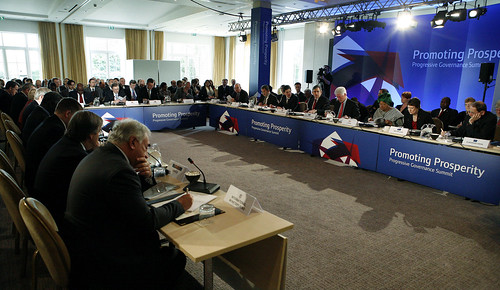
The summit was held at the Grove Hotel in Watford – which is more used to hosting the England football team and posh weddings. Locals – who were warned they would be searched before entering the hotel’s spa – seemed less than impressed at the interruption, though a few did manage to sneak in for a round of golf (though perhaps they were snipers in disguise).
And inside? We got a nice plug from Helen Clark, New Zealand’s PM, and from Africa’s first elected female head of state, Ellen Johnson-Sirleaf. Bill Clinton was also lucky enough to be collared by Global Dashboard’s Charlie Edwards on his way back from the lav, which I am sure was a highlight for both of them.
In discussion, two topics predominated. First, the global financial meltdown, with Kevin Rudd (surely the wonkiest head of state ever) fretting that ‘technology has got ahead of the regulatory environment,’ or in other words, men with computers are doing stuff with money that no-one, including the men themselves, really understands or can control.
A few leaders, Austria’s Alfred Gusenbauer among them, were calling for a World Finance Organisation to be created as an institutional big brother to the WTO (can you imagine the protests outside a WFO annual meeting?). But most were happy to settle for a revamped IMF to act as an ‘early warning system’ and for rapid action to, in the words of the head of the IMF, “disentangle the good and the bad banks”.
A global trade deal was also seen as a vital part of restoring confidence, with the WTO’s Pascal Lamy making it sound as if the conclusion of a ‘strong pro-development, pro-growth round’ was just around the corner. Peter Mandelson, who leads on trade for the Europeans, was a little less bullish, I thought.
Mandelson agreed that ‘night and day drilling’ into the detail of a proposed agreement was yielding results, but he argued that any further delay could be fatal for a deal. 2009 should be written-off, he said, due to a changing of the guard in the US in the first half of the year and in the European Commission in the second. Any agreement would have ‘turned to mush’ by 2010, he concluded.
It was a provocative point and a worrying one, given that 2009 is supposed to be the year the world does a deal on climate. How’s that going to work if everyone is too busy settling into new jobs to pay attention?
I thought the climate discussion was rather disappointing, despite Kevin Rudd’s attempt to muscle some shape into it. The climate paper was presented by Laurence Tubbiana (co-author Nick Stern had a more pressing engagement!) and she set out the same ‘seven elements for a global deal’ that Stern was promoting at Bali. It’s an unobjectionable list, but I am unconvinced by Tubbiana and Stern’s optimism that a deal will be easily struck.
Their framework, they argue, could “allow all countries to move quickly along what they see to be a responsible path”.
What is very striking here is how broadly basic understandings have already been established. Country-by-country we see targets being erected and measures being set by individual countries recognising their own responsibilities as they see international agreement being built. People seem to understand the arguments for action and collaboration on climate change much more readily than they do for international trade.
In the discussion, it was clear that leaders accepted the need for targets. After all, who doesn’t? But there seemed very little consensus on who should do what. It’s only when countries start to work out whether a global deal seems fair to them that we’ll really know whether or not it’ll be a rocky road to Copenhagen.
But climate felt like a little bit of a sideshow, with leaders keen to spend time on another scarcity problem – food. This is an area where my co-author, Alex Evans, is carrying out pioneering work (also see this summary) and it was clear how worried leaders are by rocketing prices.
But will that make any difference? In my part of our presentation (we’ll have text and perhaps some video later), I wondered whether food was going to be another ‘slow motion car crash’ like HIV/AIDS twenty years ago. Is it one of those problems that everyone can see coming, knows is going to be catastrophic, but is unable to do anything useful about? Time will tell.
by Alex Evans | Dec 20, 2007 | Climate and resource scarcity, Europe and Central Asia
I spoke at a conference organised by the Institute for Environmental Security in Brussels earlier this week. (Here’s the speech I gave, which updates the argument from The Post-Kyoto Bidding War to take account of Bali – and in particular the US’s shift from arguing for no binding targets for anyone, to arguing that if developed countries have binding targets, then so should developing ones.)
The overall theme of the conference was ‘from Bali to Poznan’ – the latter being the place in Poland where next year’s UNFCCC gathering will be held. With this in mind, the organisers secured a presentation from Poland’s Ambassador to the EU. You might have thought that the Poles would want to rise to the occasion and capitalise on the post-Bali good cheer among Eurocrats. Not a bit of it: instead, we had a rambling discussion that was heavy on Poland’s impressive track record in energy efficiency but light on strategy.
As one of the other speakers at the conference later remarked, Poland is essentially emerging from a rather, well, crazy period. It needs to show other EU member states that it’s not just a big member state, but that it has big ideas as well. A good start to that enterprise might be to have some kind of narrative about why it wanted to host the halfway point conference on the road from Bali to Copenhagen. As things stand now, officials who work on climate change are quietly dreading the prospect of the Poles chairing the summit…
by David Steven | Jun 26, 2007 | Climate and resource scarcity, Influence and networks
Dr Per Stig Møller, Danish Foreign Minister, was Environment Minister in Rio in 1993. Now he’s looking forward to the big climate showdown in Copenhagen in 2009, when optimists hope a post-2012 framework will be agreed.
Møller has a six step agenda for getting to 2009.
First, increase awareness worldwide and engage all levels of society. Second, find a way to get all major emitters to the negotiating table, while ensuring the richest take the lead. Third, develop common standards, regulations and incentives that promote low carbon growth. Fourth, invest in new technologies. Fifth, set a price for carbon that includes the full social costs of emissions. Sixth, spend more money helping developing countries adapt.
All well and good.
But where are the specifics? The Minister wants stabilization, but doesn’t talk about what target he favours – 450ppm, 550ppm, higher? He acknowledges there’s going to be a huge fight about how we will bear the brunt of cutting emissions, but doesn’t say who should get scarce allocations from the carbon budget. And he skates over how developing countries are expected to cope as their climate deteriorates. (more…)
