by David Steven | Feb 3, 2009 | Climate and resource scarcity, East Asia and Pacific
In an interview with the FT yesterday, Wen Jiabao sets out China’s negotiating position in the run up to the Copenhagen climate negotiation. Three main points:
- Green stimulus as part of the response to the financial meltdown.
- Domestic action to increase energy intensity by 4% a year (“We failed to meet the targets in the first two years of the five year period, and we succeeded in meeting the target in 2008.”)
- No quantified emissions targets for China – the country is still at an early stage of development and “in terms of per capita greenhouse gas emissions, we are certainly not the biggest one.”
How strong is China’s position? Not very, I think. China is obviously right to expect the rich world to do more, but if they accept tough targets and China refuses to, then there are two consequences. 450ppm stabilization becomes impossible – and it’s the rest of the G77 that will end up with a highly inequitable deal.
(more…)
by David Steven | Feb 2, 2009 | Economics and development, Global system, London Summit
The G20 London Summit in April will be Barack Obama’s first trip to Europe. The Canadians get him first (apparently this is traditional), while the Japanese (who see the G20 as an evil plot to dilute their influence) are hoping for a sneaky bilateral before the big G20 powwow.
But London will be the big one. Gordon Brown – tired of saving the world on his lonesome – will slip into the role of Robin. Obama will play Batman and kick the world back into shape. The role of Joker is yet to be cast.
But will the summit be a success? The British PM has a lot riding on it, and not just because he believes he can use the event to transform his electoral prospects. We’re in the midst of “the first financial crisis of the global age,” he says, and the best solution is try to bind all the key global issues (economy, trade, climate change, energy, development etc) into a new vision for a “global society”.
“This is not like the thirties,” Brown told a Davos audience (slightly plaintively, perhaps). “The world can come together.” But will it? And more to the point, will Obama reserve sufficient bandwidth to global coordination? Or will he be sucked into further America First policies, as the mess at home hoovers up a growing proportion of his time, energy and political capital?
The past does not dictate the present of course, but the historical precedents are not so good. The nearest equivalent to the London Summit in the thirties was World Monetary and Economic Conference, which was held in the summer of 1933.
This meeting, which bought 66 countries together in last ditch attempt to trigger global economic recovery, was derailed by a new US President – Franklin D Roosevelt – who had recently been elected in a landslide. Roosevelt rejected a compromise deal that had been hammered out by his own delegation.
The result was humiliation for a weakened British Prime Minister, and a furious reaction from the other European nations, led predictably enough by the French. The Germans, meanwhile, were left out on a limb. Hitler – just settling in as Chancellor – was forced to disown his Economic Minister mid-summit. It was an early setback for him on the international stage.
(more…)
by David Steven | Jan 30, 2009 | Climate and resource scarcity, Cooperation and coherence, Global system

Image Author: mike_is_scrumptious
Assume a robust global deal on climate and the world’s cities will have to transform their infrastructure, economies and societies in little more than a generation.
Assume uncontrolled emissions growth and they face growing impact from a less hospitable and more volatile climate.
Either way – big changes are on the way. Few cities’ leaders grasp the scale of the challenge, especially in developing countries, where towns and cities will have an additional 1.5bn residents to cope with by 2030.
This new think piece has been prepared as part of the British Council’s Climate and Cities programme. Download the pdf (which has full references) or read the full text below the jump.
(more…)
by David Steven | Jan 28, 2009 | Economics and development
Courtesy Flickr user massdistraction
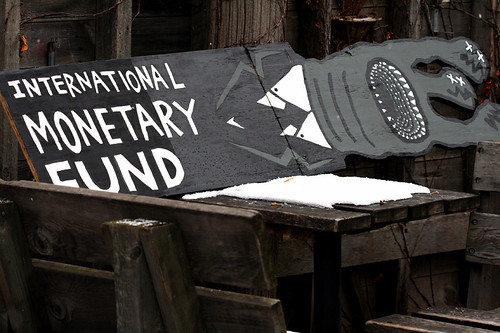
The IMF today predicted a grim economic outlook for 2009, with some green shoots in 2010.
The news is especially grim for the UK and Eurozone countries, with a 2.8% and 2% fall in output in 2009 and barely any growth in 2010. The US is predicted to do quite a lot better – a 1.6% fall this year, but 1.6% of growth next. That should cue a pleasant new wave of American triumphalism.
China floats through the crisis more or less unscathed. Growth slips to 6.7% in 2009, but bounces back to 8% in 2010. India does a little worse, Brazil suffers pretty badly, while the Mexican economy really tanks.
But I really don’t know why I even bothered to read the stats. Nine months ago at the Progressive Governance Summit, Dominique Strauss-Kahn told everyone that Europe and the US would experience a slowdown, but not a loss of growth (with the European economy expected to outperform the American one).
Even since it last ran its models in November (just three months ago!), the IMF has knocked 1.7 percentage points off world growth, and a staggering 6 points from its prediction for what were once known as the Asian tigers.
The IMF itself is forced to admit that “the uncertainty surrounding the outlook is unusually large.” Doesn’t that translate as “our models weren’t built for these crazy conditions, but we’ll run them anyway and PR them heavily to the 1000 or so media outlets that’ll reprint our speculation as fact”?
Or am I missing something here?