by Alex Evans | Jun 28, 2008 | Climate and resource scarcity, North America
First things first: bookmark this link. It points to the Economics and Strategy page at CIBC World Markets, the Canadian investment bank whose research team brought us the superb brief I linked to a few weeks back, entitled Could Soaring Transport Costs Reverse Globalisation? Having checked back a few times since then, it has become clear that (a) a lot of their research is focused on food and energy issues, and (b) all of it is excellent.
Anyway, in their current weekly StrategEcon briefing note, Jeff Rubin has some thoughts about the oil price – which he now forecasts at $150 next year and $200 the year after that (“recent announcements from OPEC and China won’t be sufficient to hold oil prices in check. The additional 200,000 barrels per day pledged from Saudi Arabia is a pittance compared to the four million barrels per day that depletion will hive off world production this year”.)
What’s really interesting, though, is this little observation:
As gasoline prices climb inexorably, American driving habits are going to have to undergo a massive change, mimicking the driving habits long adopted by Europeans who have faced much higher gas prices. Average miles driven will likely fall by as much as 15%, while the market share of light trucks, SUVs and vans will be literally halved, reversing the trend of the last fifteen years. But the most fundamental, and unprecedented change will be in the number of vehicles on the road.
Over the next four years, we are likely to witness the greatest mass exodus of vehicles off America’s highways in history. By 2012, there should be some 10 million fewer vehicles on American roadways than there are today—a decline that dwarfs all previous adjustments including those during the two OPEC oil shocks. Many of those in the exit lane will be low income Americans from households earning less than $25,000 per year. Incredibly, over 10 million of those American households own more than one car.
Soon they won’t own any.
And the New York Times last week gave some corroboration on the ground:
Suddenly, the economics of American suburban life are under assault as skyrocketing energy prices inflate the costs of reaching, heating and cooling homes on the distant edges of metropolitan areas.
Just off Singing Hills Road, in one of hundreds of two-story homes dotting a former cattle ranch beyond the southern fringes of Denver, Phil Boyle and his family openly wonder if they will have to move close to town to get some relief.
They still revel in the space and quiet that has drawn a steady exodus from American cities toward places like this for more than half a century. Their living room ceiling soars two stories high. A swing-set sways in the breeze in their backyard. Their wrap-around porch looks out over the flat scrub of the high plains to the snow-capped peaks of the Rocky Mountains.
But life on the edges of suburbia is beginning to feel untenable. Mr. Boyle and his wife must drive nearly an hour to their jobs in the high-tech corridor of southern Denver. With gasoline at more than $4 a gallon, Mr. Boyle recently paid $121 to fill his pickup truck with diesel fuel. In March, the last time he filled his propane tank to heat his spacious house, he paid $566, more than twice the price of 5 years ago.
Though Mr. Boyle finds city life unappealing, it is now up for reconsideration.
Here’s James Howard Kunstler, prophet of suburbia’s demise, at TED last year:
[youtube:http://www.youtube.com/watch?v=Q1ZeXnmDZMQ]
by Alex Evans | Jun 26, 2008 | Climate and resource scarcity, Influence and networks
WEF has just published a statement on climate change ahead of the G8 from what appears more or less all of the world’s CEOs (A is for ABB, Abercrombie & Kent, Agility, AIG, Airbus, AkzoNobel, Alcoa, AMD, ANA, Anglo American, Arup; B is for Bain & Co., Bayer, BG Group, Booz & Co., BP, British Airways, BC Hydro, BT… oh, you get the idea). They say this:
Addressing climate change will require clear and honest communication as to the scale of the challenge we all face. Lord Stern describes the problem for us succinctly:
“Current annual global emission flows are around 40-45 Gigatonnes of CO2 equivalent (GtC02-eq).
About 45% of current global emissions come from developing countries and this is set to grow.
A 50% reduction in global emissions by 2050 equates to an aggregate annual flow of around 22GtC02-eq.
As there will be around 9 billion people in 2050, this implies per capita emissions per year of about 2-2.5 tonnes CO2-eq.
Currently, US emissions are more than 20 tonnes of CO2-eq per person per year, Europe and Japan 10-15 tonnes, China 5 or more tonnes, India around 1.5 and most of Africa much less than 1 tonne CO2-eq per person per year.
The consequence is that rich countries will have to take the lead and demonstrate strong cuts.
Since around 8 billion people will be in currently developing countries, those countries will also have to be in the range of 2-2.5 tonnes CO2-eq by 2050, otherwise the world average for the total would be unachievable.
Refreshing to see some actual numbers rather than the usual guff about “developed countries taking the lead”, isn’t it?
by Charlie Edwards | Jun 23, 2008 | Middle East and North Africa
You have to hand it to three US intelligence amigos: Donald Kerr , Tom Fingar and Mike McConnell. They don’t just subscribe to the concepts of need to share and the responsibility to provide intelligence. They are systematically trying to embed new processes across the intelligence architecture.
One of the key areas they are currently eyeing up is diversity – for pretty obvious reasons. The agencies need to better understand countries like Indonesia and China, find and develop new technologies and listen to and share from different experiences (think more outreach to think tanks and academic institute). In a speech to The 2nd Annual Intelligence Community/Heritage Community Summit Donald Kerr gives an example of diversity in action:
In this work there are countless stories about the importance of diversity. There’s one I recently learned from an FBI intelligence analyst who had worked on Saddam Hussein’s debriefing team in Iraq. While Saddam was being interviewed, a key component of the strategy was to keep him isolated from people outside of the FBI agencies who were questioning him, but he was fluent in several languages. Not deeply so, but sufficiently, and the interviewers needed to find guards who could speak a language that he wouldn’t understand.
It turned out to be really difficult. He knew bits of Spanish, but not the rapid fire Spanish of Puerto Rico. So Puerto Rican speakers would really flummox him, they certainly do me. And that’s what the FBI settled on for his guards. US military members who were native Puerto Ricans in terms of the Spanish that they spoke.
by Charlie Edwards | Jun 21, 2008 | Conflict and security, Off topic
A fantastically useful map created by RSOE EDIS, a nonprofit emergency services organization based in Budapest:

The live map or hazardscape is regularly updated from hundreds of sources- like the WHO, US Geological Survey as well as from emergency services (mainly, it has to be said, in developing countries) who report on live operations from around the world. The map is a useful reminder of the number of risks that rarely make the news; an epidemic hazard in Russia, forest fires in Greece, to flash floods in China and earthquakes in Mexico.
by Alex Evans | Jun 20, 2008 | East Asia and Pacific
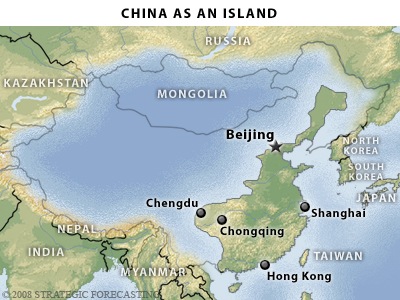
So says Kevin Kelly on what is now my favourite blog. Here’s why:
China shares borders with more countries (14 in total) than any other country on earth. Very few of those borders have ever been very permeable to migration of culture, commerce and ideas because of mountains, deserts, swamps, and high altitudes. In many ways China has acted as an island for millennia. The very large zone of an impermeable buffer, and mountainous and unfarmable land is shown in this image as water.
What’s left is the island of China. This is the traditional center of China, of fertile river valley farming, and home to the Han people. It is also the zone of manufacturing today. It is where all of its giant, throbbing cities lie. The island alone is huge, still among the largest countries in the world.
Prosperity in China is found only on the island. Off the island, in the waters deep, China remains remarkably undeveloped. In fact the level of development in the “Chinese waters” is about equal to the low levels of the neighboring countries. I was surprised to find in my own travels that many towns in the Chinese waterland were as remote, poor, and disadvantaged as any places I had seen in Nepal, Burma, Bangladesh, Pakistan, Afghanistan — all neighbors of China. Not coincidentally, this waterland is also inhabited by non-Han peoples, what the Chinese call their minorities. It is not just Tibet where the nan-Han are outnumbered. In most of the counties covered by this buffer zone (shown as water), minorities dominate. There are lots of them, speaking their own language, often their own dress. What is most remarkable is how remote the rich island seems from the outer waterlands.
The China everyone talks about is the island. China’s worry is the outer zone will leave. Will they go the way of the Soviet Union and break off one by one? Will there be two futures? Much of the control-freak nature of the central political party has been trying — at almost all costs — to keep the whole waterland under control of the island — to keep the country intact. And when you look at this map, it is clear that a break up, or at least a break down, is a very real possibility. In fact the more you look at it, the more amazing it is that China has not devolved before now.
