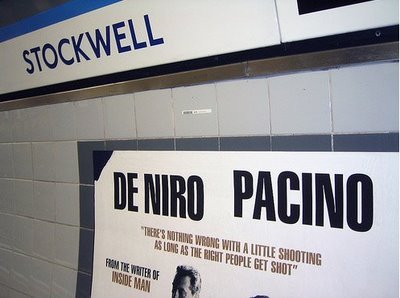
by Charlie Edwards | Sep 24, 2008 | Off topic
As reported elsewhere: Jurors have retraced the final steps of Brazilian Jean Charles de Menezes, including visiting the Tube station where he was shot dead by police. Posters displayed along the platform include the following for ‘Righteous Kill’, a film starring Robert De Niro and Al Pacino.


by Alex Evans | Aug 28, 2008 | Africa, Climate and resource scarcity, Economics and development
Paul Collier, author of The Bottom Billion, is amusing himself by taking shotguns to sacred cows on agriculture and development again. This time, as Owen Barder points out, he’s on Comment is Free, where he regales us with his views on GM technology. As you may have guessed, he’s not in quite the same place as Prince Charles:
[Europe’s] GM ban has three adverse effects. It has retarded productivity in European agriculture; grain production could be increased by about 15% were the ban lifted. More subtly, because Europe is out of the market for GM technology, the pace of research has slowed. GM research takes a long time to come to fruition, and its core benefit – the permanent reduction of global food prices – cannot fully be captured through patents. European governments should be funding this research, but it is entirely reliant on the private sector. Private money for research depends on the prospect of sales, so the ban has not only blocked public research – it has reduced private research …
It is conventional to say that Africa needs a green revolution. The reality is that the green revolution was based on chemical fertilisers, and even when fertiliser was cheap, Africa did not adopt it. With the rise in fertiliser costs as a byproduct of high energy prices, any green revolution will perforce not be chemical. What African agriculture needs is a biological revolution. This is what GM offers, if only sufficient money is put into research. There has as yet been no work on the crops specific to the region, such as cassava and yams.
What to make of his claims? Well, first, I’m curious about his source for the assertion that Europe would have 15% higher grain yields if it permitted GM, as in fact, GM tech hasn’t actually made any major advances in yields for the three main cereal crops (wheat, rice and maize).
What’s certainly true that GM technologies can contribute to making crops more resilient to biotic stresses (pests, weeds etc.). The second generation of GM research is now focusing on abiotic stresses like reduced water availability, soil salinisation etc. But if life sciences represent one R&D approach towards more resilient agriculture, an alternative is ecologically integrated approaches like integrated pest management, integrated soil fertility management and so on.
What both approches have in common is moving away from the Green Revolution’s high-input approach and towards a high-knowledge approach instead. But whereas in life sciences, the knowledge-intensiveness is concentrated at the top end of the supply chain – in R&D labs in biotech and seed companies – with whole systems approaches, the type of knowledge involved is both more participative, and more open to local adaptation. Given adequate investment in extension services to train farmers, then, the latter approach can improve economic resilience as well as crop resilience – by reducing farmers’ dependence on expensive off-farm inputs.
Although there’s much to admire about Collier, when it comes to agriculture, his approach does sometimes come across as a bit, well, ideological. Here he is in The Times a few months back, for instance, where he says:
“The remedy to high food prices is to increase supply. The most realistic way is to replicate the Brazilian model of large, technologically sophisticated agro-companies that supply the world market. There are still many areas of the world – including large swaths of Africa – that have good land that could be used far more productively if it were properly managed by large companies. To contain the rise in food prices we need more, globalisation not less.
Unfortunately, large-scale commercial agriculture is deeply, perhaps irredeemably, unromantic. We laud the production style of the peasant: environmentally sustainable and human in scale. In respect of manufacturing we grew out of this fantasy years ago, but in agriculture it continues to contaminate our policies. In Europe and Japan huge public resources have been devoted to propping up small farms. The best that can be said for these policies is that we can afford them.
In Africa, which cannot afford such policies, the World Bank and the Department for International Development have orientated their entire efforts on agricultural development to peasant-style production. Africa has less large-scale commercial agriculture than it had 60 years ago. Unfortunately, peasant farming is not well suited to innovation and investment. The result has been that African agriculture has fallen farther and farther behind.” [emphasis added]
The remedy to high food prices is to increase supply? Not necessarily. Remember Amartya Sen’s sage observation on this point: food security is less about the overall quantum of food available than about who has the resources to access it: as he once put it pithily, “starvation is the characteristic of some people not having enough to eat. It is not the characteristic of there not being enough to eat”.
So although we do indeed need to increase global food supply – by 50% by 2030, the World Bank reckon – that on its own ain’t enough. The process also has to work for the three quarters of the world’s poor who live in rural areas, most of whom rely at least partly on agriculture. Although these people should have benefited from high food prices, they haven’t – because they’re largely net food buyers, not net food sellers; because fertiliser costs have risen even faster than food prices; because they’ve got poor infrastructure; and so on.
Now, if you’re Collier, you probably think that the best thing for poor people in rural areas would be if they just packed themselves up and decamped to the nearest city. But actually, the evidence set out in the latest World Development Report supports the opposite case. Between 1993 and 2002, the number of people living on less than a dollar a day declined from 28% to 22% of people in developing countries. The principal driver for this improvement, the report continues, has been falling poverty in rural areas (where poverty fell from 37% to 29% over the same period) – and 80% of the decline in rural poverty was due not to migration to cities, but simply to better conditions in rural areas.
Countries like Vietnam show that ag-based growth, export success and smallholder farming can all come together in a virtuous circle: unlike most developing countries, Vietnam has done reasonably well out of high food prices. But to achieve this, various factors need to be in place: infrastructure, access to credit, access to technology, functioning markets, risk management mechanisms, acess to assets backed up by effective rule of law and dispute resolution, etc. etc.
But most small farmers in Africa have never had the benefit of these enabling conditions. In this regard, they’ve been let down by their governments (who despite an African Union target of spending 10% of government budgets on agriculture, mostly spend less than half that level), and by donors (who largely forgot about agriculture until the food price spike, having allowed the proportion of development assistance spent on agriculture to fall from nearly 20% at its peak to around 3% today).
Perhaps it would be worth trying out what real commitment to making smallholder farming work could achieve in Africa, before jumping to the conclusion that the only way forward is to empty Africa’s countryside of people?
by Alex Evans | Aug 20, 2008 | Climate and resource scarcity
Full marks to WWF for their report on virtual water use today, which finds that when imports of virtual water – the water used to grow or manufacture goods that are then imported into the UK, sometimes from severely water-stressed countries – each Briton uses some 4,645 litres, making the UK the sixth largest net importer of water in the world. Only 38% of the UK’s net water use actually comes from Britain’s own resources, the report adds. (Press release; report.)
Virtual water’s a handy concept, not least in that it shows up where consumers’ real water impact takes place. Turning off the tap while brushing one’s teeth is all very well, but if you really want to have an impact, go vegetarian: here’s the amount of water it takes to produce selected foods:
1 kg of potatoes – 500 litres
1 kg of wheat – 900 litres
1 kg of rice – 1,900 litres
1 kg of poultry – 3,500 litres
1 kg of beef – 15,000 litres
(Source: the excellent Atlas of Water. Buy one today.) Agriculture’s easily the world’s largest consumer of water, too: it accounts for 70% of global water use, compared to 20% for industry and 10% for the domestic sector.
In case you wondering, WWF says the top 5 net importers of virtual water are Brazil, Mexico, Japan, China and Italy. And the top 5 exporters? The USA, Australia, Argentina, Canada and Thailand. (Sixth is India, where water tables are plummeting.)
by Richard Gowan | Aug 8, 2008 | Conflict and security, Europe and Central Asia
The international response to events in Georgia is still at the declaratory stage, and some analysts predict a long struggle. It’s not a good sign when the Finns are talking about “fully-fledged war” (the Finns don’t have a lot of luck: the had the EU presidency during the Lebanon war in 2006, and now they’re chairing the OSCE).
But a couple of things seem clear already. Firstly, this war is not going to end the way the Georgians presumably wanted: a lightning move by their forces creating a fait accompli in South Ossetia that Russia would have to accept. Russia has already nixed that, so Georgia is in a position where it cannot achieve its initial war aim. (I am at a loss to imagine how the Georgians ever thought they could achieve it, as doing so would have required an element of surprise that they couldn’t pull off, but whatever). Logically, it should pull back and look for a deal to consolidate some gains, but that’s not what tends to happen in the cases…
The second thing that’s pretty clear is that South Ossetia is in an unholy mess. As Jules points out, it’s tiny, and there are increasingly credible reports of a death toll in the hundreds – the Ossetes are claiming 1000+. Out of a population of 60,000. Media images imply that physical destruction has been significant. And if the Georgians decide to try to slug it out with the Russians, not only in Ossetia but in Abkhazia and Georgia proper, this damage is going to spread and intensify.
(NB: the really scary scenario is that the Georgians will now decide that their best hope of winning global sympathy, or even direct military aid, is to fall back into their own territory and get lots of CNN coverage of their heroic resistance. Logically, the Russians should refuse to play along, but again, I don’t trust in that).
What seems probable is that, after an indeterminate period of violence, we will end up with a situation in which South Ossetia is under full or partial Russian control, and a wreck. If there was a ceasefire, two basic options would be on the table. Russia could declare South Ossetia a separate state, or even part of Russia – the West would not recognize this, and the Russians would have to handle clearing up the wreckage, as they did in Chechnya. If the outcome is less clear-cut, however, it may be necessary for the international community to (i) patrol a ceasefire line and (ii) pick up a least part of the reconstruction burden.
As far as the peacekeeping part goes, I rather doubt we’ll return to the status quo ante: a dysfunctional mixed force of Russians, Georgians and Ossetes doing joint patrols, monitored by OSCE military observers. The likely alternatives are (i) a light Ceasefire Observation Mission, which could well be created out of the OSCE presence, or by enlarging the UN Observer Mission in Georgia, which currently only watches the Abkhazia situation and (ii) a heavier interpositional military mission, along the lines of the UN forces in Cyprus and the Golan Heights, though probably not on the scale of that in Lebanon. I think we can rule out any larger civilian-military peacebuilding mission – the reconstruction will stay separate.
If you were going for the interpositional military option, who’d do it? NATO is out of the question, and the OSCE doesn’t do military forces beyond the unarmed observer level. That leaves (i) the EU (suggested by the Estonians, but might look too like NATO in Disguise to the Russians), (ii) the UN (not impossible, although if we’re talking about European troops, they’ll want a special command structure that reduces their reliance on UNHQ, as they have in Lebanon) or (iii) an ad hoc multinational force. In all cases, I’d expect the bulk of the force to be European. The obvious lead country is Germany: it has a history of trying to sort out the Caucasus, and it’s got some troops to spare, unlike France and the UK…
In theory, I’d prefer a force made up of higher-end Latin Americans (Argentina, Brazil, Chile) as they’re intelligent peacekeepers and relatively impartial – the problem for any European force, whatever its flag, is that it’ll be pulled in all directions by the EU’s splits over Russia policy. But the LAs are in Haiti, and I don’t think that EU governments would accept such a slight to their collective ego.
I expect to be proved wrong by events. It will all look different in the morning.
by Alex Evans | Jun 3, 2008 | Climate and resource scarcity
One of the catches with this week’s UN food summit is that it’s not immediately clear just what deal the various heads of state and ministers assembled here are supposed to cut – and that leaves the (hundreds of) journalists here looking for story angles. Look at some of the main issues at play in the food prices issue and you start to see their problem:
Humanitarian relief. The World Food Programme’s urgent appeal for $755m needed to keep feeding the 73 million people dependent on it for help has been making headlines all spring – but now the funding gap has been plugged, thanks to a half a billion dollar donation from Saudi Arabia.
(Incidentally, it’s a mystery on a par with the Marie Celeste as to why WFP didn’t wait until the summit to announce the cash. Here in Rome, it would have been the story from the summit. As it was, the news – announced late on a Friday afternoon – sank with hardly a trace. One leading food journalist I spoke to this morning said he didn’t get the press release until two days later. You couldn’t make it up…)
Trade. Numerous policymakers have pointed to the long term importance of trade reform, and pushing ahead with the Doha Development Round. But as far as this summit is concerned, that’s off the agenda, since the Doha Round has its own, separate, negotiations.
Changing diet patterns. The growth of a global middle class eating a grain-intensive western diet is the single biggest driver of rising prices, and as I noted in another post earlier today, it raises the awesomely complex and politically difficult question of fair shares. But there’s no chance of any substantive discussion of that here this week.
Investing in agricultural supply. Everyone agrees that a ‘new green revolution’, or whatever you want to call it, will be essential given that demand is set to rise 50% by 2030. But while the UN’s High Level Task Force sets out a strong analysis in its newly published paper on elements of a comprehensive strategy, it’s hard to see what actual deal this week’s summit could cut in this area. Admittedly, several countries are likely to announce major new funding commitments while they’re here. But the amounts will have to be very big to become the story of the week.
So what does that leave? If I worked for the UN Secretary-General, I’d be putting all of my effort into persuading one or two of the really big producers who’ve imposed export restrictions on crops – like India, Russia, Kazakhstan or Argentina – to announce an easing of those restrictions. That would mark an important step forward, and represent a triumph for the UN and its Secretary-General.
But without that, it looks like the story of the week is likely to be about biofuels – where it’s hard to see any great strides towards consensus being made here in Rome. On the contrary, with the US and Brazil defending biofuels to the hilt even as others (including FAO head Jacques Diouf) fire broadsides off against feeding crops to cars, the risk is of a damaging spat. That will make for a lively story, if it becomes the angle that journalists here go for – but could also lead to all sides entrenching their positions, which would be a Bad Thing.