by Daniel Korski | Nov 17, 2008 | North America
The rumour that Barack Obama may appoint Hilary Clinton as his top diplomat has filled the Sunday papers. Personally, I think she would be a better Defense Secretary or a nominee to the Supreme Court, although she is bound to do well as Secretary of State too.
If she were given the State Department, she is more likely to follow Colin Powell’s management style -– which a place like Foggy Bottom sorely needs –- than emulate Condi Rice’s neglect of the department. At the same time, she is likely to play a key role in foreign policy, unlike General Powell, as President Obama is compelled to focus on the economy.
It is just that I think Senator Clinton would do better at the Pentagon. She supported the Iraq War, which will make her better at coaxing the military into a draw-down of forces and a shift of focus onto Afghanistan. Though the officers and soldiers will accept the democratic transition from Bush to Obama, a military that has gone to war twice, suffered both casualties and reputationally, and seen itself as the sharp end of U.S foreign policy for eight years will need to be helped to make the switch by someone they trust. With her hawkish views, time on the Senate Armed Services Committee, and work on Unified Action, a large U.S military exercise, the New York senator is well placed to take this role on.
(more…)
by David Steven | Nov 15, 2008 | Conflict and security, South Asia
In an email exchange with George Packer, David Kilcullen sounds a pessimistic note about prospects in Afghanistan. The situation is ‘dire’ but there’s a chance to win it around.
He’s even more downbeat about Pakistan:
Pakistan is extremely important; indeed, Pakistan (rather than either Afghanistan or Iraq) is the central front of world terrorism. The problem is time frame: it takes six to nine months to plan an attack of the scale of 9/11, so we need a “counter-sanctuary” strategy that delivers over that time frame, to prevent al Qaeda from using its Pakistan safe haven to mount another attack on the West. This means that building an effective nation-state in Pakistan, though an important and noble objective, cannot be our sole solution—nation-building in Pakistan is a twenty to thirty year project, minimum, if indeed it proves possible at all—i.e. nation-building doesn’t deliver in the time frame we need. So we need a short-term counter-sanctuary program, a long-term nation-building program to ultimately resolve the problem, and a medium-term “bridging” strategy (five to ten years)—counterinsurgency, in essence—that gets us from here to there. That middle part is the weakest link right now. All of that boils down to a policy of:
(a) encouraging and supporting Pakistan to step up and effectively govern its entire territory including the FATA [Federally Administered Tribal Areas], and to resolve the current Baluch and Pashtun insurgency, while
(b) assisting wherever possible in the long-term process of state-building and governance, but
(c) reserving the right to strike, as a last resort, at al Qaeda-linked terrorist targets that threaten the international community, if (and only if) they are operating in areas that lie outside effective Pakistani sovereignty.
by Charlie Edwards | Nov 14, 2008 | Conflict and security, North America, South Asia
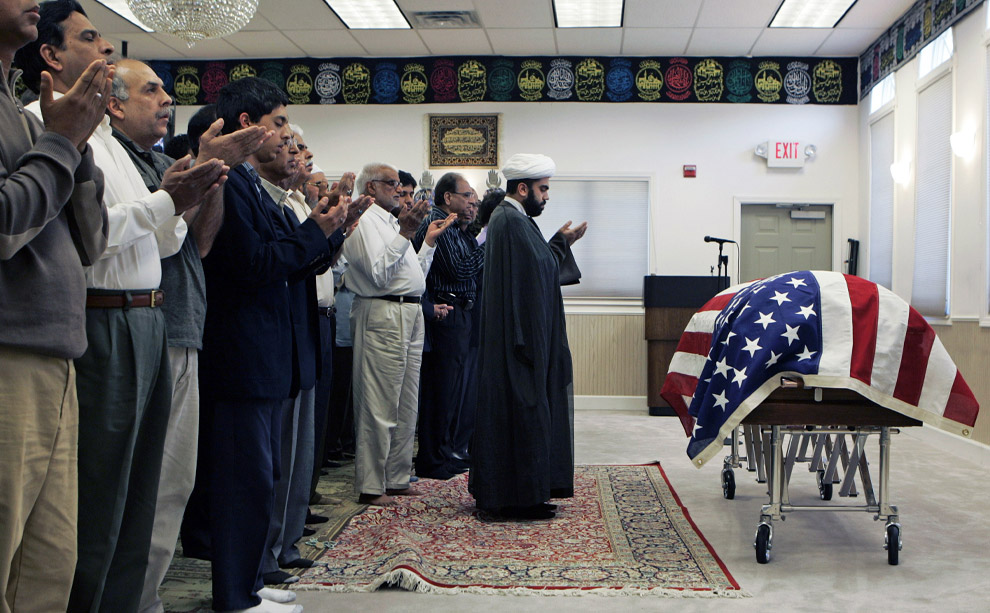
One of thirty-one photos recently published in The Boston Globe:
Imam Hashim Raza leads mourners in prayer during a funeral for Mohsin Naqvi at al-Fatima Islamic Center in Colonie, N.Y., Monday, Sept. 22, 2008. Naqvi was a Muslim, a native of Pakistan (he emigrated to the U.S. with his family when he was 8 years old and became a citizen at 16) and a U.S. Army officer. He was killed by a roadside bomb while on patrol last week in Afghanistan. (AP Photo/Mike Groll)
by Charlie Edwards | Nov 13, 2008 | Conflict and security, Cooperation and coherence, Influence and networks, Middle East and North Africa, North America, UK
The received wisdom within the British Government and the higher echelons of the Ministry of Defence’s Main Building is that the situation in Basra is safer and better since Charge of the Knights, the Iraqi led operation earlier this year. Given the situation on the ground, the argument goes, it makes sense that British Armed Forces should depart soon.
This argument is seductive and credible – but not without risk. Senior Ministers who have recently returned from Basra, like Douglas Alexander, have argued that it makes sense to leave now. In theatre the discussion is more nuanced and centres on the progress of each Military Transition Team (MiTT) in Basra and the surrounding areas. If one was to characterise the general feeling then it would be something along the lines of: ‘We have done our best but now it is up to the Iraqis’.
But should we really be thinking of leaving Basra so soon?
(more…)
by Charlie Edwards | Oct 22, 2008 | Conflict and security
William S Lind suggests that beyond Afghanistan, the Fourth Generation future belongs neither to al Qaeda nor to the Taliban but to two more sophisticated models, Hezbollah and the Latin American drug gangs (I would add other criminal networks and piracy too). He writes:
Both can fight, but fighting is not primarily what they are about. Rather, both are about benefiting their members with money, services, community, identity, and, strange as it may sound, what passes locally for good government. Even the drug gangs’ governance is often less corrupt than that of the local state. Both of these 4GW models can fall into the fatal error of alienating the local population, but the tendency is not inherent. While Hezbollah is religiously defined, it seems to appeal well beyond the Puritans, which means it can give orders Puritans will not obey. The drug gangs’ principal faith is in making money, and few faiths are more broadly latitudinarian. In Iraq as elsewhere, the fading of the al Qaeda model is being balanced not by the rise of a new state but by the adoption of other models of 4GW. So far, as best I can determine, no foreign intervention in a Fourth Generation conflict has succeeded is re-creating a real state (you can add Ethiopia in Somalia to the long list of failures).
With that in mind it is depressing to read that the newly appointed commander of Nato’s anti-piracy patrol off the coast of Somalia says it will be difficult to defend ships from pirate attacks. This at a time when Nato is sending seven frigates to support US navy vessels already there, and India and several European countries have said they will also mount anti-piracy patrols.
“The time that a pirate unveils himself to the time that he’s onboard ship is such a short period of time,” says Admiral Mark Fitzgerald
Cynics might suggest that this is a careful piece of expectations management (think about the failure of SOCA as another example of how a Government over promises/ but under delivers), but it’s no wonder that NSAs (non state actors) are able to leverage considerable influence in proportion to their size and capabilities when the bureaucracies are not necessarily constrained by current laws/rules but by process of implementing them. The rules of engagement are still being debated by Nato – and if I were a betting man I would suggest that such rules are unlikely to be in place before the NATO task force has to respond to its first attack.
In his interview with the BBC Admiral Mark Fitzgerald also raises a rather more worrying issue*. Given how busy the sea lanes are, he asks: How do you prove a guy’s a pirate before he actually attacks a ship?
Some possible suggestions below:


*TiC
