by Daniel Korski | Jul 16, 2008 | Conflict and security
Bush, Obama and McCain have in the last few days all talked about Pakistan and Afghanistan.
In my view all three shirk the need for 1) a new political settlement in Afghanistan, including through negotiations with “pragmatic” Taliban elements, 2) a new trans-Atlantic push on Pakistan and the region (and not only a CT-focused approach), and 3) the need to invest in the Afghan National Police.
Here is what they have said:
(more…)
by Daniel Korski | Jul 10, 2008 | Conflict and security, UK
Today’s defence news is a new survey showing that British soldiers – and the British army – are operating at breaking point. In the Army, 59 per cent of those questioned rated the level of morale as “low” or “very low”. In the Royal Navy it was 64 per cent and the Royal Marines 38 per cent. The worst perception of morale was in the RAF, where 72 per cent of those asked thought that morale was low.
Yesterday, I discussed the British army’s operation in Afghanistan with James Fergusson – whose fast-paced book A Million Bullets about British operations in Helmand is a must-read – and he backed up the survey with real-life anecdotes of poor morale among the frontline troops.
But how do the survey results compare to the experience of other allies, for example the U.S military?
Two months ago, findings showed that US troop morale improved in Iraq last year, but soldiers fighting in Afghanistan suffered more depression and lower morale. Eleven percent of U.S soldiers surveyed in Iraq said their unit’s morale was “high” or “very high”, compared with 7 percent the previous year. Individual morale was reported “high” or “very high” among 20.6 percent, compared with 18.3 percent the previous year.
But more than 27 percent of troops on their third or fourth combat tour suffered anxiety, depression, post-combat stress and other problems. That compared with 12 percent among those on their first tour. (Extensive suvreys of the U.S military’s mental health can be found here)
When U.S officers were asked in a recent survey to grade the health of each military service on a scale of 1 to 10, with 1 meaning the officers have no concern about the health of the service and 10 meaning they are extremely concerned, the officers reported an average score of 7.9 for the Army and 7.0 for the Marine Corps. In a fascinating contrast to the RAF, the health of the Air Force fared the best, with a score of 5.7.
On the question of the morale of the U.S. military today, U.S officers responded:
17% Very high
47% Somewhat high
22% Somewhat low
4% Very low
10% Don’t know
Conclusion: winning wars – like the U.S Army is in Iraq today – makes a difference on how troops feel. But – no surprise here either – long tours, poor equipment, continued stress and a seemingly endless war effort hurt morale.
In 1941, U.S. Army’s morale chief, James A. Ulio explained what morale was:
I’ll tell you what morale is. It is when a soldier thinks his army is the best in the world, his regiment the best in the army, his company the best in the regiment, his squad the best in the company, and that he himself is the best damn soldier-man in the outfit.
Not a bad definition, and something the MoD should hard about how best to achieve.
by Charlie Edwards | Jun 27, 2008 | UK
(Updated 26 July 2008)
By my estimation the UK’s national security strategy is 100 days old. So what initiatives from the UK NSS have gained traction? What ideas have been quietly dropped? And what proposals are still hanging around in the ether?
In his statement to the House of Commons Gordon Brown listed the following:
1. The publication of first a ever cross-departmental strategy for supporting service personnel, their families and veterans. To be published in mid/ late July (my guess Thursday 17th July)
2. Increase the the number of security service personnel by 4000. Ongoing but growth constrained by training capacity
3. A 10 per cent increase in resources for the Joint Terrorism Analysis Centre To be confirmed – relatively easy to do.
4. Set aside funds to modernise GCHQ’s interception capability. To be confirmed
5. Publication of a national register of risks. Published soon
6. The creation of a National Security Forum. NSF will be a NDPB. See here for details
7. Introduction of a resolution in both Houses that enshrines an enhanced scrutiny and public role for the Intelligence and Security Committee. No obvious sighting – to be confirmed
8 & 9. A new bargain to non-nuclear powers and an international conference on the related issues later this year. No news – unless conference was this one (which I don’ think it was)
10. The creation of a standby international civilian capability for fragile and failing states (Brown commits 1000-strong UK civilians including police, emergency service professionals, judges and trainers). No news
11. Between now and 2011 £600 million for conflict prevention, resolution and stabilisation work around the world, including in Israel and Palestine, Darfur, the Democratic Republic of Congo, Iraq and Afghanistan, Kenya and the Balkans. Not new money but I think a repeat announcement from last year’s Comprehensive Spending Review.
12. Britain to pay for 850 Burundian troops as part of the African Union peacekeeping force. Confirmed
13. Creation of an integrated civilian-military headquarters headed by a civilian in Helmand. To be confirmed
14. 30 per cent Increase in Foreign Office staff to Middle East and South Asia. Ongoing
15. Creation of a UK wide civil protection force. (Initiative seems to have been dropped)
If I have missed any initiatives out/ or you know things have changed please post a comment.
by Charlie Edwards | Jun 25, 2008 | Conflict and security, UK
This afternoon I’m giving a presentation to the Sandhurst Defence Forum. The subject of my talk: Strategic Myopia develops some of the themes from the report I wrote last year and focuses on a number of issues resulting from the publication of the UK’s first national security strategy.
There hasn’t been much news on the UK NSS for sometime (no one seems to have noticed, for example, the civil defence force initiative has been quietly dropped). That said, today’s papers are ablaze with news of Sir Jock Stirrup’s warning that sustaining operations in both Afghanistan and Iraq is becoming almost impossible. From his interview with the press gallery:
“We are not structured or resourced to do two of these things on this scale on an enduring basis but we have been doing it on an enduring basis for years,” Sir Jock said. “Until we get to the stage when one of them comes down to small scale, we will be stretched beyond the capabilities we have.”
3 things spring to mind:
- Where is the Defence Secretary Des Browne? Aside from the MoD’s official spokesmen, General Sir Richard Dannatt and the CDS seem to be the only ones who speak on behalf of the department. Is there any political leadership in the MoD?
- Have the MoD really developed any sustainable planning assumptions going forwards (see after the jump)?
- Is this all actually a ruse to get a better deal out of the forthcoming white paper on support for the military?
Stunts like Liam Fox’s announcement last week for military families to get preferential access to public services is nice PR but hideously impractical. But it plays well with the media (though I doubt it plays well with the military).
The point is that announcement like Sir Jocks increases the need for a new defence review. Given this is very unlikely before the general election in 2010, the MoD has got to come up with a sound strategy for the next couple of years. Keeping Minister’s quiet and letting General’s do the talking should not be part of it.
Bonus post: If like me, you have been wondering why the defence planning assumptions seem to increasingly irrelevant and out of step with current operations I’ve posted some information on the current DPAs after the jump (more…)
by Alex Evans | Jun 20, 2008 | East Asia and Pacific
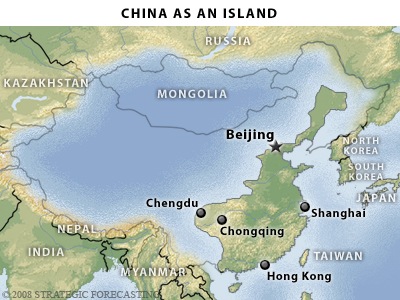
So says Kevin Kelly on what is now my favourite blog. Here’s why:
China shares borders with more countries (14 in total) than any other country on earth. Very few of those borders have ever been very permeable to migration of culture, commerce and ideas because of mountains, deserts, swamps, and high altitudes. In many ways China has acted as an island for millennia. The very large zone of an impermeable buffer, and mountainous and unfarmable land is shown in this image as water.
What’s left is the island of China. This is the traditional center of China, of fertile river valley farming, and home to the Han people. It is also the zone of manufacturing today. It is where all of its giant, throbbing cities lie. The island alone is huge, still among the largest countries in the world.
Prosperity in China is found only on the island. Off the island, in the waters deep, China remains remarkably undeveloped. In fact the level of development in the “Chinese waters” is about equal to the low levels of the neighboring countries. I was surprised to find in my own travels that many towns in the Chinese waterland were as remote, poor, and disadvantaged as any places I had seen in Nepal, Burma, Bangladesh, Pakistan, Afghanistan — all neighbors of China. Not coincidentally, this waterland is also inhabited by non-Han peoples, what the Chinese call their minorities. It is not just Tibet where the nan-Han are outnumbered. In most of the counties covered by this buffer zone (shown as water), minorities dominate. There are lots of them, speaking their own language, often their own dress. What is most remarkable is how remote the rich island seems from the outer waterlands.
The China everyone talks about is the island. China’s worry is the outer zone will leave. Will they go the way of the Soviet Union and break off one by one? Will there be two futures? Much of the control-freak nature of the central political party has been trying — at almost all costs — to keep the whole waterland under control of the island — to keep the country intact. And when you look at this map, it is clear that a break up, or at least a break down, is a very real possibility. In fact the more you look at it, the more amazing it is that China has not devolved before now.
