by David Steven | Dec 2, 2011 | Economics and development, UK
In his autumn statement, George Osborne warned that, without his programme of fiscal consolidation, “Britain would have borrowed an additional hundred billion pounds in total [by 2014/15]. If we had pursued that path, we would now be in the centre of the sovereign debt storm.”
But how confident can we be that that storm has been averted? In the city, sovereign risk and an economic downturn are seen as the most important threats to the UK financial system. An economic downturn now seems more than likely, and will be savage if efforts fail to shore up the euro.
What about a sovereign debt crisis in the UK? When asked to name the most important current threat, risk managers for around 70 UK financial institutions now put debt at the top of their list.
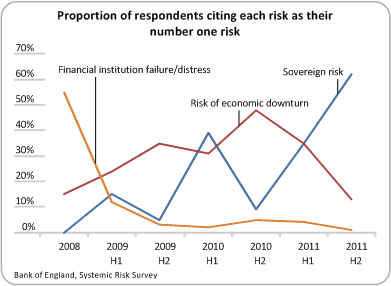
I think they’re right to be worried. Even after this week’s downward revisions, the Office of Budget Responsibility expects tax revenues to grow rapidly over the next two financial years – but there’s little prospect of that happening if there’s a sharp downturn.
Imagine, instead, if the government’s income declined in the same way it did after 2008 – that would mean more than £150bn less revenue than expected over two years (a ‘taxation double dip’). Following the Chancellor’s logic, that would be enough to steer the UK straight into a debt storm.

Now you could argue that revenue will prove more robust than it did after 2008 and that’s probably true if the UK sees ‘normal’ economic underperformance. But euro breakup – accompanied by an inevitable banking crisis, massive disruption of exports, lower oil revenues etc. – would take us far beyond normal.
Bottom line: if the euro goes, it probably takes the British government with it. Happy days. (more…)
by Ryan Gawn | Dec 1, 2011 | Conflict and security, Economics and development, Influence and networks, South Asia

Remember that “terrible phrase”, Winning Hearts And Minds (WHAM)? Using development programs as a tool for counterinsurgency? PRTs and Money as a Weapons System? So last decade, right? Well it’s back, and there’s some new evidence to show that it might actually work – for certain things, and when done right. From Afghanistan, of course. It’s only taken 10 years.
(more…)
by Claire Melamed | Dec 1, 2011 | Articles and Publications, Economics and development, Global system
Any global framework for development which is agreed after 2015 will be a political deal between states. This paper looks at recent trends in policy and politics in emerging economies and traditional donors to assess where a consenus might lie. It suggests some principles for a post-2015 agreement which emerge from recent policy developments.
Download Report
by Richard Gowan | Nov 30, 2011 | Cooperation and coherence, Economics and development, Europe and Central Asia

A new report from ECFR on Russia makes startlingly depressing reading:
- The economic crisis has exposed a governance crisis inside Russia: even Putin now admits that as much as 80% of Kremlin orders have been ignored in the regions. Instead of modernising, Russia in 2010 was as corrupt as Papua New Guinea, had the property rights of Kenya and was as competitive as Sri Lanka.
- The crisis has also prompted a foreign policy rethink inside Russia: Russia is now aiming for a low cost sphere of influence in the post-Soviet space and is increasingly nervous about China.
The report claims that, having tried to project itself as an equal to Brazil, India and China, Russia is now entering a “post-BRIC” phase defined by deep pessimism about its future prospects. The report repays very close reading.
by Mark Weston | Nov 30, 2011 | Economics and development
Doug Saunders of Canada’s Globe and Mail has an interesting post on whether the economic boom that lasted from the early 1990s to the late 2000s was worth it. He concludes, on the basis of incomes, home ownership rates and household debt in the US, Canada and Europe, that ‘in the countries that kept a lid on consumer and mortgage lending, the economic boom was worth all the hype. Everywhere else, it was like a bad dream.’ By this analysis, only France, Canada and Germany have reaped sustainable rewards.
But what if we take a wider view? In a globalised world, it is not only recessions and financial crises that cross borders, but also goods, money, people and knowledge. As global trade, aid and migration have increased in the past two decades, at least some of the economic benefits of the boom are likely to have had impacts beyond the borders of North America and Europe.
So how are things looking on a global scale? Was the boom worth it for the world as a whole? Well, so far, emphatically yes. Take poverty for example. As David showed on here a few weeks ago, world poverty has plummeted – from over 40% of the population in 1990 to just over 20% today. Or look at life expectancy – another key aspect of quality of life and one which you would expect to improve as economic growth helps people and countries pay for health care and better diets. That too has improved, by a massive five years worldwide since 1990. And in education, increases in which will help countries to maintain in the long-term their advances in other areas, the number of children who are out of school worldwide has shrunk by a third in the past two decades.
Of course, it’s much too early to predict whether all or any of these improvements will survive the current crash (let alone the environmental damage that has gone hand in hand with growth), and it’s difficult to disentangle the effects of the boom from the effects of, say, better governance in poor countries. But it’s also too early to say the boom wasn’t worth it. The world is a much wealthier, healthier and more knowledgeable place today than it was before the boom started, and even if stagnation takes hold and there are no further improvements in the imminent future, many people will still be in a better place than they were 20 years ago. It seems unfashionable to be pleased about anything in today’s gloomy atmosphere, but taking a global perspective is a cause at least for temporary cheer.

