by Alex Evans | Oct 23, 2011 | Climate and resource scarcity, Global Dashboard, Global system, Influence and networks
A while ago, there used to be a magazine called Whole Earth Review. Not all that many people remember it now, but at the time it brought together some of the most cutting edge thinkers around. It was an offshot from the seminal Whole Earth Catalog, which ran from 1968 to 1972, and which had been set up by Stewart Brand – who also founded Global Business Network and the Long Now Foundation. Among Whole Earth Review’s early editors were Kevin Kelly, who would go on to set up a magazine called Wired, and Howard Rheingold, who would years later identify the phenomenon of smart mobs.
The Whole Earth Review emerged, in other words, out of conversations between people who had a habit of being a long way ahead of their time. (All of the Review’s back issues are online, by the way – go read.) And in the winter of 1989, an especially interesting issue of the Review came out. Its subject: “the global teenager”.

Before you ask, no, the Review didn’t predict the Arab Spring, Occupy Wall Street, or the London riots; not exactly, anyway (although there is an article on a certain technology, “gradually becoming accessible to the general public”, called Usenet – which noted with interest how “Chinese students in North America used it to organise support for the pro-democracy movement back home”).
Instead, it did something arguably more interesting and important: it jumped, feet first, in to what the global youth bulge would mean for the world. Not just in consumption patterns, or the need for investment in education or job creation or whatever, but at a much more subtle, interesting and fundamental level.
(more…)
by Leo Horn Phathanothai | Oct 21, 2011 | Climate and resource scarcity
This arresting question was raised at every stop on a recent visit to four European capitals to present the findings of the World Resources 2010-2011: Decision Making in a Changing Climate, which was jointly launched this week by the World Resources Institute, UNDP, UNEP and the World Bank.

The question came variably from journalists, think tankers, academics and government officials. Invariably, the US record on the issue was contrasted with China’s apparent boldness and resolve in embracing a low-carbon future. But it’s not just the US. Across the ‘free world’ governments appear to be shirking in front of the formidable challenges and difficult decisions that climate change throws up, backpedaling on earlier pledges and commitments as economic and financial turmoil knocks climate change in to the long grass, politically.
Is there something about democracies then that make them singularly ill-equipped to adapt to the vagaries of a changing climate? Could it be, for example, that the political myopia enforced by electoral cycles makes it inherently difficult for democracies to address long term issues? While the question is thought-provoking and in tune with the current mood of self-questioning and soul searching in the West, I wonder if anyone asking the question was seriously suggesting democracy be sacrificed on the altar of climate change adaptation. A recent Eurobarometer survey carried out in June 2011, indicates that public sentiment would in fact favour a higher prioritization of climate change than was the case the last time the poll was taken in 2009.
A reading of this World Resources Report 2011 suggests that the more important, useful (and interesting) question to pose is whether – regardless the political system in place – the decision-making process can be improved to make for more effective adaptations to a changing climate. A clear message from the report is that good decisions – i.e. those that are responsive, proactive, flexible, durable and robust to a range of climate outcomes – are the ones that are opened up to the public and grounded in participatory processes that are unmistakably democratic in character. Given the deep uncertainties and long time horizons characteristic of decisions relevant to climate change adaptation, effective public engagement is all the more critical to ensure legitimacy and durability of policy decisions. And public participation is important in another important regard: in ensuring that public values and interests are reflected in decisions about what constitutes acceptable levels of risk. On this point, see also Voice and Choice – an excellent report which delves deeper into the benefits of public participation in decision-making.
The findings of the World Resources Report 2010-11 are on the whole intuitive. The report is well worth a read in particular for the case studies of adaptation decision-making at the national level in the developing world which are particularly rich and illustrative of the inventiveness and initiative of governments of all political shades in adapting to a changing climate.
by Richard Gowan | Oct 21, 2011 | Conflict and security, Middle East and North Africa, South Asia
President Obama has announced that American troops will pull out of Iraq by the year’s end. Why?
The United States had earlier agreed to exit Iraq by the end of the year and leave 3,000 to 5,000 troops in Iraq as trainers, with some members of Congress advocating the retention of a reduced fighting force as well. But Pentagon lawyers insisted that the Iraqi Parliament grant immunity from legal prosecution to the troops if they were to remain. In recent weeks American negotiators in Baghdad concluded that it would be impossible to obtain that immunity, essentially scuttling any chance of a substantial troop presence here next year.
I can understand the Pentagon’s position. But what if a country’s troops enjoyed immunity from prosecution while operating on domestic soil? That, as Sushant K. Singh points out in a WSJ op-ed today, is the case for Indian forces who operate in Kashmir under the Armed Forces Special Powers Act (AFSPA).
Enacted by India’s parliament in 1958 to facilitate a counterinsurgency in northeastern India, the law allows the army greater scope to operate in those areas state governments declare to be “disturbed.” It gives armed forces the power to shoot to kill in law-enforcement situations, to arrest without warrant and to detain people without time limits. The act also forbids prosecution of soldiers without approval from the central government, which in practice is rarely granted. It was extended to Kashmir in 1990, after the Pakistan-backed insurgency overwhelmed local police.
Every national government needs legal cover to fight insurgencies, but the devil in AFSPA lies in its particular draconian details. Not surprisingly, the continued application of this law to Kashmir has been a massive political problem.
Meant to protect soldiers who may kill a civilian by mistake during an operation, the act has ended up blocking all state-level attempts to prosecute soldiers for alleged charges of rape and murder. Separatists point to the law as an example of Delhi’s “imperialist designs” to occupy Kashmir. India’s reputation abroad suffers for its use of a law which arguably violates its international human rights obligations. But for the army’s insistence that it can’t do counterinsurgency without AFSPA, the law would have certainly been repealed by now.
But now, as Sushant has emphasized before, things are looking up in Indian-controlled Kashmir. The number of militants on the loose has dropped, and terrorist incidents have declined. The protests that shook the region last year have not been repeated. Now Omar Abdullah, Kashmir’s admired Chief Minister, wants to end the application of AFSPA in the most stable districts of Kashmir. There’s a good case for this:
Scaling back AFSPA’s application would bolster the standing of pro-India leaders in the state, allowing them to seize the political space in separatist strongholds. By taking away their strongest rallying cry, more separatists will be forced to seek negotiations with New Delhi, so that they can join the political mainstream.
This political change could have security implications. Many Kashmiris, egged on by separatists, resent the army and New Delhi as “occupying” forces. In the long term, insurgents can keep surviving in Kashmir only as long as some locals assist them. Here, a normal political situation can reassure locals and help the security forces. Encouraged by the security turnaround, New Delhi is already considering withdrawing 10,000 central security forces this year—that will reduce the sense of “siege” some Kashmiris feel.
President Obama has said that he wants “normal” relations with Iraq after U.S. forces depart. It’s good to see that India is in a position to establish normal relations with some long-troubled parts of itself.
by Alex Glennie | Oct 21, 2011 | Climate and resource scarcity, Economics and development, Global system
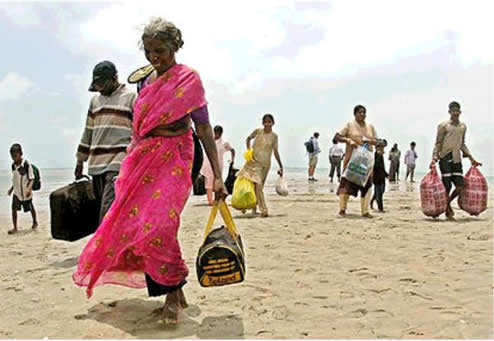 I spent yesterday afternoon at the launch of the new Foresight report on Migration and Global Environmental Change, a study commissioned and led by the government’s chief scientific adviser, Sir John Beddington. Drawing on the best available science and analysis from other disciplines, the project aimed to develop a picture of how international and internal migration patterns might be affected by global environmental changes between now and 2060, and the implications of these developments for policymakers.
It is a substantial report, and looks like important reading for those working on migration, climate change and many other related issues. It is also full of crunchy data and pretty charts, which always helps. Some of the top-line conclusions are unsurprising. It states that environmental change has a clear impact on migration through its influence on the web of political, economic and social drivers that lead people to move, and that this impact will only increase in the future as the world becomes more populated and as natural hazards proliferate. It also argues that the complex interaction of drivers will lead to different migration outcomes, and that well-planned and coordinated policy responses will reduce the risks of humanitarian emergencies and displacement. So far, so predictable.
However, some of its findings and recommendations are more counterintuitive, and should be studied carefully by policymakers. Three in particular jumped out at me. (more…)
by Claire Melamed | Oct 21, 2011 | Africa, Economics and development, Global system, UK
 On Wednesday ODI was host to Tony Blair, giving a speech on ‘leadership’ and the work of his Africa Governance Initiative.
There were, of course, predictable howls of protest from people furious that ODI gave a platform to the man who sent troops into Iraq. My view, for what it’s worth, is that Iraq was terrible but that Blair also did many good things: huge investments in the health service and education, the minimum wage, the Human Rights Act, the creation of DFID, the increases in aid. I’m unwilling to get into a game of trying to trade these off against each other, and Iraq doesn’t cancel out the good stuff as far as I am concerned. But anyway.
Blair talked about the importance of effective leadership – his main argument (very much informed by his own time in government, he said) was that ‘without a strong centre, nothing gets done’. I found this quite a refreshing challenge to the usual focus in the development canon on processes of governance and democracy. Ideal processes won’t necessarily turn out leaders who can actually act (one might cite the American constitution and Obama’s current trials as exhibit A here), while some leaders can do considerable amounts of good while presiding over very far from ideal processes (some might argue that Kagame falls into this category – I find it very hard to judge).
One wouldn’t want to push this too far. Being able to participate in a political process that you trust to deliver, and not being subject to opression and fear while you do so, is a good thing in itself. But it was a useful reminder that people matter in history, and that having people who can get things done, and who want to do the right things, is a crucial part of making progress happen. As a part of effective leadership, my former colleagues at ActionAid and Christian Aid will be pleased to know that he put a great focus on the importance of governments being able to raise their own money through tax, and the huge importance of getting investment deals right so that governments benefit.
Rightly, most of development is focused on what happens in societies and economies at large. But I found it quite useful to be reminded that what happens at the top of governments can be about making good stuff happen, and we should not always just focus on governments when they start doing things wrong.
