Migration and climate change: old assumptions and new ideas

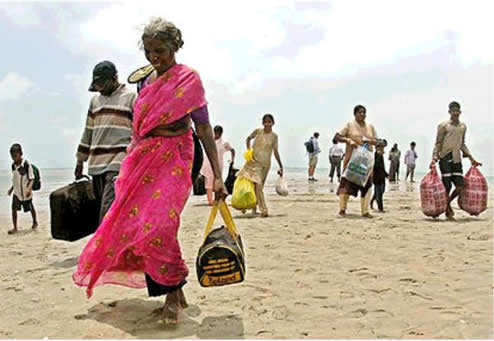
I spent yesterday afternoon at the launch of the new Foresight report on Migration and Global Environmental Change, a study commissioned and led by the government’s chief scientific adviser, Sir John Beddington.  Drawing on the best available science and analysis from other disciplines, the project aimed to develop a picture of how international and internal migration patterns might be affected by global environmental changes between now and 2060, and the implications of these developments for policymakers.

It is a substantial report, and looks like important reading for those working on migration, climate change and many other related issues.  It is also full of crunchy data and pretty charts, which always helps.   Some of the top-line conclusions are unsurprising.  It states that environmental change has a clear impact on migration through its influence on the web of political, economic and social drivers that lead people to move, and that this impact will only increase in the future as the world becomes more populated and as natural hazards proliferate.  It also argues that the complex interaction of drivers will lead to different migration outcomes, and that well-planned and coordinated policy responses will reduce the risks of humanitarian emergencies and displacement.  So far, so predictable.

However, some of its findings and recommendations are more counterintuitive, and should be studied carefully by policymakers.  Three in particular jumped out at me. (more…)

Tony Blair on development and leadership

On Wednesday ODI was host to Tony Blair, giving a speech on ‘leadership’ and the work of his Africa Governance Initiative

There were, of course, predictable howls of protest from people furious that ODI gave a platform to the man who sent troops into Iraq. My view, for what it’s worth, is that Iraq was terrible  but that Blair also did many good things: huge investments in the health service and education, the minimum wage, the Human Rights Act, the creation of DFID, the increases in aid.  I’m unwilling to get into a game of trying to trade these off against each other, and Iraq doesn’t cancel out the good stuff as far as I am concerned.  But anyway. 

Blair talked about the importance of effective leadership – his main argument (very much informed by his own time in government, he said) was that ‘without a strong centre, nothing gets done’.  I found this quite a refreshing challenge to the usual focus in the development canon on processes of governance and democracy.  Ideal processes won’t necessarily turn out leaders who can actually act (one might cite the American constitution and Obama’s current trials as exhibit A here), while some leaders can do considerable amounts of good while presiding over very far from ideal processes (some might argue that Kagame falls into this category – I find it very hard to judge).

One wouldn’t want to push this too far.  Being able to participate in a political process that you trust to deliver, and not being subject to opression and fear while you do so, is a good thing in itself.  But it was a useful reminder that people matter in history, and that having people who can get things done, and who want to do the right things, is a crucial part of making progress happen.  As a part of effective leadership, my former colleagues at ActionAid and Christian Aid will be pleased to know that he put a great focus on the importance of governments being able to raise their own money through tax, and the huge importance of getting investment deals right so that governments benefit. 

Rightly, most of development is focused on what happens in societies and economies at large.  But I found it quite useful to be reminded that what happens at the top of governments can be about making good stuff happen, and we should not always just focus on governments when they start doing things wrong.

What is catalytic foreign aid?


Is ‘aid exit’ or ‘catalytic aid’ a new development strategy for poor countries?

You might think so judging by comments buzzing around about ‘catalytic aid’ or ‘aid to end aid’ from leaders of some of the world’s poorest countries – for example, the President of Rwanda in the FT a while ago (here) and more recently President of Liberia (here) and not a low income country (yet), the UK Prime Minister, David Cameron visiting Nigeria recently (see here) said:

…we can spend aid in a catalytic way to unleash the dynamism of African economies…

…kickstarting growth and development…

…and ultimately helping Africa move off aid altogether.

Added to this are the recent related report from international NGO, ActionAid on ending aid dependency which notes:

…the proportion of government spending that comes from aid and over the last decade it has fallen on average by a third in the poorest countries. In Ghana aid dependency fell from 47% to 27%, in Mozambique from 74% to 58% and in Vietnam from 22% to 13%. Although aid levels increased, economic growth and the countries’ ability to mobilise their own resources increased faster…

Reading all this you might say hey, what happened to the 0.7 thing? So, what does it all mean for foreign aid and poor countries development strategies?

(more…)

The last 100 years as seen through the eyes of defence planners

Think you have a tough job? Then you haven’t thought about the confusing lives that defence planners lead…

1900 If you are a strategic analyst for the world’s leading power, you are British, looking warily at Britain’s age old enemy, France.

1910 You are now allied with France, and the enemy is now Germany.

1920 Britain and its allies have won World War I, but now the British find themselves engaged in a naval race with their former allies, the United States and Japan.

1930 For the British, naval limitation treaties are in place, the Great Depression has started, and defense planning for the next five years assumes a “ten year” rule – no war in ten years. British planners posit the main threats to the Empire as the Soviet Union and Japan, while Germany and Italy are either friendly or no threat.

1936 A British planner now posits three great threats: Italy, Japan, and the worst, a resurgent Germany, while little help can be expected from the United States.

1940 The collapse of France in June leaves Britain alone in a seemingly hopeless war with Germany and Italy, with a Japanese threat looming in the Pacific. The United States has only recently begun to scramble to rearm its military forces.

1950 The United States is now the world’s greatest power, the atomic age has dawned, and a “police action” begins in June in Korea that will kill over 36,500 Americans, 58,000 South Koreans, nearly 3,000 Allied soldiers, 215,000 North Koreans, 400,000 Chinese, and 2,000,000 Korean civilians before a cease-fire brings an end to the fighting in 1953. The main opponent in the conflict is China, America’s ally in the war against Japan.

1960 Politicians in the United States are focusing on a missile gap that does not genuinely exist; massive retaliation will soon give way to flexible response, while a small insurgency in South Vietnam hardly draws American attention.

1970 The United States is beginning to withdraw from Vietnam, its military forces in shambles. The Soviet Union has just crushed incipient rebellion in the Warsaw Pact. Détente between the Soviets and Americans has begun, while the Chinese are waiting in the wings to create an informal alliance with the United States.

1980 The Soviets have just invaded Afghanistan, while a theocratic revolution in Iran has overthrown the Shah’s regime. “Desert One” – an attempt to free American hostages in Iran – ends in a humiliating failure, another indication of what pundits are calling “the hollow force.” America is the greatest creditor nation the world has ever seen.

1990 The Soviet Union collapses. The supposedly hollow force shreds the vaunted Iraqi Army in less than 100 hours. The United States has become the world’s greatest debtor nation. Very few outside of the Department of Defense and the academic community use the Internet.

2000 Warsaw is the capital of a North Atlantic Treaty Organization (NATO) nation. Terrorism is emerging as America’s greatest threat. Biotechnology, robotics, nanotechnology, HD energy, etc. are advancing so fast they are beyond forecasting.

2010 Take the above and plan accordingly.

Extracted from The Joint Operating Environment 2010, published by US Joint Forces Command.