by Alex Evans | Jul 20, 2011 | Climate and resource scarcity, Global Dashboard
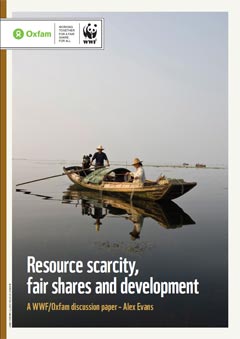 Yesterday WWF and Oxfam co-hosted a workshop in London on scarcity, fair shares and development – I did the introductory presentation, and wrote a paper ahead of the event which is published online today. In one sentence, my argument at the workshop was that,
As the 21st century global economy hits natural resource limits and planetary boundaries, fundamental questions about fair shares will start to arise – and these questions will increasingly come to be seen as the new front line for international development.
As I stressed in the presentation,this is not to say that I believe we’re headed for a neo-Malthusian nightmare:
On the contrary, I think we can be confident that markets will adapt and that technological innovations will emerge – as they always do. But that process of transition will take time. It will need to overcome inertia, market failures, externalised costs and perverse subsidies. And until it’s complete, poor people and poor countries risk losing access to resources that they depend on for their basic needs. And so any discussion of limits is also, inevitably, a discussion about fair shares.
And this will be a different kind of ‘fairness’ agenda to the one that those of us who think of ourselves as progressives are used to. I think we’ve only just begun to internalise just what a game changer the emergence of environmental and natural resource limits will be for global agendas about justice and equality:
Left and right have long disagreed about more or less everything, except the existence of an expanding ‘cake’ to share out. As long as the cake is expanding, then you can argue – as the political philosopher John Rawls famously did in his Theory of Justice back in 1971 – that inequality is OK if the worst off people are better off, in absolute terms, than they’d be under an equal distribution. But if the cake is finite, then by definition more for the better off means less for the worse off. It’s a much starker proposition.
by Alex Evans | Jul 18, 2011 | Influence and networks
Looking forward to Rupert Murdoch’s Select Committee appearance tomorrow? This quote from his biographer Michael Wolff, speaking today to ITV (and transcribed on the Guardian) should help whet your appetite:
He will handle it very poorly. This is something that Rupert doesn’t know how to do, has never done, has resisted doing and frankly can’t do. Rupert is – on top of everything else – an incredibly shy man and he is also a very inarticulate man and he is also a man who, I don’t think he is going to know what to do with the fact that he will be confronted here. It is very likely he will get angry. He will say things that people should not say in public. I know they are drilling him and rehearsing him over and over and over and over again and they are saying to him ‘do not say anything, just answer the questions in as few words as possible’. Whether he absorbs that lesson or not…actually I can’t imagine that he will or that he has.
Update (after the session): So much for that prediction. The NY Times seems to have the most grounded summary of yesterday’s proceedings, thanks to better contacts at News Corp’s US headquarters and perhaps a bit more distance from the issue than the UK press:
After days of intense anxiety over their appearance before a parliamentary committee on Tuesday, there seemed to be consensus inside the company and out that the Murdochs and the News Corporation had finally caught a break […]
“This was the best day these guys have had in a really long time,” said David Bank, media analyst for RBC Capital Markets. “No shoe dropped, no smoking gun was found, it all sort of sounded kind of contained.” […]
Inside the company, executives seemed relieved at how relatively smoothly the process went. “No one is despondent, no one thinks this went poorly,” said one person briefed on Tuesday’s events who asked not to be identified revealing private conversations. “I wouldn’t bet against those two.”
by Alex Evans | Jul 18, 2011 | Influence and networks

OK, that’s it. We are officially no longer a serious country:
The prime minister, who found out that Stephenson was resigning just over an hour into his overnight flight from Heathrow to Johannesburg, made a series of phone calls to the home secretary, Theresa May, and government officials from his Virgin plane.
These had to be made on the Virgin credit card phones available in all seats after the No 10 secure satellite phones failed.
by Alex Evans | Jul 17, 2011 | Climate and resource scarcity, North America

Lest you thought that surging food prices were only an issue for low income countries and people living on less than a dollar a day, this week’s Economist article on food stamps in the US was pretty arresting:
Participation has soared since the recession began (see chart). By April it had reached almost 45m, or one in seven Americans. The cost, naturally, has soared too, from $35 billion in 2008 to $65 billion last year. And the Department of Agriculture, which administers the scheme, reckons only two-thirds of those who are eligible have signed up.
As the graph shows, while the number of beneficiaries has risen sharply, costs have increased even faster – no surprise, given what’s been happening to food prices. And guess what: the Republicans want to slash the program.
In their budget outline for next year they proposed cutting the amount of money to be spent on food stamps by roughly a fifth from 2015. Moreover, instead of being a federal entitlement, available to all Americans who meet the eligibility criteria irrespective of the cost, the programme would become a “block grant” to the states, which would receive a fixed amount to spend each year, irrespective of demand. The House has also voted to cut a separate health-and-nutrition scheme for poor pregnant women, infants and children, known as WIC, by 11%.
The Economist notes that “it is … hard to argue that food-stamp recipients are undeserving”:
About half of them are children, and another 8% are elderly. Only 14% of food-stamp households have incomes above the poverty line; 41% have incomes of half that level or less, and 18% have no income at all. The average participating family has only $101 in savings or valuables.
And even assuming that the (Democrat-controlled) Senate blocks cuts to food stamps, the larger context is of painful reductions to welfare provision even as the US economy remains anaemic:
Unemployment benefits last for a maximum of 99 weeks at the moment, and that is due to fall to six months from next year. No one knows exactly how many people have exhausted their allotment, as the government does not attempt to count them. But almost half of the 14m unemployed have been out of a job for six months or more, and so would no longer qualify for benefits under the rules that will apply from January 1st.
by Alex Evans | Jul 15, 2011 | What we're watching
[youtube]http://www.youtube.com/watch?v=he2a4xK8ctk[/youtube]
