The man Soros calls the new Keynes
[youtube]http://www.youtube.com/watch?v=eU7UdI41Pu4[/youtube]

[youtube]http://www.youtube.com/watch?v=eU7UdI41Pu4[/youtube]
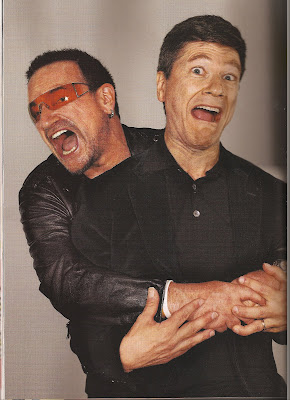
An economist joke:
Bono and Jeff Sachs are meeting in Harvard to talk about world poverty. After a while, they decide to head out to a Harvard Square eaterie for some lunch.
They are rapidly mobbed by hysterical fans, demanding autographs, photos and so on.
Jeff Sachs says to Bono: “You’re probably not used to this sort of thing.”
A trial that has just got under way in New York looks likely to provide some interesting insights into how South American drug traffickers are going about their business in West Africa, which for several years now (as detailed here and here) has been used as a transit point on the cocaine route to Europe and the US.
A prosecution witness in the trial has claimed that Fumbah Sirleaf, son of Liberian president Ellen Johnson Sirleaf and former director of Liberia’s National Security Agency, agreed to pose as a corrupt official (not too difficult a disguise for most West African politicians) to help the US Drug Enforcement Agency in a sting operation.
As the Canadian Press reports, Sirleaf and a colleague allegedly met a pair of Colombians representing a South American drug trafficking organisation, and extracted from them a promise to give them $1m and 50 kilos of cocaine in return for letting them use Liberia as a hub. ‘What these defendants did not know,’ said the witness, a DEA agent, ‘was that Liberian officials had not put their country up for sale. The Liberians had been pretending to be corrupt.’ Sirleaf recorded the conversations with the Colombians, and handed the tapes to the DEA. Defence lawyers say their clients were entrapped. Watch this space for updates.

I’ve been spending the weekend at the Mount Washington Hotel in Bretton Woods, New Hampshire – the scene of the conference that produced the IMF, the World Bank and the global monetary order that followed World War 2. This time, it’s been playing host to the 2nd annual conference of the Institute of New Economic Thinking, the think tank set up by George Soros after the first wave of the financial crisis in 2008.
He’s pulled together an all-star cast of speakers – Gordon Brown, Joe Stiglitz, Paul Volcker, Martin Wolf, Niall Ferguson, Adair Turner and more – who carry with them much rockstar economist allure, to the extent that I spotted two hotel staff members demanding to have their photos taken with Stiglitz .
But what it doesn’t feel like is a gathering of masters of the universe (though Fox News thinks the whole show is an evil conspiracy, which is nice – maybe we’ll be offered membership of the Bilderberg Group). On the contrary, there’s a lot of uncertainty in the air here, on what’s happening, where things are heading, and what should be done. About the only point of consensus seems to be that we’re not out of the woods yet, and that countries are failing to look beyond their narrow self-interest.
Martin Wolf, for instance, observed that what’s happening in the eurozone is that “Germany is serially bankrupting all its partners – it’s only just beginning”, a process that will only end when the eurozone is a surplus economy like China, with everyone else cast out or in permanent recession.
Gordon Brown, too, was emphatic about the need for collective action to deal with shared challenges – but pretty gloomy about the prospects for it. Will Hutton’s Observer despatch from the conference is a good summary of reasons to be downcast (“I said to one top British official that I thought that not only was there a real chance of British growth being subdued for years, but that the whole economy risked sliding towards Japanese-style stagnation. He indicated that others in government thought so too.”)
But if there’s a silver lining to all this, it’s that there’s an opening here to rethink basic beliefs from first principles.
Text of speech by Alex Evans to Institute for New Economic Thinking annual conference at Bretton Woods; the YouTube video is here. (April 2011)