by Andy Sumner | Jan 6, 2011 | Economics and development, South Asia, UK

The UK parliament’s development committee begins its inquiry into UK aid to India next week with a question mark over the future of UK aid to a country where there are 450 million poor people – a third of the world’s poor -living below US$1.25/day. In fact, 8 Indian states alone have more poor people than the 26 poorest African countries combined.
This is emotional territory – on both the UK and India side – during Cameron’s autumn 2010 visit sparks flew with the Indian finance minister calling UK aid ($700m) ‘peanuts’ in an angry response to the suggestion that the UK might end aid to India.
An Indian official’s memo leaked to the BBC largely concurred with the ‘who do you guys think you are?’ line.
It might be that the Indians got mad because DFID signaled it wanted to direct more aid to individual states rather than the central government. More recently the idea of an emerging power, that is a foreign aid donor itself, accepting aid has raised substantial debate within India itself.
DFID’s Secretary of State, Andrew Mitchell is said to be open to discussion either way but was persuaded so far by Cameron that the UK can’t be seen to be cutting aid to a country that British people think is a poor country even if it isn’t.
Donors have a somewhat tangled logic on middle income countries (MICs):
1. The mission of donors is poverty reduction
2. 72% of the poor live in MICs
3. Donors are withdrawing from MICs, where the poor live
4. Oops…
Currently, India receives about $2bn of aid/year from donors and the UK makes up about a third of this. Since 1998, India has received more UK overseas aid than any other country. Further DFID works in 27 MICs and spends about a third of bilateral programming in MICs in 2008/9. In contrast, almost a half of EU ODA is to MICS.
The paradox is India, like many other countries was ‘graduated’ out of ‘poor country’ status by the World Bank in 2009 to middle income status (more than $1000 per person per year) but is still home to a third of the world’s poor or 450 million people. India is still IDA (World Bank) eligible but will likely graduate three years from now.
(more…)
by Alex Evans | Jan 6, 2011 | Climate and resource scarcity, Economics and development
As if to mark the start of the new decade with an indication of what we can expect from it, the FAO’s Food Price Index has just surpassed its 2008 peak (it’s now at 214.7, compared to 213.8 in June 2008), putting it at its highest level since its launch in 1990. FAO is now warning of a new “food price shock” that could lead to a “food crisis”, and its senior economist Abdolreza Abbassian warns that “it will be foolish to assume this is the peak”.

But if the Index is at its highest ever level, why aren’t we seeing riots on the scale of 2008, when (according to the International Food Policy Research Institute – pdf), 61 countries experienced unrest, with protests turning violent in 23 of them? And should we expect to see the global total of undernourished people climb back over the one billion mark next time the UN figures are compiled?
A few things make this food spike different from the last one.
First, this one is – so far – about a somewhat different set of food commodities. Whereas the 2008 spike was heavily concentrated in key grains – rice, corn, wheat, soya – this one is being driven more by meat, sugar and vegetable oils, which are less fundamental as staple foods in low income countries. Admittedly, corn has been rising strongly too – but rice, in particular, has so far not spiked (it hit $1,000 a tonne in 2008; it’s at $535 a tonne today – see the FT graph below).

Second, many African and Asian countries have actually had good harvests over the last year. As the FT points out, “while the international export price for corn jumped 45 per cent between May and November [last year], it declined by up to 10 per cent in parts of Africa”. Part of the backstory here is how well many African countries have done at investing in their agriculture sectors since 2008, through programmes such as CAADP – an interesting datum to stir in to the argument over whether low income countries should scale up endogenous production capacity and seek to reduce their reliance on international markets to meet their needs.
Third, while oil prices are high at the moment (around $95 a barrel), they’re certainly not at their 2008 peak level of $147 a barrel – a factor that helped drive food prices much higher as costs rose for fertiliser, transportation, processing, on-farm energy use and so on. (On the subject of what drove the 2008 spike, incidentally, this new IFPRI report is worth a look – it raises a sceptical eyebrow at those who argue the role of biofuels in that spike was overstated.)
Fourth, and perhaps most importantly, we haven’t yet seen a slide into panic measures that amplify the problem. The last food spike was a story in two acts, with the first part of the spike driven by fundamentals like rising demand for biofuels and the depreciation of the US dollar, and the second, steeper part of the spike driven in particular by export bans or restrictions imposed by over 30 countries. Although Russia imposed an export ban on wheat last summer, and India has recently restricted the export of some staple vegetables, we’re not in the trade meltdown scenario of 2008 – thankfully.
But don’t breathe a sigh of relief just yet. The oil price may well rise higher over the year ahead, as emerging economy growth continues to power onwards. Further depreciation in the dollar would be likely to increase commodity prices. And above all, don’t forget climate change. Extreme weather could cause poor countries’ food outlook to darken substantially this year – as Oxfam’s Gawain Kripke puts it, the latest rise in food prices is “a grave reminder that until we act on the underlying causes of hunger and climate change, we will find ourselves perpetually on the knife’s edge of disaster”.
by Jules Evans | Jan 6, 2011 | Economics and development, Influence and networks
 So last week, I sent off an application for a provisional driver’s license (I know, I know – 33 and still can’t drive). At the bottom of the DVLA application was a box asking if I agreed to donate my organs in the event of an accident. An easy way to feel noble, I thought, and ticked the box.
Now, I discover I’ve been nudged! The Cabinet Office’s Behavioural Insight team, run by David Halpern, released its first report last week. The team is advised by behavioural economist Richard Thaler, who wrote the book Nudge, and it tries to find ways to ‘nudge‘ British citizens towards socially desirable behaviour. The unit ‘draws on insights from behavioural economics and shows ways in which health improvements can be made without resorting to legislation or costly programmes.’ So, for example, Thaler found that men could be ‘nudged’ to pee in urinals, rather than on the floor, by putting little toy goalposts in the urinals. Brilliant – although I feel a bit sorry for the poor behavioural economists who had to hold the goalposts in place. I just hope they had lab goggles.
Anyway, the report reveals how the Behavioural Insight unit has been quietly nudging us Brits over the last few weeks. It highlights two new initiatives:
– A smoking cessation pilot beginning in early 2011. This will encourage participants to make commitments to quit smoking (for example, by signing a contract) and will reward those who pass regular smoking tests. The pilot will be run by Boots, with the support of the Behavioural Insights team and the Department of Health.
– A system of ‘prompted choice’ on organ donor registration will be introduced to the DVLA application form for renewing and applying for driving licenses. This will require applicants to state whether or not they wish to become an organ donor. Where this has been introduced in other countries, it has significantly increased the number of organ donors. If the DVLA scheme proves successful, it will be rolled out to other areas.
So! My decision to donate my organs to humanity was not as noble as I thought. I was nudged, m’lud. Good idea though. I’d be interested to see the results, and wouldn’t be surprised to see a big rise in organ donations. If they get enough donations, maybe they can flog some spare organs to other countries, reduce the deficit eh?
by Richard Gowan | Jan 5, 2011 | Africa, Climate and resource scarcity, Conflict and security, Cooperation and coherence, Global system, Influence and networks
On 22 December, I published an op-ed over at World Politics Review (now behind a paywall, but also available for free via ECFR) about Ban Ki-moon’s overloaded agenda:
For Ban Ki-moon, the past few weeks have arguably been the most dramatic he has encountered since becoming United Nations secretary-general nearly four years ago. In Côte d’Ivoire, UN peacekeepers are guarding the internationally recognised winner of this month’s presidential election while the country slides toward chaos. Meanwhile, in New York, the Security Council spent Sunday locked in fruitless debates on the simmering Korean crisis.
Ban, as South Korea’s former foreign minister, can do little to shape the council’s discussions of his home country’s security. He has based his tenure on maintaining good relations with both Washington and Beijing, and taking a forceful stance on the Korean situation would alienate one or both. Ban must focus on Africa instead.
That doesn’t just mean Côte d’Ivoire, though. Ban and his advisers are painfully aware that another crisis is in the making in South Sudan, which is slated to hold a referendum on independence from Khartoum on January 9. Unless the poll is delayed or rigged, it will almost certainly result in a vote for independence. The resulting tensions could tip into major violence, either immediately or later in 2011.
Ban has his detractors, but I found a lot to praise in his performance last month:
Ban has so far handled the Ivorian crisis well. He was quick to recognise the electoral victory of Alassane Ouattara over President Laurent Gbagbo, speaking out days before the Security Council could agree on a statement. This weekend, he flatly refused a demand by Gbagbo to pull UN forces out of the country.
Ban knows that Western and African governments are solidly on his side in this case: Even China backs Ouattara’s cause. Nonetheless, his firm line is a welcome break from his frequently stated preference for soft-spoken diplomacy. Ban’s many critics, both inside and outside the UN, believe that he tends to equivocate and has too little interest in the UN’s peace operations. He has raised his game.
And, two weeks on, I still think Ban is handling the Ivorian crisis impressively. But I am depressed by a poorly cobbled-together op-ed published under his name in multiple outlets last week. (more…)
by Richard Gowan | Jan 5, 2011 | Cooperation and coherence, Europe and Central Asia, North America, Off topic
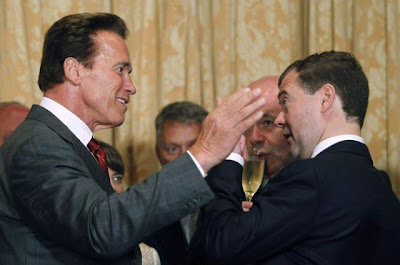
Two twits tweet:
Russian President Dmitry Medvedev has accepted Arnold Schwarzenegger’s proposal to go skiing.
‘@Schwarzenegger: Thanks. We agreed – I remember. We’ll definitely find the time,’ Medvedev wrote on Twitter.
Action movie star Schwarzenegger, who on Monday stepped down as California governor, earlier used his Twitter account to invite the Russian leader to ski with him.
Medvedev, one of whose hobbies is mountain skiing, wished good luck and success in new undertakings to the ‘Governator’ on Monday.
