by Claire Melamed | Jan 31, 2011 | Economics and development
There’s much anxiety in development-land these days. New, frightening beasts like ‘results’ and ‘value for money’ are stalking the defenceless and helpless herds of ‘empowerment’ and ‘rights’. With their new slashing, tearing, efficiency-driven ways, the fear is these interlopers will exterminate the shyer folk and irretrievably warp the development process.
Actually, scrap the analogy. Firstly, it’s possibly a bit overwrought, and secondly, it’s just not true. It is absolutely wrong and quite dangerous to equate a concern for results with the view that development is just about handing out food parcels.
If you think results don’t matter, then consider the alternative. Without measuring results, we would never know if aid money made any difference. We would have no way of reporting back to communities about what governments were doing. We would have no way of judging between different claims on scarce development budgets, other than the whims of aid administrators and the vagaries of development fashion. And we would never, ever, know if things were getting better or worse.
It seems extraordinary to me that anyone could object to having more information about whether a policy change or a development project has an impact. More information can only help the people who really should be driving development – poor people themselves – to make choices and take control of what is done in their name.
This is not to say that what is counted doesn’t matter. A concern for results shouldn’t mean that we just reach for the nearest indicator and call it development. Quite rightly, there are many voices out there pointing out that development is a complex social and political process, involving power, rights and justice – all concepts that are difficult to capture on a spreadsheet. And, yes, there is a danger that pursuit of ‘results’, narrowly defined, could steer development projects and policies towards what is best counted, not what is best.
Now that is the argument worth having. What should we count? Those who are concerned with empowerment, rights and other such slippery but absolutely essential ideas should be rushing to the statisticians, and calling out for better ways of measuring if what they are doing in the name of empowerment and rights is actually working. Yes, as the saying goes, ‘not everything that can be counted, counts’, but ‘not everything that counts can be counted’ just isn’t good enough. We just ask people to take it on trust that things are working because the professionals say so? I think not.
Don’t get mad, get counting. The results agenda is completely compatible with a view that people are the agents of development and that it is their experiences and relationships that define progress. There are ways of measuring how people feel about things – in the UK, for example, we have things like the British Social Attitudes survey which asks people what they think and then reports it, and measures changes in things like attitudes to inequality, feelings about old age or views about the effectiveness of education policy over time. And we know that there are many ways of involving poor people in defining indicators and collecting numbers.
It could be so exciting. Let’s ask poor people what they call results, and what they consider the best value for money? Surely, surely you want to know?
by Alex Evans | Jan 31, 2011 | Climate and resource scarcity, Economics and development
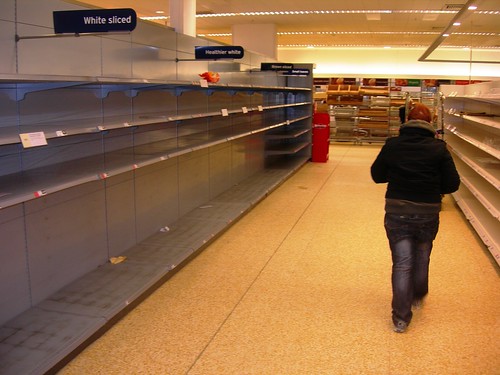
The last food price spike, which peaked in 2008, was a play in two acts. During Act One – until mid to late-2007 or thereabouts – rising prices were largely driven by supply and demand fundamentals: factors like crops being diverted to biofuels, low stock levels, poor harvests in some regions, that kind of thing.
But Act Two was different, driven by perceptions, panic and positive feedback loops. The export bans that over 30 countries imposed were part of this; so too was the spectacle of import-dependent countries frantically trying to rebuild their stock levels, in the process pushing prices up even further. (Some, like the World Development Movement, would also argue that futures market speculation was part of this phase as well – but this remains hotly contested.)
Although Russia’s wheat export ban last summer hasn’t led – so far – to a full-on rash of export bans like in 2008, we are starting to see the panic buying again, according to Javier Blas in the FT last week:
Over the last two weeks, developing nations have put in orders for unusually high amounts of staples, mostly wheat and rice, or announced plans to build stocks. Governments are reacting to growing social unrest about rising domestic prices. The result: international agricultural commodities prices are already rising fast just as the market suddenly faces a step increase in demand.
In Chicago, soft wheat prices have risen to a fresh 29-month high at $8.60 a bushel. The cost of premium hard wheat, used to bake bread, is rapidly approaching the key $10 a bushel level in Kansas and Minneapolis. Rice prices have also moved higher to nearly $550 a tonne, although the cost of the Asian staple is rising from a lower level and is still far below the record of 2008.
The accelerated buying is coming from a broader spectrum of developing nations.
Algeria bought 800,000 tonnes of wheat on Wednesday, bringing the total since the start of the year to a hefty 1.7m tonnes. Although the North African country is one of the world’s biggest wheat importers, buying about 5.0m-5.5m tonnes a year, its purchases so far in 2011 appear well ahead of normal patterns. And Saudi Arabia has said it plans to double the size of its wheat stocks to cover the demand of a year.
Bangladesh, one of the world’s largest rice importers, on Thursday raised its import target for the grain to 1.2m tonnes, up from an initial estimate of 600,000 tonnes. Badrul Hasan, director for procurement at the nation’s Directorate General of Food, told Bloomberg News the reason was “panic buying” among the country’s population.
As government step-up their purchases, the shortage of supplies is going to become more evident, and is likely push prices even higher, leading to outright panic buying, as in 2007-08. As such, traders and investors looking for rising prices denting demand should be careful: governments will pay almost any price to secure wheat and rice if they feel social unrest is looming because of rising domestic food prices.
by Richard Gowan | Jan 29, 2011 | Influence and networks, Latin America and the Caribbean, North America, Off topic

Google “Fidel Castro”, and you can find an amazing trove of pictures of him with some of the most famous world leaders of the last half-century like Pope John Paul II, Richard Nixon and Nikita Khrushchev – not to mention the very dapper Saddam Hussein above. But, as I note in a review piece for The National, there’s one leader Castro has never got to do a photo-op with, although I bet he really wanted to…
Of all the nuggets of diplomatic gossip made public by WikiLeaks last year, one of the oddest concerned Fidel Castro’s “doomed love” for Barack Obama. In 2009, US officials in Havana reported that Cuba’s former leader – now in his mid-eighties and forced into retirement by ill-health – appeared obsessed with the new president’s potential to transform American politics and foreign policy. As the year wore on, obsession gave way to dyspeptic gloom, as Castro concluded that Obama was not a true radical after all.
How did the US diplomats know all this? Did they have back-channel communications with Castro or a mole on the inside? The answer is more prosaic. Their analysis was based on Castro’s regular opinion pieces for the official newspaper Granma, which are available online in English. Now Ocean Press has published a selection of these pieces, dating from May 2008 to June 2010, in a slim but prodigiously boring volume.
How boring exactly?
In a reflection published on the eve of the US elections in November 2008, for example, Castro felt it necessary to inform readers that “the Democratic candidate Obama is partly black” and that “the dark skin and features of that race are obvious in him”. Now, my memories of the 2008 campaign are growing a little hazy, but I am reasonably sure that perceptive commentators and even sections of the general public had spotted this earlier than November.
Similarly, Castro welcomes the choice of Hillary Clinton as secretary of state by noting that she was “Barack Obama’s rival and the wife of President Clinton”. Who knew?
Read the rest of the piece, including insights into Castro’s fear of robots, here.
UPDATE: this news just in from Havana proves that Castro’s Obama crush is so over…
HAVANA TIMES, Jan. 28 — Former Cuban President Fidel Castro questioned the State of the Union speech by U.S. President Barack Obama last Jan. 25. In one of his usual Reflections, Castro strongly criticized what the U.S. president said regarding the U.S. economy, renewable energy and international cooperation, among other issues. “It is difficult that God can bless so many lies,” the historic leader of the Cuban Revolution said.
by Alex Evans | Jan 28, 2011 | Articles and Publications, Reports
Eight critical uncertainties for development over the next decade, and ten recommendations for what ActionAid – who commissioned this report by Alex Evans – should do to prepare for them (January 2011)
Download Report
