BASIC puts forward its candidate to replace Yvo de Boer at UNFCCC

A small but potentially rather significant exchange in the UN Secretary-General’s spokesman’s press briefing on Thursday last week:

Question:  India has said that it’s put forward a candidate to replace Mr. [Yvo] de Boer on the UNFCCC [United Nations Framework Convention on Climate Change].  It’s named the individual, and said that it has the support of China and other BRIC nations.  I just wondered, first, can you confirm that names have been received by the Secretary-General for that post?  How many names and what’s the process for selection?

Spokesperson:  I can’t confirm whether specific names have been given or not.  Clearly, there is a process that’s under way.  This is an appointment that is indeed made by the Secretary-General in consultation with the Board of the United Nations Framework Convention on Climate Change.  There is still a way to go in that selection process, and I don’t want to get into details here

So who might India’s candidate be? Over to wire coverage a day earlier from Indo Asian News Service (which seems to have been barely noticed outside India):

Environment Minister Jairam Ramesh has written to the United Nations backing the candidature of Vijai Sharma, secretary with the ministry, for the post of executive secretary of UN Framework Convention on Climate Change (UNFCCC). The minister said here Wednesday that China has already supported the move.

‘Vijai Sharma is our official candidate for UNFCCC executive secretary. I have written to the United Nations Monday and have also written to BASIC (Brazil, South Africa, India, China) countries seeking their support. We have got support from China already for his candidature and we will get support from other BASIC countries,’ Ramesh said at an interaction at the Indian Women’s Press Corps.

Ramesh said the time has come for the post to go to a developing country. ‘The first three secretaries have all been from developed countries and Vijai Sharma has long years of experience with UNFCCC. He was chief spokesperson for G77 for Kyoto negotiations. I am pursuing it. I am not sure as European countries and the US will prefer somebody from a smaller country and India is unarguably at a different profile but I would like to see him there,’ the minister said.

Sharma – a career bureacrat – is well-respected inside the UNFCCC process as far as I can make out.  But I wonder whether India’s making a tactical error in equating “developing country” interests with those of the BASIC grouping of emerging economies. At Copenhagen, BASIC’s hardline position was conspicuously not in the interests of the least developed countries who stand most to lose from climate change.  It’ll be interesting to see whether an alternative developing country candidate comes forward – one from the ‘survival’ rather than the ‘growth’ faction of the G77.
Better late than never

Leaders should therefore commission an independent review of the IPCC’s integrity, auditing the executions of its mandate to provide a comprehensive, objective, open and transparent assessment of the scientific basis of the risk of human-induced climate change.

This review should not be of the state of climate science – where the IPCC has, and should retain, primacy – but rather of the quality of the IPCC’s procedures and the integrity of the research methods on which its findings rely.

– David and I in Hitting Reboot (published December 22, 2009)

The UN is to commission an independent group of top scientists to review its climate change panel, which has been under fire since it admitted a mistake over melting Himalayan glaciers.

The experts will look at the way the Intergovernmental Panel on Climate Change (IPCC) operates and will recommend where they think changes are needed. The panel will be part of a broader review of the IPCC, full details of which will be announced by the UN next week.

– The Guardian (published March 1, 2010)

How intelligence clearance turns you into a moron

Daniel Ellsberg, in 1968, speaking to Henry Kissinger, who was just entering government for the first time:

“Henry, there’s something I would like to tell you, for what it’s worth, something I wish I had been told years ago. You’ve been a consultant for a long time, and you’ve dealt a great deal with top secret information. But you’re about to receive a whole slew of special clearances, maybe fifteen or twenty of them, that are higher than top secret.

“I’ve had a number of these myself, and I’ve known other people who have just acquired them, and I have a pretty good sense of what the effects of receiving these clearances are on a person who didn’t previously know they even existed. And the effects of reading the information that they will make available to you.

“First, you’ll be exhilarated by some of this new information, and by having it all — so much! incredible! — suddenly available to you. But second, almost as fast, you will feel like a fool for having studied, written, talked about these subjects, criticized and analyzed decisions made by presidents for years without having known of the existence of all this information, which presidents and others had and you didn’t, and which must have influenced their decisions in ways you couldn’t even guess. In particular, you’ll feel foolish for having literally rubbed shoulders for over a decade with some officials and consultants who did have access to all this information you didn’t know about and didn’t know they had, and you’ll be stunned that they kept that secret from you so well.

“You will feel like a fool, and that will last for about two weeks. Then, after you’ve started reading all this daily intelligence input and become used to using what amounts to whole libraries of hidden information, which is much more closely held than mere top secret data, you will forget there ever was a time when you didn’t have it, and you’ll be aware only of the fact that you have it now and most others don’t….and that all those other people are fools.

“Over a longer period of time — not too long, but a matter of two or three years — you’ll eventually become aware of the limitations of this information. There is a great deal that it doesn’t tell you, it’s often inaccurate, and it can lead you astray just as much as the New York Times can. But that takes a while to learn.

“In the meantime it will have become very hard for you to learn from anybody who doesn’t have these clearances. Because you’ll be thinking as you listen to them: ‘What would this man be telling me if he knew what I know? Would he be giving me the same advice, or would it totally change his predictions and recommendations?’ And that mental exercise is so torturous that after a while you give it up and just stop listening. I’ve seen this with my superiors, my colleagues….and with myself.

“You will deal with a person who doesn’t have those clearances only from the point of view of what you want him to believe and what impression you want him to go away with, since you’ll have to lie carefully to him about what you know. In effect, you will have to manipulate him. You’ll give up trying to assess what he has to say. The danger is, you’ll become something like a moron. You’ll become incapable of learning from most people in the world, no matter how much experience they may have in their particular areas that may be much greater than yours.”

….Kissinger hadn’t interrupted this long warning. As I’ve said, he could be a good listener, and he listened soberly. He seemed to understand that it was heartfelt, and he didn’t take it as patronizing, as I’d feared. But I knew it was too soon for him to appreciate fully what I was saying. He didn’t have the clearances yet.

Recounted in Mother Jones; h/t Nils Gilman.

Daniel Hannan rewrites Falklands’ history

Hannan Speaks

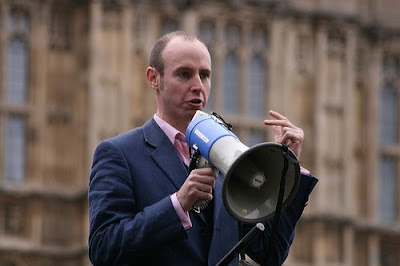
MEP and internet superstar, Daniel Hannan is up in arms at what he sees Barack Obama sucking up to ‘Peronist Argentina’ on the Falklands.

“When matters last came to a head,” he writes, “Ronald Reagan had no difficulty backing Margaret Thatcher: the Gipper knew who America’s friends were.”

Of course, it wasn’t nearly as simple as that, as I am sure Hannan (a huge Thatcher fan) knows well. Michael Moynihan (no foe of Hannan’s, by the way)  sets the record straight:

Before the British took military action in 1982, the Reagan administration was, to the consternation of the British foreign office, very much on the fence and, initially, wedded to the neutrality position… In a letter to Thatcher, Reagan said that his government would take a neutral position on the matter—again, causing great anger—but would come out in favor of its ally if the Argentinians decide to start shooting…

It was only a communications error that prevented the United States from abstaining, rather than vetoing, a United Nation Security Council resolution calling for a ceasefire—which Britain strenuously opposed.

Hannan’s fudging gives me a chance to plug James Rentschler’s superb Falklands diary. Rentschler was the Reagan official who ended up responsible for US policy on the islands after Argentina invaded. He was nonplussed by the task:

Never heard of [the Falklands], right? Me neither at least not until last evening when Prime Minister Margaret Thatcher sent an urgent message through the Cabinet Line requesting the President to intercede with the Argies. 1800 British-origin sheepherders, pursuing a peaceful life on some wind-blown specks of rock in the South Atlantic, now targeted by Argentine amphibious assault units – who, in turn, may soon be attacked by the largest naval armada ever to steam out of British ports since Suez? Yes indeed, the thing certainly does sound like Gilbert and Sullivan as told to Anthony Trollope by Alistair Cooke. But what started out as comic opera now looks to become not only quite serious, but exceptionally nasty. The Argentines have clearly misjudged the British temper, and this guy Galtieri, speaking first in broken mafioso-type English before the State Department interpreter tactfully intervenes, sounds like a thug. (more…)