by Alex Evans | Dec 8, 2010 | Climate and resource scarcity, UK
BBC News:
UK Climate Secretary Chris Huhne is set to fly back to London from the UN climate summit for the Thursday’s Commons vote on student tuition fees. Campaigners say the move could damage prospects of a deal, as Mr Huhne has been tasked with brokering a compromise on the troubled Kyoto Protocol.
The coalition asked Labour to withdraw an MP from the ballot so Mr Huhne could stay, but the opposition declined … it is understood that Mr Huhne and his team are still attempting to secure a “pairing” with either a Labour MP or someone from a smaller opposition party, which would allow him to remain in Cancun.
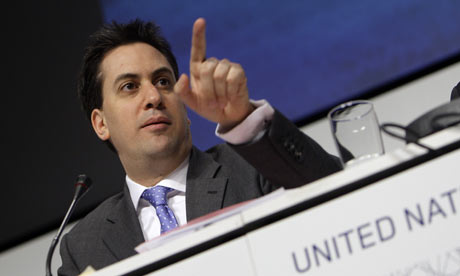
Not disputing that the tuition fees issue is a massive deal. But the Parliamentary arithmetic on this one isn’t seriously in doubt. Ed Miliband has an enviable reputation on climate – and he of all people should know better than to drag the Secretary of State for Energy and Climate Change back from a UNFCCC summit for the sake of political point scoring (especially when he’s playing a key brokering role, as Huhne currently is).
Shame on Labour if it can’t find this modicum of bipartisanship on the biggest global issue.
Update: over on Twitter, various Labour folk are saying that this is an internal Lib Dem matter – i.e. that Chris Huhne should pair with one of the Lib Dem rebels, not with a Labour MP.
I find this utterly unconvincing. It’s perfectly clearly established that when an MP is paired in a Commons vote, it’s with someone on the other side of the House. Labour’s opportunity here is to rise above party politics, provide Chris Huhne with a face-saving compromise and enable the sensible outcome. If we won’t take it, then we’re as bad as the rest.
Update 2: Greenpeace Director Jon Sauven in the Guardian:
“With the coalition struggling to keep the show on the road in London over tuition fees, Ed Miliband should step up to the plate and act in a statesmanlike manner by pairing up a Labour MP with Chris Huhne, the climate change secretary, who is key to the negotiations in Cancún.
“The current political gaming in Westminster could end up having detrimental consequences for the progress of the climate talks in Mexico if Huhne is forced to fly home. We need Miliband to build on his personal legacy from Copenhagen to ensure Britain’s key role in the Mexico climate negotiations is not undermined.”
Exactly.
by Alex Evans | Dec 8, 2010 | What we're watching
[youtube]http://www.youtube.com/watch?v=vf-dtsi1UDU[/youtube]
by Richard Gowan | Dec 7, 2010 | Conflict and security, Economics and development, Latin America and the Caribbean, South Asia
A breaking story from the BBC:
UN peacekeepers were the most likely source of the cholera epidemic sweeping Haiti, according to a leaked report by a French disease expert.
Epidemiologist Renaud Piarroux conducted research in Haiti on behalf of the French and Haitian governments.
Sources who have seen his report say it found strong evidence that the cholera outbreak was caused by contamination of a river by UN troops from Nepal.
The UN said it had neither accepted nor dismissed the findings.
by Alex Evans | Dec 7, 2010 | Cooperation and coherence

A French court yesterday found Continental Airlines guilty of involuntary homicide for its part in the Concorde crash outside Paris in 2000. This is regrettable, since criminalising accidents is not an intelligent approach to managing risk.
The reason Continental found itself in the dock on this case was that the last plane to take off before Concorde, a Continental DC10, shed a small piece of titanium that then punctured a tyre on the Concorde, which then led to shards of rubber flying into the fuel tanks. Not only was Continental prosecuted, but so was the individual mechanic – one John Taylor, who’s been given a fine and a suspended sentence.
Compare this to the approach taken to error reporting in high-reliability organisations. Here are Karl Weick and Kathleen Sutcliffe in their classic book on the subject, Managing the Unexpected:
The best high reliability organisations increase their knowledge base by encouraging and rewarding error reporting, even going so far as to reward those who have committed them … researchers Martin Laundau and Donald Chisholm provide [the example of] a seaman on the nuclear carrier Carl Vinson who reported the loss of a tool on the deck. All aircraft aloft were redirected to land bases until the tool was found, and the seaman was commended for his action – recognizing a potential danger – the next day at a formal ceremony.
That’s what you want to happen – a transparent organisational culture that displays what Weick and Sutcliffe call “a preoccupation with failure”.
It’s also the precise opposite of what the French court has effectively just ensured – which is that mechanics will keep schtum about their mistakes in case they get prosecuted. Not clever.
by Mark Weston | Dec 7, 2010 | Europe and Central Asia, Off topic
If you had ever planned an aerial invasion of Spain, last Friday would have been a good day to do it. For on that day, unannounced, Spain’s air traffic controllers decided to go on strike. At 5pm, all three hundred of those on duty called in sick. Five hundred flights were grounded; the skies remained empty for hours. Nobody in the government, the air force or the media had any prior warning. Nor did any of the 600,000 passengers who had to spend the bank holiday weekend (the most important in the Spanish calendar) sleeping on crowded airport floors with no food, no prospects of flight, and no information.
Spain’s air traffic controllers are among the least productive in Europe. The hourly cost of employing them is higher than in any other European country, and their annual salary, for which they work 32 hours per week, is €200,000. The wildcat strike was called because that salary has come down in the past year, bringing it closer to, but still higher than the European average, and because a new law prevents them from counting as working time all the many sick days they take (each controller averaged more than a day per month last summer).
Spain, as you may have noticed, is in the throes of a terrible recession (20% unemployment, frequent talk of IMF bailouts, no real sign of any let-up). Tourism is one of its biggest industries. The strike is likely to cost an economy already on its knees 400 million euros in lost revenue. And for a few hours on Friday until the army stepped in, the country’s skies were unpoliced.
The air traffic controllers nevertheless decided that this was an opportune time to take action. This now looks like a catastrophic miscalculation. Those who are struggling to feed their families are not delighted by the idea that a group earning in one year what the average Spaniard earns in ten think they are entitled to a pay increase. That that increase would come out of public funds (the industry is state-owned) when the country may be on the verge of bankruptcy does not add to the strikers’ popularity.
Fortunately, this tale of myopic greed has a happy ending. On Friday night the government declared a “state of alarm.” This placed air traffic controllers under temporary military supervision, effectively making them military personnel. If they do not perform their duties, therefore, they will be subject to the same penalties a soldier would face for disobedience. This can mean up to six years in prison. Within hours of the announcement of the state of alarm, the strike was over, as the spooked wildcats scurried back to their watchtowers. Disciplinary proceedings against them have already been opened, and the government seems determined to follow through with its threat. Hundreds of pampered air traffic controllers now face unemployment at best, imprisonment at worst. For the industry as a whole, privatisation beckons. The Spaniards I have spoken to, meanwhile, are pleased to see the spoilt brats getting their comeuppance. Many are no doubt wondering if the state of alarm can be extended to bankers.
