by David Steven | Apr 30, 2010 | Europe and Central Asia
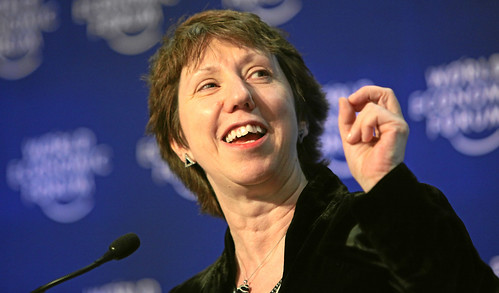
And for the EU’s latest foreign policy disaster (and one that reflects enormously badly on Gordon Brown if the story is true), the Telegraph claims that Baroness Ashton is on the brink of resigning after only months in her job:
“Every day is an uphill struggle,” said a European Commission official. “No one predicts she can stay five years, not even she.”
Lady Ashton has come under fire from powerful countries led by France, for allowing the Commission to seize too much control of a new EU diplomatic service that she is building from scratch.
Her lack of political authority has been blamed for a failure to stamp out bureaucratic Brussels in-fighting over who will control the new European External Action Service, with 7,000 diplomats manning over 130 embassies around the world.
Bitter turf wars over budgets and senior posts mean the diplomatic corps will be delayed, a situation that has angered governments and embarrassed the EU on the global stage.
Following one recent row, she allegedly threatened to walk out of her job and had to be talked out of resigning on the spot by diplomats and officials.
Of course, this may be wishful thinking by the Telegraph, but it’s another shocking misstep if true…
Update: And the plot thickens. According to the Daily Mail, Peter Mandelson is floating the resignation rumours because he expects to be Foreign Secretary and needs to find a job for David Miliband.
An Ashton aide told the MailOnline the report had ‘Mandelson’s fingerprints all over it.’ Mandelson wants to force Ashton to resign and hand over the EU job to David Miliband, the source said.
Miliband, the Foreign Secretary, was offered Ashton’s job last year but refused it, reportedly because he didn’t want to spend ‘years on a plane’.
But does Mandelson really expect Labour to form the next government? And how could he push Ashton out between now and Gordon Brown naming his cabinet after the election?
by Alex Evans | Apr 30, 2010 | UK
So with a week to go until polling day and the polls still suggesting the possibility of a hung Parliament as the result of the gripping election campaign currently underway in Britain, this is as good a moment as any to start thinking through how such a scenario might pan out – and what it will mean for Whitehall and foreign policy.
First, the obvious question of what colour coalition we might end up with. Many in Labour had assumed that the Lib Dems’ natural inclination would be to snuggle up with them, given their shared progressive tendencies. Rather a rude awakening for them, then, to see Nick Clegg distancing himself from Labour last weekend – prompting plaintive noises from David Miliband on Twitter, who complained that
“Clegg swerve to back Tories needs to be explained to all progressive minded voteras. Old politics not new.”
But according to a senior Tory I spoke to earlier this week, it’s straightforward political logic that the Conservatives would be the Lib Dems’ first choice as a coalition partner, given the political risks they’d run for the next election campaign if they were seen to have propped up “the fag end of an unpopular government”. Well, maybe, maybe not – Lib Dem activists and MPs, most of whem are well to the left of Nick Clegg, might have something to say about that.
More interestingly, though, this same Tory also suggested to me that David Cameron himself might secretly prefer a coalition with the Lib Dems – if the choice is between that and a wafer-thin outright majority. Cameron’s own position as party leader would be secured by an outcome that puts him in Number 10, coalitions included. But the wafer thin majority scenario would face him with the horrendous possibility of his administration being John Major 2.0 – with Number 10 held to ransom by MPs well to the right of the Cameroons’ Tories. (As polling of the Conservatives’ prospective parliamentary candidates shows, many of the likely new intake of Conservative MPs are not, shall we say, in the same place as Global Dashboard readers on issues like Europe or climate change).
A coalition government, on the other hand, might strengthen Cameron’s hand considerably – above all when it comes to making the tough calls needed on public spending cuts. A government with a tiny majority and less than a third of the popular vote has a de facto legitimacy problem in taking brutal decisions. A coalition with 60% of the popular vote, on the other hand, will find it much easier to claim a serious mandate – if it can agree a joint program.
But it’s also too soon to rule out the possibility of a Lib / Lab coalition. There’s a whiff of panic in the air, with even seasoned commentators questioning whether Labour could be obliterated as a political force. My old boss Matthew Taylor said two days ago that “if Labour trails in a bad third next week, a divided, demoralised and impoverished Party could easily go into a long term decline, becoming a Party whose highest realistic aspiration is to a be a minority partner in a future coalition”; Rachel Sylvester, too, asks whether we’re looking at “the end for Labour”. All this may make for fertile ground for a further-reaching coalition deal than the Tories would be willing to offer – and note that Nick Clegg followed his appearance on the Andrew Marr show with an interview with Patrick Wintour setting out his terms for a deal with Labour.
Whichever of the two big parties the Lib Dems get into bed with in a hung parliament scenario, a massive what-if will be whether The Deal is just a short term political pact – on that runs through to October 2011, say – or a proper continental-style Coalition, built to last for a four year term. And that brings us to one of the biggest questions in all this: what would be the Lib Dems’ top negotiation priorities.
To the extent that the media are asking this question, their main assumption is that it will be electoral reform that sits at the top of Nick Clegg’s shopping list. But while that certainly does matter for them, the other sine qua non will be as many seats in the Cabinet as possible. This is all about being seen to be a serious party, ready for government. Today, the Lib Dems have zero ministerial experience, and only two front benchers with national recognition (Clegg and Vince Cable). But if they secured – say – five Cabinet seats, and held on to them for four years, then that could shift how people see the party for good.
I agree with that analysis – and would only add that given the public spending context, there’ll be much more of a premium on some jobs than others. Of course, the obviously top jobs – PM, Chancellor, Foreign and Home Secretaries – will be desirable simply by dint of profile and prestige, even if (as in the case of Chancellor) they’ll be unpopular due to spending cuts. (Interesting to note, incidentally, that in his Paxman interview, David Cameron ruled out any possibility of Vince Cable being Chancellor in a Tory / Lib Dem coalition, saying he disagreed with his underlying analysis of the crisis. That would of course increase the chances of a Lib Dem foreign secretary, always a more politically straightforward job to give to a ‘frenemy’: c.f. David Miliband under Gordon Brown, Joschka Fischer under Gerhard Schroder).
As for the other posts in the Cabinet, I think they’ll fall into two camps. On one hand, there’ll be the big public spending departments: Children & Schools, Housing & Planning, Work & Pensions, Communities & Local Government, Transport, Defence, Scotland, Wales and Northern Ireland. Running any of these departments will, for the most part, involve a whole world of pain: unpopular cuts, furious public sector workers who will spend much of their either abusing you or on strike (or both), and a steady stream of bad news stories. I’d also include Health in this list, as I simply don’t believe that any party will be able to protect it a hundred per cent.
And on the other hand, those departments that are not primarily about spending money: Business & Innovation, International Development, Energy & Climate, Environment & Food, Culture (plus the Leaders of both Houses, and Chief Whip). Given the choice, wouldn’t you rather have one of these? And what’s interesting from a Global Dashboard perspective is that suddenly it’s the departments for global issues that are the really interesting ones, rather than (as has traditionally been the case) the big spending departments. Also interesting is that these are some of the issues the Lib Dems are most interested in.
So much for the political stripe of a coalition government and its ministerial composition. Next question: how might it change the way policymaking works in Whitehall?
[Read the rest of our After the Vote series.]
by David Steven | Apr 29, 2010 | Economics and development, UK
If the BBC leaders’ debate tonight devotes more time to bigotgate than to housing, I am going to dedicate the rest of my days to working for the Corporation’s demise.
Britain’s unsustainable housing market is at the root of many of the country’s problems and could wreak appalling damage on voters during the next parliament. It must feature in the debate.
Someone should start by reminding Gordon Brown of a promise he made in his first budget speech in 1997:
Stability will be central to our policy to help homeowners. And we must be prepared to take the action necessary to secure it. I will not allow house prices to get out of control and put at risk the sustainability of the recovery.
As I argued recently:
When Brown spoke, the average house cost £75k – about £10k above the early 1990s nadir. A long long boom was just beginning. Prices would peak in February 2008 at an average of… £232k!!!
In other words, Brown promised not to let house prices spiral out of control and then allowed them to treble, during a period when household disposable income increased by only 30% or so.
2007 saw what is often called a housing price crash, but as this graph shows, it was really only a blip.

As the government pumped money into the economy and pushed interest rates to unprecedented low levels, the bubble started to inflate again. House prices are now back to the levels of June 2007.
Second guessing the housing market is a mug’s game, surely this is unsustainable. British houses are overvalued by nearly a third, according to one measure. Worse is the amount of mortgage debt outstanding – $1.238 trillion. By comparison, government debt is ‘only’ £950 billion.
Low interest rates and buoyant employment (relative to the economy’s woeful performance) have kept householder’s head above water – but the highly-indebted remain highly vulnerable to any increase in interest rates or to further job losses.
My best case for the housing market is a long period of stagnation (we desperately need lower prices). Worst case would be a sudden, vicious and self-fulfilling collapse. I believe this is currently the most serious economic risk facing the British people (one which is, of course, interrelated to Europe’s sovereign debt problems).
So what do the major parties have to say about this in their manifestos?
- Labour wants to expand home ownership and exempt all houses under £250k from stamp duty (likely to push house prices up). It says it will build 110k houses over two years (likely to push prices down).
- The Conservatives promise to exempt first time buyers from stamp duty if their house costs less than £250k. It wants to put communities in charge of planning, which is highly likely to reduce the number of houses built.
- The Lib Dems plan to use loans and grants to bring 250k empty houses back into use.
Pretty weak beer, all told. No party questions the shibboleth that Britain needs more homeowners. None is prepared to explain how they will manage risks that have been increased by the response to the financial crisis.
Far less do they have policies to fulfil Brown’s promise from 1997 – to end boom and bust in the housing market radical proposals (see my Long Finance paper) to prevent the mortgage market from screwing borrowers every twenty years or so.
So here’s my question for tonight’s debate:
In 1997, Gordon Brown promised he’d never let house prices get out of control again, but then presided over a housing bubble that has left British householders owing £1.2 trillion on their mortgages. In government, what will you do to stop the housing dream from becoming a housing nightmare?
by David Steven | Apr 29, 2010 | Economics and development, Europe and Central Asia, UK
If you’re in any doubt of the seriousness of the Greek sovereign debt crisis, read Mohamed El-Erian in the FT. A banking crisis has fuelled a sovereign debt crisis, which could in turn spark another banking crisis (with the whole caboodle, as I have argued, part of a sustained episode of financial instability that stretches back to the 1990s):
A number of things have to happen very fast over the next few days to have some chance of salvaging the situation. At the very minimum, the government in Greece must come up with a credible multi-year adjustment plan that, critically, has the support of Greek society; EU members must come up with sizeable funds that can be quickly released and which are underpinned by the relevant approval of national parliaments; and the IMF must secure sufficient assurances from Greece (in the form of clear policy actions) and the EU (in the form of unambiguous financing assurances) to lead and co-ordinate the process.
This is a daunting challenge. The numbers involved are large and getting larger; the socio-political stakes are high and getting higher; and the official sector has yet to prove itself effective at crisis management.
Meanwhile, the disorderly market moves of recent days will place even greater pressure on the balance sheets of Greek banks and their counterparties in Europe and elsewhere. The already material risks of disorderly bank deposit outflows and capital flights are increasing. The bottom line is simple yet consequential: the Greek debt crisis has morphed into something that is potentially more sinister for Europe and the global economy. What started out as a public finance issue is quickly turning into a banking problem too; and, what started out as a Greek issue has become a full-blown crisis for Europe.
Election or no election, the UK simply cannot afford to sit on the sidelines while this crisis runs out of the control. Alistair Darling needs to stop giving speeches to activists in Scotland and get back to work at the Treasury.
Lord Adonis stopped campaigning as soon as Eyjafjallajökull erupted. Darling must do the same as the UK faces contagion from Eurozone turmoil.
