by David Steven | Mar 14, 2010 | Influence and networks
Could the Economist be any more patronising?
“I noticed that the doormat was at a slightly crooked angle. I reached down and moved the mat back into its correct place.” Thus began a recent entry on The dullest blog in the world. Although this publication is something of a satire on the internet’s inane blogs, scientists are finding—to their surprise—that useful information can actually be mined from the tedium of the blogosphere.
Especially when, in the very same issue, it hangs the business end of an article on cloud computing around the work of two bloggers:
Amazon’s “Spot Instances” have also led to an animated debate among the cloud cognoscenti about how computing will evolve. Some argue that it will go the way of power and even financial markets, complete with arbitrage, derivatives and hedging. Reuven Cohen, a blogger and co-founder of Enomaly, a maker of software that allows firms to build public clouds, thinks that such things will come quickly as technology improves. In contrast, James Urquhart, a blogger who works for Cisco, argues that there are barriers that could prevent computing from becoming freely tradable. [etc. etc.]
No links, of course – after all the Economist wouldn’t want to risk diverting precious traffic to other websites. But for those of prepared to risk the boredom, you can find Cohen’s blog here, and Urquhart’s is here. Oh and here’s the Dullest Blog in the World.
Urquhart has an especially good piece on the intersection between the cloud and geopolitics – which I thoroughly recommend. Bet it’s had more hits than the average technology post the Economist puts online.
by Michael Harvey | Mar 12, 2010 | Cooperation and coherence, East Asia and Pacific, Economics and development, Europe and Central Asia, North America, UK
– The FT has news that London’s position as the dominant global financial hub is slipping, with the UK capital now tied with New York for top spot in the latest rankings. Elsewhere Barry Eichengreen and Kevin H. O’Rourke examine the latest economic data comparing the present crisis with the Great Depression across a range of indicators (including global output, world trade, and equity markets). Robert Shiller, meanwhile, explains the difficulties of using past experience to predict the course of the current crisis.
– European Geostrategy suggests that EU security and defence policy is like a jazz band and explains why a White Paper providing a “grand strategy” is needed. EUobserver, meanwhile, has news on the emerging shape of the European diplomatic service – its structure and staffing – as member states gear up to secure the important EEAS secretary general post.
– Elsewhere, Constanze Stelzenmüller takes an in-depth look at the travails of German security policy, offering insights into how it might evolve. Highlighting the lack of strategy, she argues that “fundamental decisions regarding German security policy have been repeatedly forced into the Procrustean bed of moral necessity, domestic imperatives, or the demands of external alliances.”
– Finally, over at openDemocracy, Andy Yee explores the “hedgehog’s dilemma” between China and the West, highlighting a gradual acceptance of different core values. TIME magazine, meanwhile, assesses the slow progress toward democracy in Hong Kong and the possible wider implications from Beijing’s perspective.
by David Steven | Mar 12, 2010 | Influence and networks, UK

[Updates below: Maybe ergot, maybe not. The CIA’s obsession with acid.]
After ‘Duke of Edinburgh asks female sea cadet if she works at a strip club’, the most popular story on the Telegraph website at the moment accuses the CIA of having secretly fed LSD to the villagers of Pont-Saint-Esprit in France in 1951.
It’s a serious accusation. Not only would this be chemical warfare against an ally (or quasi-ally at least), the Telegraph tells us that five people died and ‘dozens were interned in asylums’ after the ‘quiet, picturesque village in southern France was suddenly and mysteriously struck down with mass insanity and hallucinations.’
The timing of the story is very odd. It is based on an obscure book by HP Albarelli, which was published in 2008 and is now out of print in the UK.
[Albarelli has been in touch to say that the book is newly published, despite showing as 2008 on Amazon UK. According to his publisher, TrineDay, the book was out November 2009.]
Albarelli’s theories are dismissed out of hand by Steven Kaplan, the Goldwin Smith Professor of History at Cornell University and a noted bread expert (yes, really).
Kaplan has also written a book about Pont-Saint-Esprit, in French, entitled Le Pain Maudit. He was not interviewed by the Telegraph, however, but he made the following comment to France 24:
I have numerous objections to this paltry evidence against the CIA. First of all, it’s clinically incoherent: LSD takes effects in just a few hours, whereas the inhabitants showed symptoms only after 36 hours or more. Furthermore, LSD does not cause the digestive ailments or the vegetative effects described by the townspeople…
It is absurd, this idea of transmitting a very toxic drug by putting it in bread. As for pulverising it [for ingestion through the air], that technology was not even possible at that time. Most compellingly, why would they choose the town of Pont-Saint-Esprit to conduct these tests? It was half-destroyed by the US Army during fighting with the Germans in the Second World War. It makes no sense.
Now maybe Albarelli is right and Kaplan is wrong, but you’d think the Telegraph would make some effort to talk to Kaplan before publishing a story that has gone around the Internet like wildfire. It’s not as if Henry Samuel, the Telegraph France correspondent, wasn’t aware of Kaplan’s work.
After all, parts of his article bear an extremely suspicious resemblance to a review of Kaplan’s book, published by the New York Times in 2008.
Here’s the NYT:
What became a national disaster began on Aug. 16, 1951, when the inhabitants… were suddenly stricken by frightful hallucinations of being consumed by fire or giant plants or horrid beasts.
A worker tried to drown himself because his belly was being eaten by snakes… A man saw his heart escaping through his feet and beseeched a doctor to put it back in place. Many were taken to the local asylum in strait jackets.
And here’s the Telegraph:
On August 16, 1951, the inhabitants were suddenly racked with frightful hallucinations of terrifying beasts and fire.
One man tried to drown himself, screaming that his belly was being eaten by snakes… Another saw his heart escaping through his feet and begged a doctor to put it back. Many were taken to the local asylum in strait jackets.
The details that are not from the Times (“An 11-year-old tried to strangle his grandmother. Another man shouted: “I am a plane”, before jumping out of a second-floor window, breaking his legs.”) come from this French blog post from Monday this week .
It presumably prompted the paper suddenly to jump on Albarelli’s conspiracy theory (and yes – it’s a fairly close translation):
Un gamin de 11 ans, Charles Granjhon, tente d’étrangler sa mère… Un homme saute du deuxième étage de l’hôpital en hurlant : “Je suis un avion.” Les jambes fracturées, il se relève et court cinquante mètres sur le boulevard avant qu’on puisse le rattraper.
Questions for the Telegraph’s editor:
1. Did Samuel read Albarelli’s book or speak to him? [Albarelli says he wasn’t called by the Telegraph.]
2. Did he speak to Kaplan or any other sources?
3. Does he accept that the Telegraph plagiarized the Times?
4. And shouldn’t he set the bar a little higher before publishing stories of this type? (more…)
by David Steven | Mar 12, 2010 | UK
[youtube]http://www.youtube.com/watch?v=CP9_kkzfN-w[/youtube]
It’s no wonder the markets are raising questions about UK public finances – neither of the main parties has anything approaching a clear message on fiscal tightening.
From Labour, you get blithe assurances on taxes. Liam Byrne didn’t quite ask us to read his lips yesterday when promising no new tax increases, but he might as well have done. Carl Emmerson from the Institute for Fiscal Studies was unimpressed:
I cannot see how the Government can promise to not affect front line services when you look at the scale of the cuts they have got to plan for.
Liam Byrne is talking just about the first four years and after that there will undoubtedly have to be more pain and that is likely to be tax rises or even greater public sector cuts.
But the Tories are not in the clear either. I was baffled by William Hague’s recent speech at the Conservative Party Spring Forum. Half way through his speech, he lays out the Tory pitch to the undecided voter:
And to those who say they do not know what the Conservatives will do, let us tell them. We will cut the spending that cannot go on and the borrowing that leads to ruin.
So what follows? Here are all the commitments Hague makes that will cost money:
(i) Cutting taxes on business to give the UK the ‘most competitive’ tax environment in the G20
(ii) reversal of Labour’s planned national insurance increase
(iii) abolition or reduction of inheritance tax
(iv) two year freeze on Council tax (despite promises of the ‘biggest ever’ transfer of power to Councils)
(v) stamp duty abolished for first time buyers (despite unsustainable prices in the housing market)
(vi) more university places and apprenticeships
(vii) nursing care in their homes for the elderly.
And here are all the commitments is the only commitment that will clearly save money (though not much):
(i) Scrap ‘a large slice’ of expensive quangos.
And voters are supposed to be convinced this adds up to “vision of a Britain restored.”
Both parties need to convince the electorate they can get Britain back on its feet (the slogan I’d advise either to run their campaign under). But as Martin Wolf argues in today’s FT, at the moment it’s shaping up to be an election that both sides deserve to lose.
by David Steven | Mar 11, 2010 | Influence and networks, UK
Just to press on with the Daily Mail vendetta for a tad longer, the superb Will Tooke has caught the ‘newspaper’ in another piece of fakery. This time, taking liberties with James McKie, the war hero who threw a grenade back at the Taliban.
I saw the grenade come over hit Captain Kerr on the back of his body armour and land between me and him, about a foot away from me, right next to him.
Instinctively, Captain Kerr dived, tried to get away from the grenade, but there wasn’t a lot of room. He ended up on top of me, away from the grenade.
I dived forward, picked up the grenade and threw it off the roof. It detonated half way down in the alley, two feet away from us, with most of the frag going into the wall…
When I saw the grenade there, I thought, I hope it doesn’t hurt too much.
(Do watch the whole interview with McKie – it’s quite extraordinary.)
A story that’s right up the Mail’s Straße but – as Tooke points out – there was a catch:
The problem was, the [only] picture was taken when all the action was over, and it seems [it] just wasn’t dramatic enough for the Daily Mail to match the story of intense bravery. If only there was a picture of Rifleman McKie doing the sort of high octane daring do you see in war movies, you know, like that film The Hurt Locker that just won a load of Oscars. Gosh, that would be perfect.
So what did the Mail do? They took this photo of McKie:
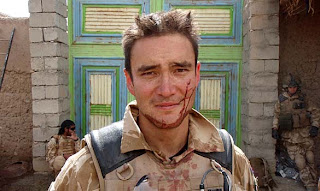
…purloined this one from the Hurt Locker (which pops up in Google image search)…

…and photoshopped the two together to make this doozy…

Journalism – it’s easy. If you’re shameless.

