by Alex Evans | Feb 23, 2010 | Influence and networks, North America
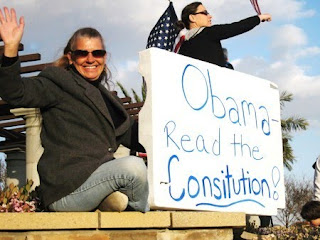
Ali Rizvi has a delicious piece in the Huffington Post, containing such delights as this:
What was until recently a difference in ideology has devolved, in a little over a decade, into a difference in intellect … By painting educated, well-earning, science-embracing, articulate, introspective, intellectual citizens as un-American, the Republican party has built an entire base made up of those who not only don’t possess these attributes, but enthusiastically abhor those who do. Not only are these factions now split along lines of educational achievement, socioeconomic status, and cultural and religious values, but most significantly, along an “intellectual divide”.
And this:
It’s one thing to be ignorant. It’s another to take pride in it. And it’s quite another to venture beyond that into full-blown stupidity. It’s not often that you get to use the word “stupidity” in a non-ad hominem context, but now — with the majority of Republicans believing Obama is a socialist without having any idea what socialism is, over a third believing he is foreign-born, and featured Tea Party speakers calling for the hanging of a US senator — it’s becoming harder and harder to euphemize some of things we’re witnessing as anything but.
by Alex Evans | Feb 22, 2010 | Cooperation and coherence, Europe and Central Asia
Proving again why he should be on everyone’s must-read list of foreign policy blogs, the Economist’s Charlemagne has news of even more clamouring from national governments on the need for Cathy Ashton to assert greater independence from the European Commission (and in particular from Jose Manuel Barroso).
Last week, the trouble started again after “news broke that Mr Barroso had pre-empted the creation of the new European External Action Service, and chosen the next EU ambassador in Washington”:
The incumbent is a former Irish prime minister, John Bruton, and plenty of EU politicians would like to see a similar heavyweight, political figure get the job. Instead, Mr Barroso has chosen a career Brussels official from his native Portugal, João Vale de Almeida (who was until a few months ago the head of Mr Barroso’s private office). In theory the appointment was made under the old rules, which operated before the Lisbon Treaty came into force on December 1st 2009, when overseas missions of the EU were delegations of the European Commission. In practice, most if not all foreign ministers found out about the appointment only very recently, and they are hopping, because they were not consulted.
Late on Sunday, as EU foreign ministers started to arrive for the monthly meeting of the Foreign Affairs Council, news started to emerge that Carl Bildt (“arguably the most serious and heavyweight foreign minister in the EU, thanks to years of international experience and a stint as prime minister of his country”) had written formally to Cathy Ashton – demanding “a discussion of how Mr Vale de Almeida came to be nominated for the EU’s most senior overseas post”:
Mr Bildt’s letter, dated February 19th, asks Lady Ashton how the nomination of Mr Vale de Almeida came about, without applying the very principles governing such appointments which are currently the subject of discussion among the 27’s EU ambassadors. The letter also seeks clarification about the impression that the nomination was made without Lady Ashton playing the leading role set out for her in the Lisbon Treaty.
So what happens now?
Is there any prospect of Mr Vale de Almeida’s appointment being reversed? I must admit, I do not see how that can happen without causing a scandal that leaves the EU worse off. The EU’s biggest diplomatic partners, from America to China or Russia, are already slack jawed with amazement at the squabbling that has broken out since the Lisbon Treaty came into force. Yet Mr Bildt is not alone in his desire for answers, I am told. Other foreign ministers are incredulous about the way this appointment has been handled.
Well, at least we finally know the answer to Kissinger’s question about who to pick up the phone to when he wants something done. Beijing, Brasilia or Delhi.
by Alex Evans | Feb 22, 2010 | What we're watching
[youtube]http://www.youtube.com/watch?v=tRZqDN-2eYs[/youtube]
by David Steven | Feb 22, 2010 | UK
The eruption of bullygate reminds me of this recent exchange between Labour MP, Sandra Osborne, and Peter Ricketts, the Foreign Office’s Permanent Secretary:
Osborne: Could I ask you about staff morale as far as bullying, harassment and discrimination is concerned? In the staff survey of 2008-I know that Mr. Bevan referred to the 2009 survey, which has not yet been published-17% of all FCO staff reported experiencing this, and it was only 11% on average across Whitehall. Also, 20% of locally based staff reported this, as opposed to 14% of UK-based staff. How do you explain this relatively high level of reporting of harassment and bullying?
Ricketts: First, can I say that I find it absolutely unacceptable? It’s something that we are worried about and working on. We are very, very keen to see that we get to the bottom of it and root out whatever the problems are. Mr. Bevan can give you details of where we are in the 2009 staff survey. To our real disappointment, that number has not come down very significantly. It has come down from 17 to 16%, which is not good enough, so we have to continue to tackle this problem seriously.
Part of it is understanding exactly what is going on here. We put together bullying, harassment and intimidation, and I need to understand more about what are the actual problems that staff are reporting there, because any suggestion of bullying or harassment is completely unacceptable. Indeed, we are prepared to take staff out of positions abroad and bring them home if we see evidence of behaviour that is bullying or harassment, and we have done that, so we’re trying to send the strongest signal we can, which is taking people out of their postings and bringing them back to London if we see evidence of that.
Osborne went on to point out that “reported levels of discrimination, bullying or harassment tended to be higher among the staff at lower grades, disabled staff and minority ethnic groups, black staff in particular.” James Bevan, the FCO’s DG for Change and Delivery, replied:
You are right. We were so concerned by the 17% figure from the last survey that we commissioned a more detailed analysis of what the data were telling us, and they told us that, by and large, the allegations tend to relate to junior officers who feel that they are being bullied by senior officers and to local staff who sometimes feel that they are being bullied by UK staff, and that there is a higher prevalence of reported experience of this behaviour from black minority ethnic and other minority groups.
One thing that I have done is to meet with representatives of the black staff to talk through why they think this is happening. I have to say that there were some very convincing stories which resulted in my writing to all our heads of mission abroad to say that we are particularly concerned at the high levels of reported behaviour affecting black and minority ethnic staff and that we wanted to crack down on it absolutely to make sure that it reduces next year. The task for us now is to analyse the latest data in the new survey and see if that has happened. If it has not, we will have to keep going.
It’s a worrying finding.
Update: It turns out these are not new findings. From 2006:
One in ten government workers in Whitehall say that they are being bullied, a staff survey has revealed. The research says that the figure rises to one in three in the Foreign and Commonwealth Office, with black and Chinese employees suffering the worst harassment.
by Mark Weston | Feb 20, 2010 | Africa, Conflict and security, Economics and development
“It’s not diamonds that are the problem,” says Ali, a Lebanese diamond dealer in eastern Sierra Leone. “Diamonds are just stones. It’s people that are the problem.”
Sierra Leone has some of the highest quality diamonds in the world. Like a lottery winner who wastes his fortune and sinks into misery, however, the country has been unable to cope with its windfall. “Blood diamonds” have been blamed for causing its horrific civil war, which saw rebel militias, Liberian thugs, mercenaries, Sierra Leone’s army, and UN and Nigerian “peacekeepers” killing and maiming in a desperate struggle to gain control of the gem trade.
Since the war finished in 2002, Sierra Leone has languished among the world’s poorest countries, with nothing to show for its rich treasure trove of minerals. Economists see it as a classic example of the resource curse, which plagues many poor nations endowed with valuable natural commodities: mineral wealth allows governments to neglect the rest of the economy, enrich themselves, and ignore those outside their circles, forcing the excluded to resort to violence to obtain a share of the loot.
But the failure of resource-rich nations is not inevitable. Botswana has thrived on the back of its diamond mines. South Africa, brimming with gold and diamonds, is Africa’s largest economy. Australia, another diamond producer, doesn’t do too badly.
Earlier this week we spent the day at a diamond mine near Kenema. Johnny, a Sierra Leonean who has spent most of his life in England, has come back with his wife Suzy to dig for diamonds. Using borrowed money, they have leased an acre of land deep in the jungle and hired fifty men from surrounding villages to dig a forty-foot-deep pit and sift through the mud and gravel it throws up.
It is easy to see the allure. When we arrive, Johnny shows me yesterday’s haul of eight small stones. The first looks like an undistinguished lump of glass, but the second, flawless, looks like a diamond and, although rough (it will be cut in India or Antwerp), its different facets glitter as I turn it around in the sun. It is worth about £1,000. On the neighbouring plot last year, a Lebanese found a thirty-carat diamond worth £4 million. From one moment to the next, Johnny could get rich.
Or die trying. Another nearby plot was mined for two years by some Americans. They didn’t find a single gem. Prices fell by 80% in the recession, prompting many miners and dealers to switch to gold, which provides a steadier, less risky income. Ali’s business partner almost bankrupted him by giving him a fake cheque for £100,000-worth of diamonds. “We say the profit from diamonds reaches from your toes to your knees, but the losses reach up to your throat,” he says, making a strangling gesture. He is currently pursuing the man through Interpol.
(more…)
